


What does long-term, high-volume endurance participation do to aerobic fitness as we age? To answer that question, the best group of people to look at would be so-called “multi-marathoners,” people who’ve completed 100 or more marathons in their lifetime.
This new study examined a global cohort of these unique humans,1Lundy, L., Reilly, R. B., & Fleming, N. (2026). VO2max ageing and all cause mortality in a global cohort of multi marathoners. Scientific Reports, 10.1038/s41598-02652475–x. https://doi.org/10.1038/s41598-026-52475-x defined as runners who had completed or were actively pursuing at least 100 marathons.
The researchers collected online survey data from 340 runners across 24 countries. The group had a mean age of 52.2 years and averaged about 121 lifetime marathon completions. VO₂ max was not measured in a lab; instead, participants reported estimates from wearable devices like Garmin, Polar, or COROS. The researchers then compared these values with age- and sex-matched norms from a major reference dataset for cardiorespiratory fitness, the FRIEND database.
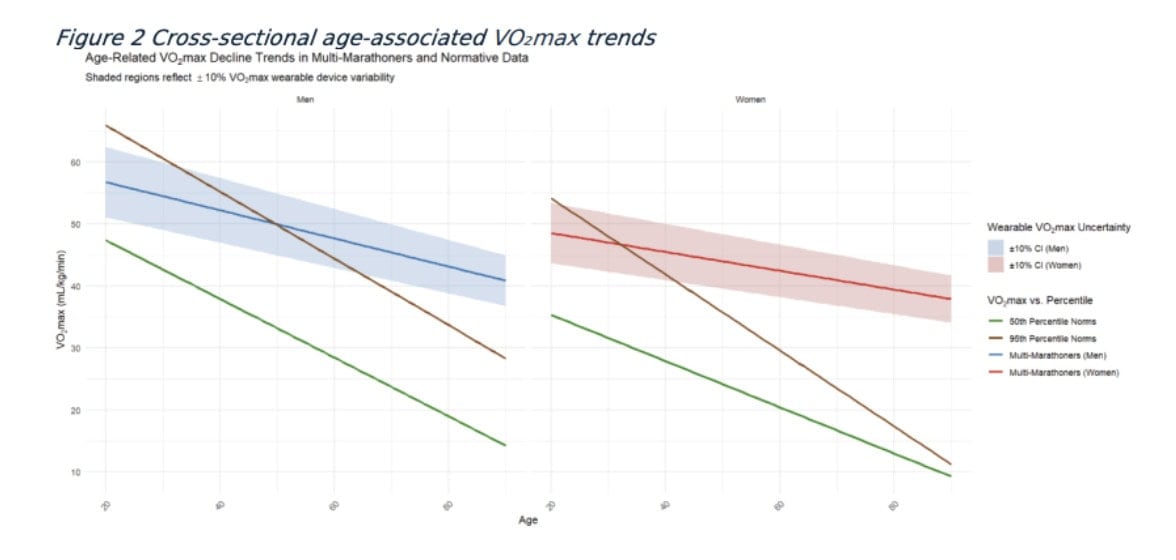
These multi-marathoners had much higher estimated VO₂ max values than population norms. Across the full cohort, average estimated VO₂ max was 47.6 mL/kg/min, which is extremely strong for a group with an average age over 50. When broken down by age and sex, every subgroup aged 30 to 69 exceeded the FRIEND 50th percentile. Several groups were not just above average; they were in the 95th percentile or higher. Men aged 60–69 and women aged 40–69 exceeded the top-tier normative benchmark.
The age-related pattern may be the most interesting part. In the general population, VO₂ max declines with age, often estimated at around 5–10% per decade after early adulthood. But in this cohort, the cross-sectional decline appeared much flatter. The study’s regression models estimated that male multi-marathoners declined by about 0.23 mL/kg/min per year, compared with 0.47 per year for average men in the FRIEND dataset and 0.54 per year for top-performing men. For women, the estimated slope was even flatter: 0.15 mL/kg/min per year in multi-marathoners versus 0.37 for average women and 0.61 for top-performing women.
The figures make this pattern easy to see. On page 12, the VO₂ max curves show multi-marathoners sitting well above average population norms across age groups. On page 13, the cross-sectional trend lines suggest that the multi-marathoner curves decline much more gradually with age than the FRIEND reference curves. And on page 14, the percentage advantage is especially large in older age groups, although that figure should be interpreted with caution because percentage comparisons can appear inflated when the reference values are very low.
The researchers also translated the VO₂ max differences into estimated reductions in all-cause mortality risk using prior models, suggesting roughly a 3.7% lower risk per 1 mL/kg/min higher VO₂ max. This yielded substantial modeled mortality advantages for multi-marathoners, especially among older groups. But this is where we need to be careful. The study did not track deaths. It modeled risk based on VO₂ max differences. That’s useful, but it’s not the same thing as proving multi-marathoners live longer.
What this means for runners
The practical takeaway is not that you need to become a multi-marathoner to age well. It’s that sustained aerobic training over years and decades may be one of the most powerful tools we have for preserving cardiorespiratory fitness. The goal should be consistency that is ambitious but survivable—enough volume to build a big aerobic engine, enough intensity to maintain high-end fitness, and enough recovery and strength work to keep you healthy long enough for those adaptations to compound. The runners in this study probably aren’t fit because they occasionally trained hard; they’re fit because they built a life around continuing to move.
References
RunClub — Free
Join 300,000+ runners in RunClub
Free training plans for every distance, a daily running game, exclusive coaching content, and a real community of runners. Create your free account in 20 seconds — no card.
Already a member? Log in →









Start the conversation