


Most runners think about fitness in terms of what they can do when they’re fresh. What’s your VO2 max? What’s your threshold pace? What can you run for a 5K, half-marathon, or uphill time trial when the legs are ready to go?
But racing rarely asks that question. Racing asks a much more interesting one: what can you still do after two or three hours of accumulated fatigue?
That’s the idea behind “durability” (a.k.a “physiological resilience”), one of the more useful concepts in endurance performance right now. It’s not just how strong your engine is at the start. It’s how much of that engine you can keep using after glycogen drops, muscles get beat up, stride mechanics shift, and perceived effort starts climbing. A new study asked whether male and female runners differ in that quality.1Jaén‐Carrillo, D., Bruce, C. D., Lawley, J. S., & Zanini, M. (2026). Highly Trained Female Runners Show Greater Durability and Physiological Resilience Than Performance‐Matched Male Counterparts. Scandinavian Journal of Medicine & Science in Sports, 36(5). https://doi.org/10.1111/sms.70299

Researchers studied 11 highly trained female trail runners and 11 highly trained male trail runners who were matched by performance level using International Trail Running Association rankings. The runners completed three lab visits: a graded exercise test, a fresh 12-minute uphill time trial, and then a 3-hour treadmill run at moderate intensity with another 12-minute uphill time trial inserted every 60 minutes. During the prolonged run, the athletes consumed 90 grams of carbohydrate per hour and drank water as desired, while the researchers measured physiology, biomechanics, perceived exertion, and muscle strength in the thigh and around the knee.
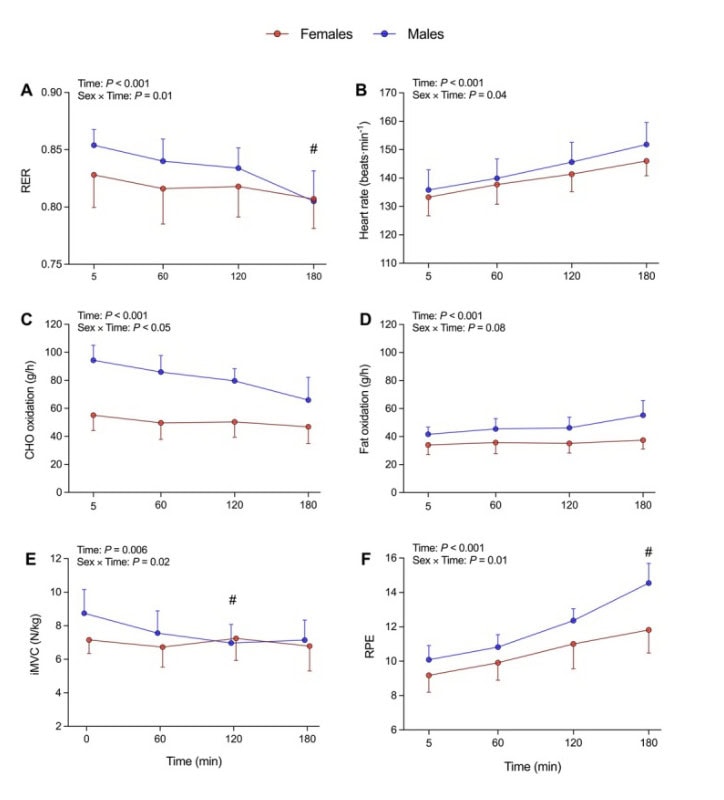
The women held up better. After three hours, female runners had only a 1.1% decline in uphill time-trial speed, while male runners slowed by 9.9%. That is a massive difference in durability. This was not because the women were working less hard in the time trials; heart rate, perceived effort, and peak oxygen uptake during the time trials were broadly similar in their responses across the protocol. Instead, the difference seemed to come from greater metabolic and neuromuscular resilience.
During the 3-hour steady-state run, both groups shifted toward greater fat use over time, but the shift was much larger in men. By three hours, carbohydrate oxidation had dropped by 29% in male runners versus only 9% in female runners. Respiratory exchange ratio also fell more in men, suggesting a bigger move away from carbohydrate metabolism. During repeated uphill time trials, the same pattern recurred: men showed larger drops in carbohydrate oxidation, larger increases in fat oxidation, and greater reductions in peak blood lactate.
That lactate finding is important. In a hard uphill effort, peak lactate is partly a sign that the runner can still access high-intensity carbohydrate-driven energy production. By the final time trial, male runners showed a 53% drop in peak lactate, compared with a 27% drop in females. That suggests the men were losing some ability to hit the same high-intensity metabolic gear as fatigue accumulated.
Muscle strength also declined more in men, with males showing an 18% reduction after two hours, while females were essentially unchanged at that time point. Meanwhile, running economy worsened similarly between sexes, and both groups made fatigue-related biomechanical adjustments: longer ground contact time, reduced stride length, and lower leg stiffness. In other words, the durability advantage in women did not seem to come from some radically different stride pattern. It looked more like better preservation of the metabolic and muscular systems that support performance late in a long effort.
There is one big caveat: the study matched runners by duration rather than distance. Because the men ran faster, they covered more total distance during the protocol: about 26 miles versus 22 miles for women. They also expended more energy relative to body mass. The researchers tried to account for this statistically, and the findings largely held up, but this still matters. If the study had matched distance instead of time, the gap might have been smaller.
What this means for runners
The practical takeaway is that durability deserves more attention than fresh fitness. A runner with a great threshold test or fast standalone workout may not be the runner who performs best after two or three hours, especially on hilly terrain. For everyone, one of the best ways to assess durability may be to place short, controlled hard efforts late in long runs and see how much performance, form, and perceived effort deteriorate. The race is not decided by what your physiology looks like when you’re fresh; it’s decided by what’s still available when the easy miles are behind you.
References
RunClub — Free
Join 300,000+ runners in RunClub
Free training plans for every distance, a daily running game, exclusive coaching content, and a real community of runners. Create your free account in 20 seconds — no card.
Already a member? Log in →











Start the conversation