


Bone stress injuries are one of the nightmare scenarios for distance runners. They are frustrating, slow to heal, and often show up when training, recovery, and fueling are out of sync. Female runners face a particularly complex risk profile because high repetitive loading, hormonal status, energy availability, and inflammation can all interact to influence bone remodeling.

This small study tested whether collagen peptide supplementation1Kuhlman, N. M., Jagim, A. R., Blesso, C. N., Puglisi, M. J., Chun, O. K., Jones, M. T., & Fields, J. B. (2026). Effects of collagen peptide supplementation on bone turnover, cytokine, and inflammatory markers in female distance runners: a randomized pilot study. Frontiers in Nutrition, 13, 1825906. https://doi.org/10.3389/fnut.2026.1825906 could shift bone and inflammatory markers in a favorable direction in premenopausal female distance runners.
The researchers recruited 22 endurance-trained women aged 18–35 who ran at least 35 miles per week. Participants were randomized to either 20 grams per day of collagen peptides or an isocaloric maltodextrin placebo for four weeks. The researchers measured markers of bone formation, bone resorption, osteoclast signaling, and inflammation.
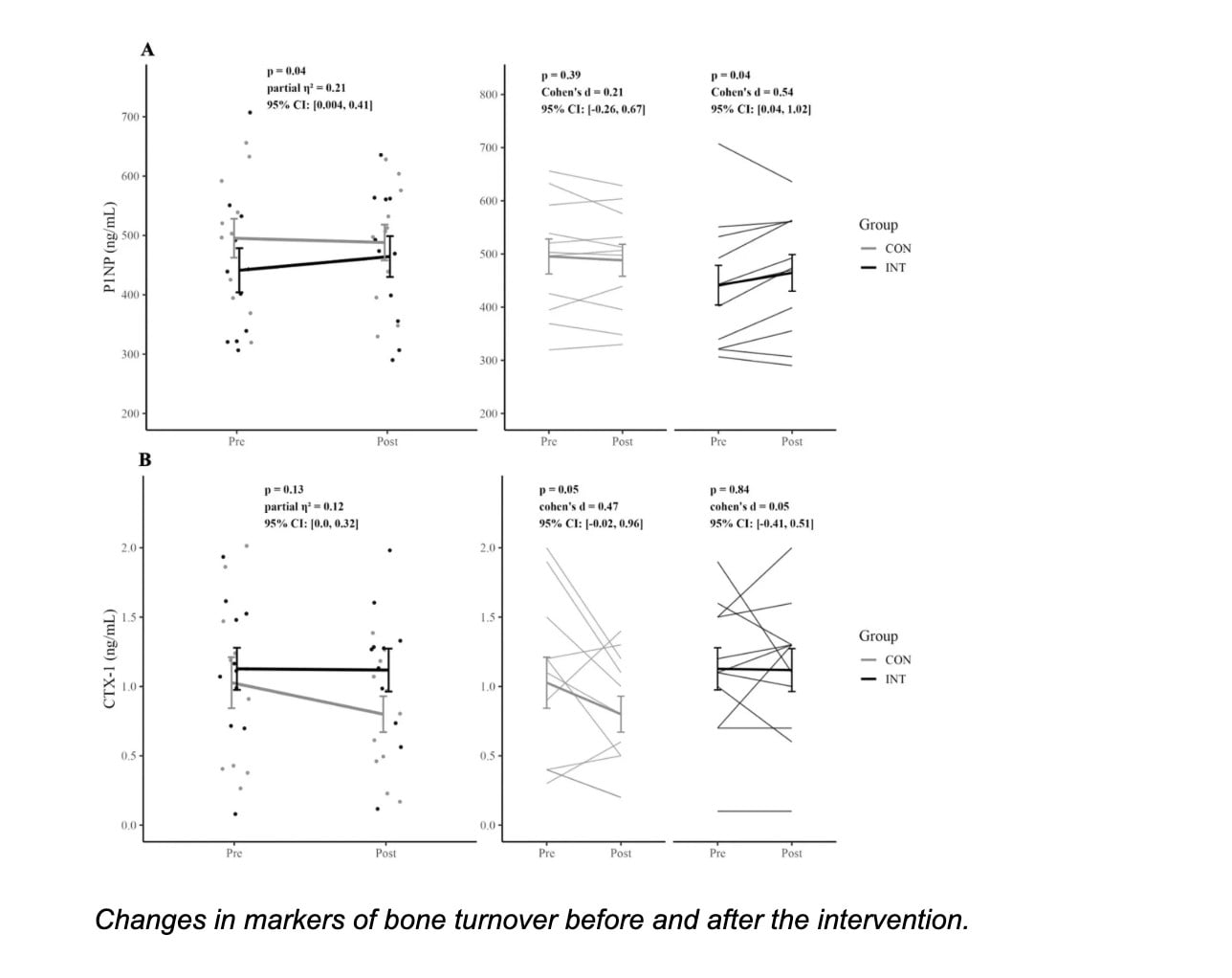
The most encouraging finding was that collagen increased P1NP, a marker of type I collagen synthesis and bone formation, whereas the placebo group showed no change. CTX-1, a marker of bone resorption, did not significantly change. That suggests the effect, at least over four weeks, may be more about nudging formation-related activity than reducing breakdown.
There were also signals in inflammatory and osteoimmune markers. Collagen supplementation reduced IL-6, whereas the placebo group showed a slight increase. The collagen group also showed a decrease in sRANKL, a signal involved in osteoclast activity, whereas the placebo group showed an increase. That overall pattern suggests collagen may have influenced both bone formation and inflammatory signaling.
That said, this is still a pilot study. The sample was tiny, only 11 runners per group. The intervention lasted just four weeks. The study measured blood markers, not actual changes in bone mineral density, bone strength, or stress injury rates. So we should not jump from “collagen improves a marker” to “collagen prevents stress fractures.” But the signal is interesting, especially because female endurance athletes are underrepresented in this kind of research.
What this means for runners
Collagen may be a useful adjunct for runners seeking to support tendon, connective tissue, or bone health, but it should sit atop the fundamentals rather than replace them. The big rocks are still enough calories, enough carbohydrate, adequate protein, calcium, vitamin D, menstrual health, sleep, and intelligent training progression.
For runners at higher risk of bone stress injury, especially female runners with high mileage or a history of low energy availability, collagen could be worth considering as part of a broader plan. But I would not treat it as a standalone bone-protection supplement. The study is promising, not definitive.
References
RunClub — Free
Join 300,000+ runners in RunClub
Free training plans for every distance, a daily running game, exclusive coaching content, and a real community of runners. Create your free account in 20 seconds — no card.
Already a member? Log in →










Start the conversation