


I think of durability as the fourth pillar of marathon performance. It’s not just how big your engine is (e.g., VO2 max), where your lactate threshold sits, or how efficient you are, but how well those things hold up after a few hours of steady running.
A new study on London Marathon finishers1Hunter, B., & Muniz‐Pumares, D. (2025). Durability of Parameters Associated With Endurance Running in Marathoners. European Journal of Sport Science, 25(11). https://doi.org/10.1002/ejsc.70073 put numbers on that idea—both in the lab and on race day—showing that the runners who lost less of their threshold speed after a long, controlled run were the ones who raced faster on the day. That sounds intuitively right; the cool part is how cleanly the data back it up, and what it suggests we should prioritize in training (and what we shouldn’t stress about).

Eighteen runners (11 men, seven women; average age ~41; average finish time 3:17) completed two treadmill lab visits surrounding the 2024 London Marathon. The first visit established the “big three” pillars of endurance performance in a fresh state: VO2 max, lactate threshold, and running economy, using a 1%-grade progressive treadmill test and blood lactate to determine the lactate threshold precisely. The second visit was the durability test. It involved a continuous 90-minute run at the speed at lactate threshold (referred to as sLT), then a five-minute walk, then the same incremental test as visit one again—now in a “fatigued” state.
The team also captured marathon heart rate and pace (through the runners’ GPS watch worn on race day), all separated into 5k segments, to examine heart-rate–to–speed “decoupling”—the drift where, at a steady effort, your heart rate rises (or pace/speed falls) over time—showing the aerobic cost of maintaining the same output is increasing.
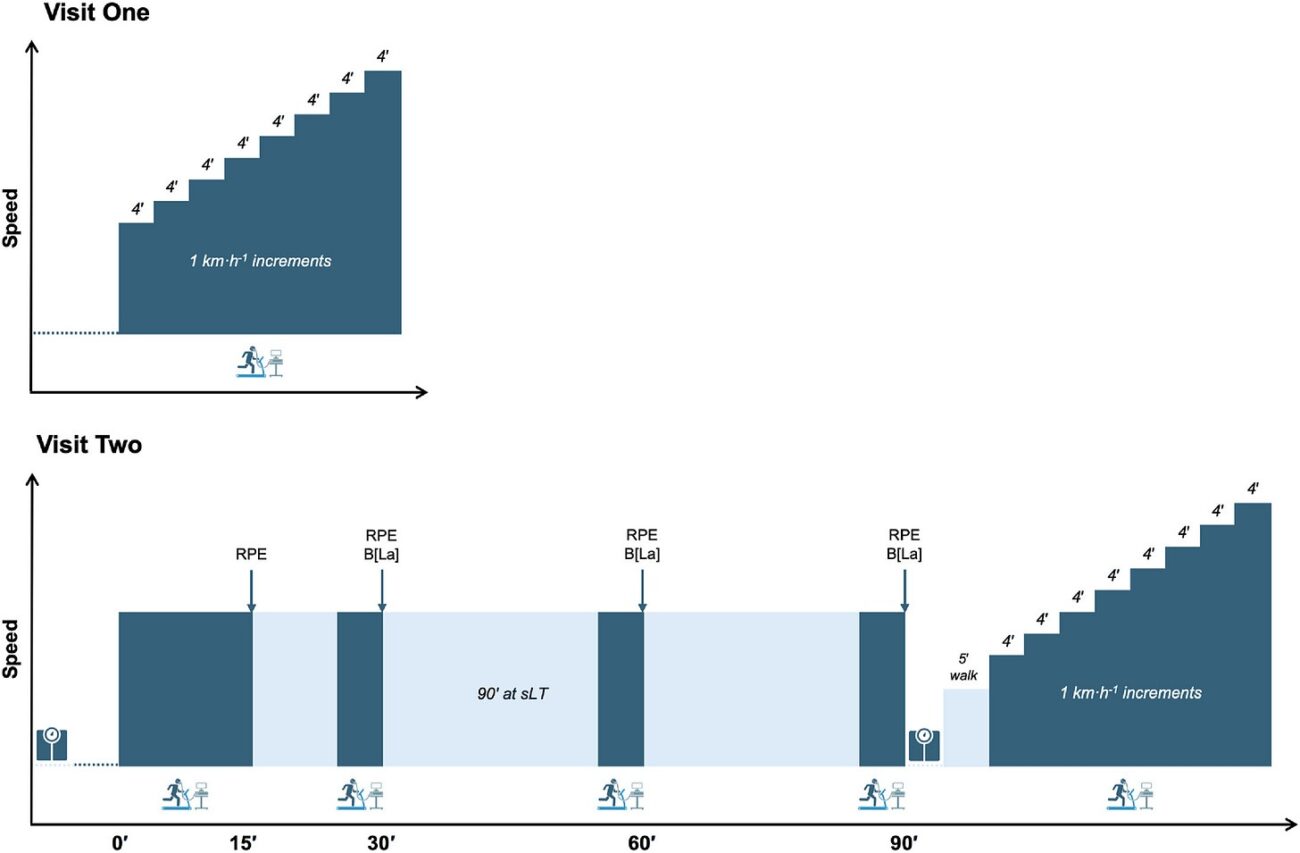
Two details that matter for interpretation: runners drank as much water as they wanted (averaging ~0.5 L), lost ~2.1% of their body mass during the 90-minute run, and were not given carbohydrates. So the POST test was conducted amid mild dehydration and likely reduced muscle glycogen, which only partially reflects the milieu in which endurance is tested in real marathons (most runners fuel with carbs during the race).
What changes during a long run?
During the 90-minute run itself, intensity drifted upward: runners started around 77% of VO2 max and finished near 82%, with heart rate, blood lactate, and effort (RPE) all rising. That upward creep fits the real-world sensation of a steady long run getting “not so steady,” even when the pace is constant.
How did this affect our durability parameters? Three findings stood out.
- VO2 max dropped ~6% from 56.7 to 53.4 ml/kg/min from before the 90-minute run (PRE) to after (POST).
- Threshold speed (sLT) fell from 7.9 to 7.5 mph (12.8 to 12.1 km/h)—about 4-6 seconds per mile (3-4 seconds per km) slower.
- Running economy didn’t meaningfully change across the 90 minutes (oxygen cost shifted upward, but the statistics favored no clear change).
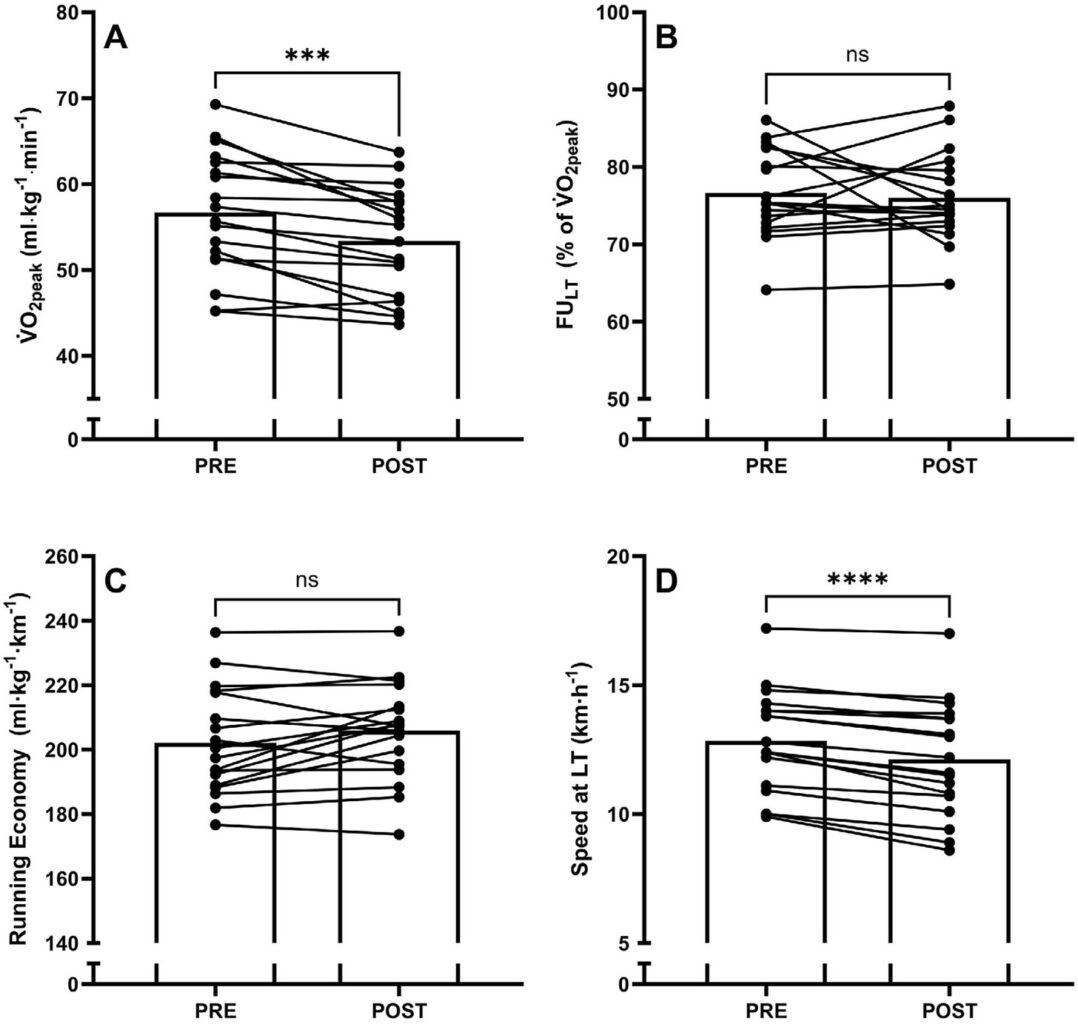
The take-home here is that the “ceiling” (VO2 max) and the speed you can sustain before drifting into a higher intensity domain (threshold speed or sLT) are the parameters that erode under prolonged load in this setup, while economy is surprisingly stable—at least through ~11 miles (~19 km) of steady running (that’s how far, on average, runners covered in the 90-minute lab test).
A look under the hood at the runners’ fuel use during the laboratory tests tells us why. Carbohydrate oxidation at lactate threshold dropped from ~2.9 to 1.9 g/min while fat oxidation roughly doubled (~0.26 to 0.52 g/min), with a small increase in breathing effort achieved via a shallower, quicker breathing pattern. In other words, after 90 minutes, the muscles are leaning harder on fat and less on glycogen at what used to be the runner’s lactate threshold. That’s consistent with glycogen depletion shifting the whole response downward (not what we want).
Which changes actually predicted marathon performance?
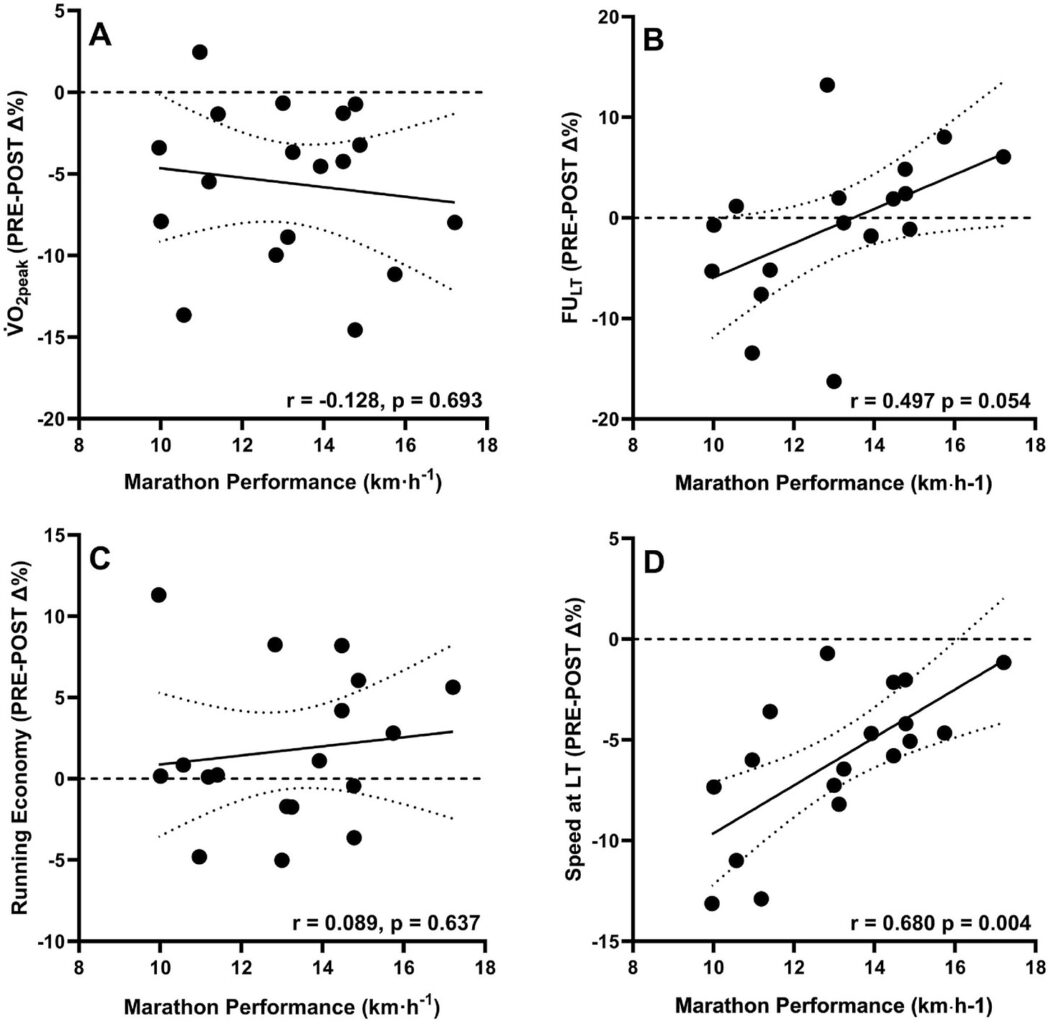
In fresh testing, the usual suspects predicted a better marathon performance: higher VO2 max and better economy correlated with faster marathon speed, and fresh threshold speed (sLT) was an especially strong predictor.
Second—and this is the durability piece—the percentage change in threshold speed from PRE to POST correlated meaningfully with marathon speed. Runners whose threshold speed eroded less after 90 minutes tended to run faster marathons. The percentage change in VO2 max, on the other hand, didn’t correlate with performance, nor did the change in running economy. These two findings caught me by surprise since prior literature has shown these two durability parameters to be meaningful predictors of performance. That wasn’t so here.
What about decoupling? Here, decoupling (the ratio of heart rate to speed) kicked in around mile 16 of the marathon (27 km) on average and peaked at miles 21–24 (35–40 km). But in this small cohort, neither the onset nor the magnitude of decoupling related to finish speed, and decoupling didn’t track the lab durability metrics either. Practically, the race-day drop in speed, more than a significant heart rate drift, drove decoupling in these data. That doesn’t make decoupling useless, but it cautions against using it as a stand-alone proxy for durability without context.
Why these changes likely happened
The pattern screams fueling and fluids. Without carbs during the 90-minute run, carbohydrate oxidation fell, fat oxidation rose, and both VO2 at lactate threshold and threshold speed slid—classic signs of glycogen depletion lowering the power you can sustain before drifting upward in intensity (fat is a less efficient fuel than carbs, especially if you want to run fast). At the same time, a ~2% body-mass loss and a higher heart rate point to mild dehydration, which can limit cardiac output and contribute to the observed drop in VO2 max.
What this means for runners
Durability is trainable and protectable. If your threshold speed stays steadier deep into a long run, you’re more likely to race faster. To build that resilience, include periodic long runs that spend meaningful time near and just below lactate threshold (for example, 30–60 minutes continuous at predicted or goal marathon pace inside a 90–120 minute session, or broken lactate threshold intervals late in a long run). Practice running fast while fatigued.
Make sure to practice race-like fueling and hydration during those sessions so you’re not artificially depressing durability with preventable glycogen and fluid deficits. In racing, early and steady carb intake (30–60+ g/h up to ~90 g/h if you’ve trained your gut to handle it) and a plan to limit body-mass loss due to dehydration to ~2% or less will also likely help preserve threshold speed and the “performance VO2” you can access.
How can you personally track durability? Compare how your threshold pace or heart rate holds up in the final third of long workouts and look at heart rate-speed decoupling as a useful supporting metric. This study is also a reminder that the good old basics still matter—raising VO2 max and improving economy remain potent levers for performance.
But for marathoners who want to access more of their potential, durability may be the difference between holding pace and hitting the wall.
To start working on your durability, check out this guide:
References
RunClub — Free
Join 300,000+ runners in RunClub
Free training plans for every distance, a daily running game, exclusive coaching content, and a real community of runners. Create your free account in 20 seconds — no card.
Already a member? Log in →












Start the conversation