


Runners love rules. Increasing mileage by no more than 10% is a good example. These ideas are appealing because they make injury prevention feel measurable. And to be fair, training load probably does matter. Most overuse injuries happen when stress exceeds the body’s ability to adapt. But the harder question is whether a simple training-load metric can reliably tell us who is about to get injured.

A large observational study1Cloosterman, K. L. A., Vos, R.-J. de, Willemsen, S., Oeveren, B. van, Visser, E., Bierma-Zeinstra, S. M. A., & Middelkoop, M. van. (2025). Association between GPS-based training load and injury risk in recreational runners: a large prospective study. Journal of Athletic Training. https://doi.org/10.4085/1062-6050-0030.25 tested that question using GPS data from recreational runners. The researchers analyzed data from 461 adult runners in the Netherlands who were training for events ranging from 10K to the marathon. Across the study, they collected 20,425 training sessions and calculated the acute-to-chronic workload ratio (ACWR) based on distance, duration, and speed. The ACWR compares the training load over the last 7 days to that over the last 28 days.
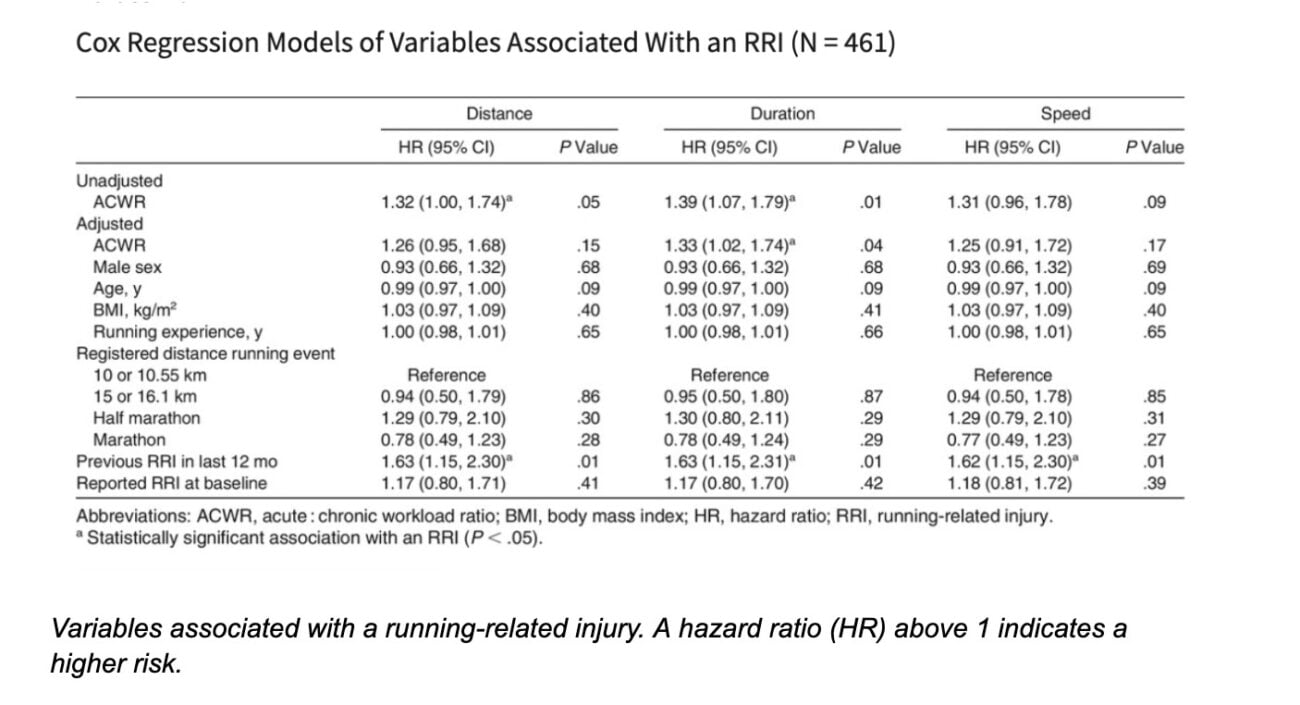
During follow-up, 42.3% of runners reported a new running-related injury. At first glance, there was some evidence that a higher ACWR, based on distance and duration, was associated with injury onset. After adjusting for confounders, only ACWR based on duration remained associated with injury risk. But the size of the association was small, and the results became even less convincing when the researchers excluded runners who already had an injury at baseline. In that analysis, ACWR was no longer significantly associated with injury onset, whether calculated from distance, duration, or speed.
This is one of those studies where the “headline result” and the “real-world interpretation” are not the same thing. Yes, there was a statistical association. But the authors were appropriately cautious, noting that the clinical relevance was questionable because the risks were small and inconsistent. A previous injury in the last 12 months appeared to be a more consistent signal than a recent spike in workload.
I like this study because it pushes back against overly simplistic injury advice. Training load matters, but injury risk is not just a math equation. Sleep, stress, strength, tissue history, shoes, terrain, intensity distribution, life load, biomechanics, recovery, nutrition, and prior injury all matter too. ACWR may be one piece of the puzzle, but it is not a crystal ball into whether you’ll get injured or not.
What this means for runners
Do not interpret this as permission to make reckless training jumps, but also do not treat your watch’s workload ratio as destiny. A sudden increase in duration or distance can increase stress, but this study suggests that general workload formulas may be too blunt to predict injuries well in recreational runners. The more practical approach is to combine load monitoring with body feedback: soreness that changes your stride, pain that worsens during a run, fatigue that does not resolve, or repeated irritation in a previously injured area deserve attention. Progress gradually, but remember that your injury risk is shaped by much more than last week’s mileage divided by the previous month’s mileage.
References
RunClub — Free
Join 300,000+ runners in RunClub
Free training plans for every distance, a daily running game, exclusive coaching content, and a real community of runners. Create your free account in 20 seconds — no card.
Already a member? Log in →












Start the conversation