


Josh Kerr has never run a mile faster than 3:45.34. The world record, Hicham El Guerrouj’s 3:43.13 from Rome in 1999, sits 2.21 seconds beyond that, and the target Kerr has set for Saturday’s London Diamond League, a 3:42.00 flat that gives Project 222 its name, is more than a second further still. Those margins sound trivial. Spread over four laps, they are the whole story of Saturday’s race.
Start with the lap arithmetic. A mile is 1,609 meters, a little more than four laps of the track. El Guerrouj’s record averages 55.46 seconds per 400m. Kerr’s personal best, set winning the 2024 Prefontaine Classic over Jakob Ingebrigtsen, averages 56.01. Running 3:42.00 requires an average of 55.18, which means covering every lap roughly 0.8 seconds faster than Kerr managed in the best race of his life.

An Attempt Built in Public
Kerr and his sponsor Brooks announced the attempt in March and have engineered everything around it that planning can control. Two pacers will share the work, with Brannon Kidder expected to lead through 950 meters and Zan Rudolf carrying it another 100 to 200, according to LetsRun, which also reports that Wavelight pacing lights will run on the rail. Brooks built Kerr a dedicated spike, the Hyperion 222, and a cooling race suit, per FloTrack. The 3:36 p.m. start comes with a forecast of about 74 F and winds up to 7 mph. Yared Nuguse, Hobbs Kessler, and Nathan Green fill out the field. “An even split or a slightly negative split, I think, is the way to do it,” Kerr told LetsRun in April. Even splits at record pace put him through 800m in 1:50.90.
The 27-Year Ledger
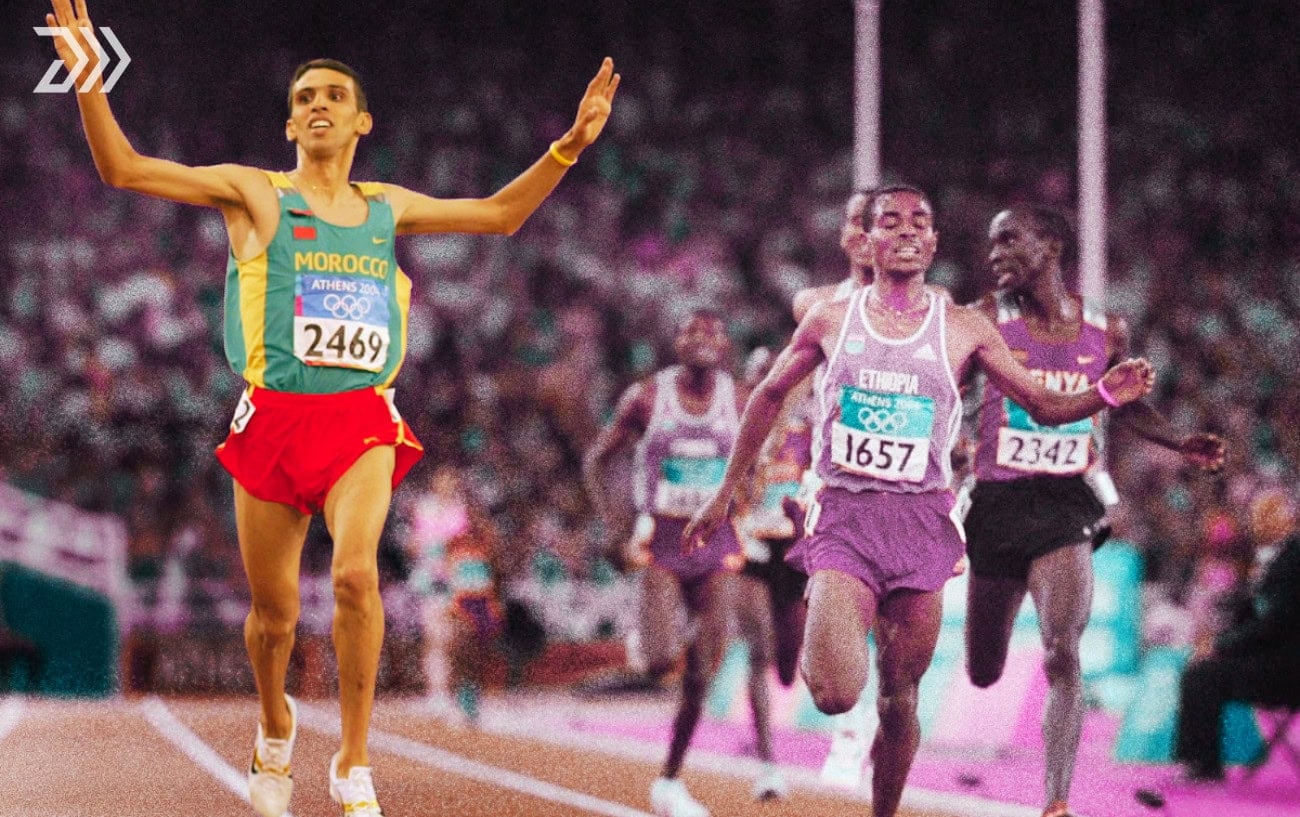
The record has now outlasted every miler who has chased it. In Rome on July 7, 1999, El Guerrouj took 1.26 seconds from Noureddine Morceli’s 3:44.39, and Noah Ngeny finished second that night in 3:43.40, a time that remains No. 2 in history, according to World Athletics. In the 27 years since, exactly two men have come within a second of the mark, and they did it in the same race: Ingebrigtsen ran 3:43.73 and Nuguse 3:43.97 at the 2023 Prefontaine Classic. Nuguse will be on the start line Saturday. Kerr, at No. 6 on the all-time mile list, has never broken 3:45.
What History Says About a Jump This Size
The record’s own progression shows how rarely it moves by margins like the one Kerr needs. Sebastian Coe’s 3:47.33 from 1981 fell to Steve Cram by 1.01 seconds in 1985. Morceli took 1.93 from Cram’s mark in 1993, the largest single cut in 28 years. El Guerrouj’s 1.26 followed six years later. More telling is where El Guerrouj started that night: his personal best stood at 3:44.90, half a second from the record, and Rome improved it by 1.77 seconds. Kerr starts 2.21 seconds back. Reaching 3:42.00 would demand a 3.34-second improvement on his lifetime best, more than the record moved in total between 1985 and 1999.
Where the Seconds Could Come From
The optimist’s case rests on what has changed since 1999. El Guerrouj had human pacemakers who stepped off before the bell; Kerr gets two pacers deep into the race plus lights holding the tempo honest. The shoes are the harder argument. Every men’s world record from 5,000m to the marathon has been reset in the super shoe era, from Joshua Cheptegei’s 12:35.36 and 26:11.00 in 2020 through Sabastian Sawe’s 1:59:30 marathon in April. The middle-distance records have barely moved: El Guerrouj’s 3:26.00 for 1,500m is now 28 years old, and the mile is a year younger. World Athletics allows 40 millimeters of foam on the road but only 20 on the track, and a race under four minutes gives that foam far less time to return its investment. The one middle-distance mark to fall recently, the 1000m record Emmanuel Wanyonyi ran down in Monaco last week, had also dated to 1999, which says the era is reaching this territory slowly.

The Case for Kerr
What Kerr brings is a habit of running fastest when it counts. He beat Ingebrigtsen for the Olympic bronze in Tokyo, again for the world title in Budapest, and again in his record mile in Eugene, and he opened 2026 by reclaiming the world indoor 3000m title in Toruń in 7:35.56. Three weeks out, he ran 4,000 meters of work at record pace in training. “It is the hardest track and field world record right now in my opinion,” Kerr told FloTrack this spring.
The race goes off at 3:36 p.m. in London on Saturday. If Kerr passes 800m in 1:50.90, the attempt is alive, and the final two laps will decide whether the mile record sees a 28th year.
RunClub
Get more running stories — join RunClub
Daily running news, a community of 300,000+ runners, free training plans for every distance, and a daily running game. Free to join — no card.
Already a member? Log in →










Start the conversation