


If you’ve ever worn a continuous glucose monitor during heavy training, you’ve probably seen some strange nighttime dips, random post-meal spikes, or roller-coaster swings you wouldn’t expect from someone logging 10–15 hours of endurance exercise a week. I’ve played with CGMs myself, and the variability (especially during marathon blocks) can be surprisingly wide.
A new month-long study looked at how different carb types—reflected by the glycemic index (GI)—shape daily glucose patterns, fuel use, and actual running performance.
Nine ultra-endurance athletes (eight men, average age 41) completed 28 days on a low-GI carbohydrate diet (using isomaltulose, GI 32) and 28 days on a high-GI carbohydrate diet (using maltodextrin, GI 100). Both diet phases were carbohydrate-rich: about 58% carbs, 15% protein, and 26% fat. Athletes were coached to consume ~7 g/kg/day of carbs. Importantly, athletes maintained their normal training throughout (around 9 hours per week).
At the start and end of each 28-day period, the athletes completed a long two-stage exercise test involving a 3-hour fasted outdoor run at a moderate intensity (only water and electrolytes allowed), a 3.5-hour carbohydrate “refeeding” period, and a run to exhaustion at ~75% of the runners’ maximal capacity on the treadmill.
Despite eating the same number of calories and nearly identical carbohydrate quantities (around 440 g/day), the low-GI month produced meaningfully more stable glucose patterns. Average 24-hour glucose levels were nearly identical—~102 mg/dL on low GI vs. 100 mg/dL on high GI—but the swings were smaller: there were more glucose deviations on the high-GI diet, runners had half as much hypoglycemia (low blood sugar dips) on the low-GI diet; and had an occurrence of extreme hypoglycemia about 1% of the time compared to 3% on the high-GI diet.
These differences were consistent on both the CGM data collected daily and the acute lab day (where the low-GI condition again showed less glucose swings during refeeding, the run test, and recovery).
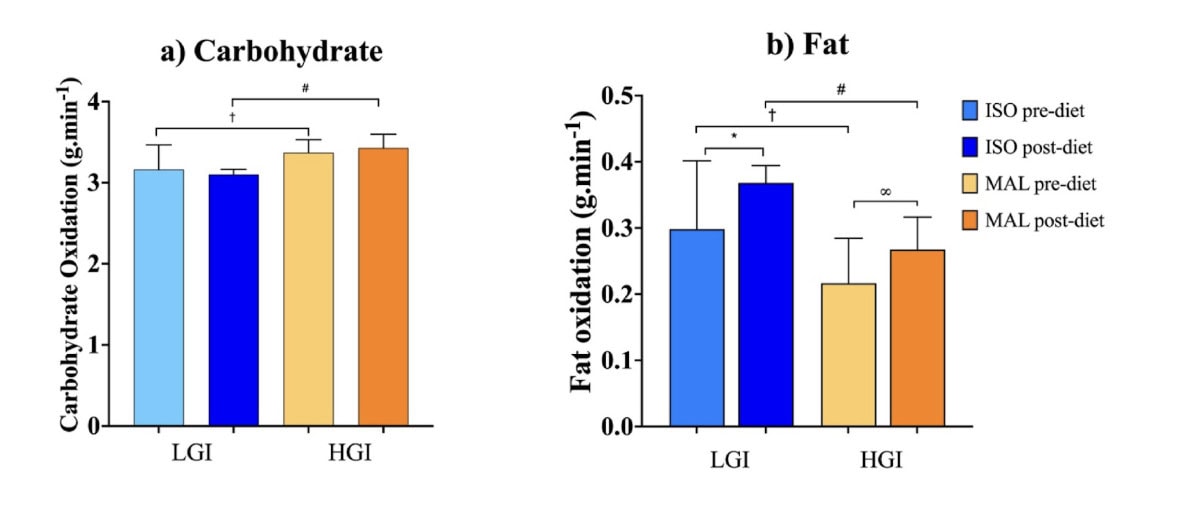
Interestingly, the low-GI diet also altered substrate use: during the first hour of the treadmill run, athletes burned fewer carbohydrates and more fat. Carbohydrate oxidation decreased by ~0.14 g/min on low GI, while slightly increasing on high GI. Fat oxidation rose accordingly.
What didn’t change? Performance. Time to exhaustion was identical between diets—about 65–72 minutes on average, regardless of GI type. Heart rate, VO₂, perceived exertion, and body composition also stayed similar.
What this means for runners
For ultra-endurance athletes—or marathoners logging high weekly volume—a month of low-GI carbs didn’t make anyone faster, but it did create more stable glucose profiles and reduced daily hypoglycemia, without compromising performance. That stability may matter for long training days, nighttime recovery, cognitive sharpness during long runs, and possibly long-term health. Fat oxidation also improved under the low-GI condition without needing carb restriction or “train low” strategies, which is appealing if you want metabolic flexibility without sacrificing hard-session quality.
RunClub — Free
Join 300,000+ runners in RunClub
Free training plans for every distance, a daily running game, exclusive coaching content, and a real community of runners. Create your free account in 20 seconds — no card.
Already a member? Log in →












Join the conversation
How can you apply this to normal runners? Thanks!