


I hate to say it, but most marathon training plans are boring. They’re plain-vanilla, boilerplate, copycat versions of each other.
Then, boom! Here comes Vinny Mauri and his radically different approach: long, hard treadmill runs at about marathon pace (MP). He ran 2:05 and 2:06 in his first two marathons. Impressive.
It makes you wonder: Has Vinny stumbled upon a better way to train for marathons?
I’m not saying that traditional marathon plans are stupid and ineffective. Quite the opposite.
Most are very good because they’re based on principles thousands of runners have developed, honed, and proven over the last 50 years. You know the drill.
Do 80% of your running at a comfortably easy pace. Do long runs every week or two, gradually building their duration while keeping your pace at 60 to 90 seconds slower/mile than your goal MP.
Include a tempo run/lactate-threshold run every now and then. And don’t forget your “strides” or occasional speedwork at about 5K race pace.
Been there, done it all. Ho hum.
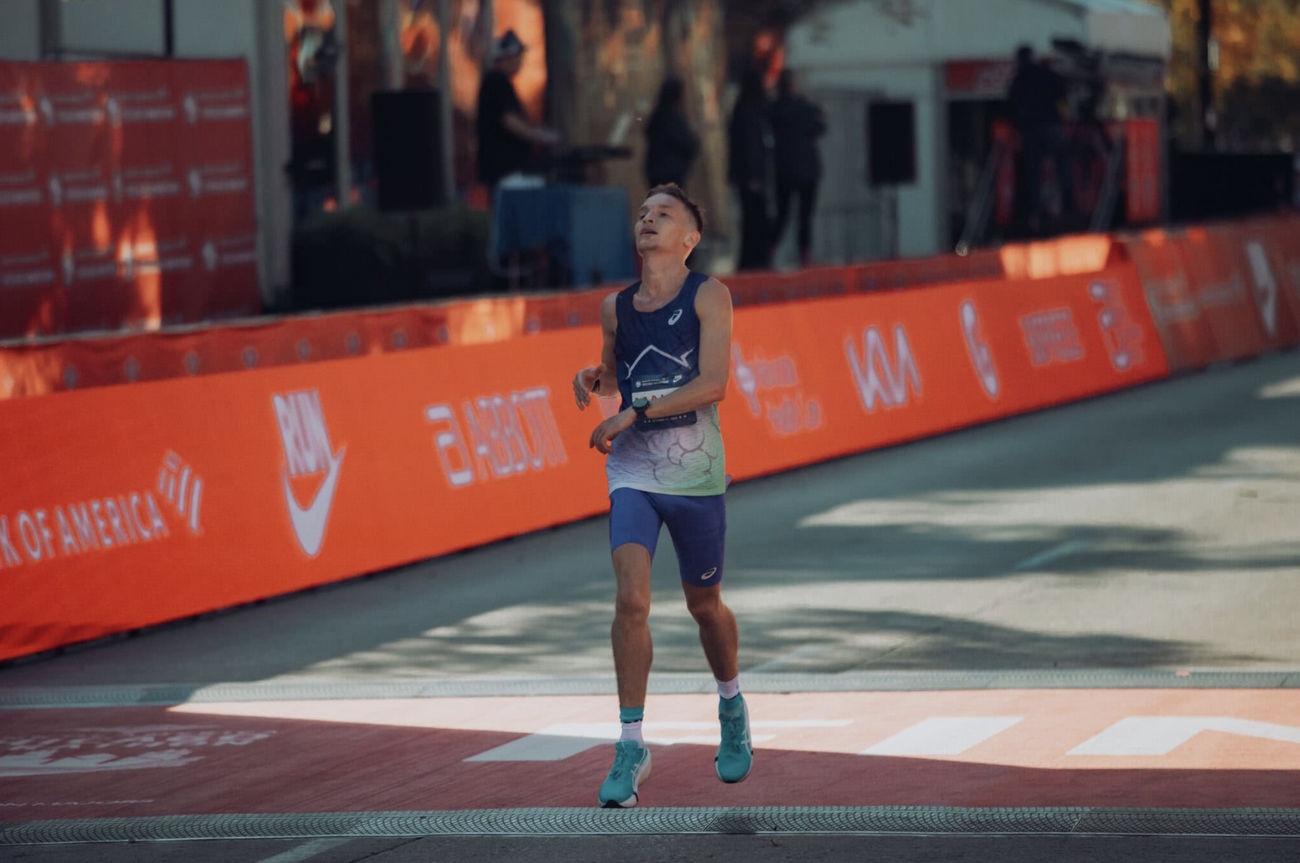
Then along comes Vinny Mauri (and CJ Albertson before him). Have they tapped into something new and better? Should you join the gold rush?
To find out, I surveyed five well-known marathon scientists and coaches. Specifically, I asked: What would happen if a recreational marathon runner doing 40 miles/week in 4 or 5 runs on a traditional program switched to just 3 Vinny runs/week?
This would give plenty of recovery time. But all the runs would have to be at or near marathon pace, while still totaling 40 miles.
Good idea? Totally crazy? Worth testing the waters?
I received insightful responses from: John Davis, Mario Fraioli, Michael Joyner, Greg McMillan, and Pete Pfitzinger. Below is a summary of what they told me.
Beware The Injury Risk And “Stride Variability”
John Davis says he already advocates more runs at 90 to 100 percent of marathon pace than most coaches. But he would worry about injury risk on the Vinny program I proposed. “To do 40 miles in a week with all of it at close to marathon pace is a much bigger biomechanical load on the body than 40 miles with most of it easy,” he notes.
On the other hand, if injuries are not a factor, Davis turns positive. “For someone who has already done many years of ‘traditional’ training with lots of easy miles plus low volume threshold and VO2 max work, I would expect Vinny-style training to produce improvements.”
Davis doesn’t reach this conclusion because Vinny training is the best way to train, but rather because it would be new and different for the traditional trainer. “New stimulus equals supercompensation, as long as recovery is adequate.”
He is concerned about treadmill training. It actually comes straight from a PhD study he authored.1Davis, J. J., Meardon, S. A., Brown, A. W., Raglin, J. S., Jaroslaw Harezlak, & Gruber, A. H. (2024). Are gait patterns during in-lab running representative of gait patterns during real-world training? An experimental study. Sensors, 24(9), 2892–2892. https://doi.org/10.3390/s24092892 The paper showed that stride-to-stride variability on a treadmill is much less than on the roads.
Translation: When you run your goal marathon, your stride variability will increase dramatically, which could lead to excessive biomechanical fatigue if you have not trained enough on the roads.
Wait A Minute: Don’t Lose Sight Of A Balanced Training Program
Mario Fraioli isn’t one of those ding-a-ling coaches who jumps on the latest big thing and recommends everyone try it. He favors proven, time-tested approaches.
When it comes to Vinny training, he’d be cautious. Fraioli says, “I might put runners on something of a hybrid program.”
He’d start with the long run, “since that’s the most important element,” and incorporate sizable chunks of that run at 90 percent of MP. Next, he’d bookend the long runs with something quicker, “either threshold reps or a mix of threshold and VO2 max-type training.”
Sounds traditional. Why is Fraioli holding the line? “Because I’ve seen this work,” he says.
He believes that someone doing 40 miles a week, with much of it near MP, would get “too much medium-hard stress on a body that likely can’t absorb it.”
Fraioli also draws the line on treadmill training, like Davis. He’s fine when his athletes use treadmills for pace familiarization and in bad weather. But he reminds us: “We race marathons outdoors over varied terrain, so it’s a mistake not to practice marathon effort in a real-world environment. We are not robots.”
At Times It Can Be Helpful To Train Like You’re “Brain Dead”
Endurance expert Michael Joyner invented the sub-2-hour marathon, at least on paper. He first proposed its possibility in an often-referenced 1991 journal article.2Joyner, M. J. (1991). Modeling: Optimal marathon performance on the basis of physiological factors. Journal of Applied Physiology, 70(2), 683–687. https://doi.org/10.1152/jappl.1991.70.2.683 He has also run a 2:25 marathon himself, and maintained a wide-ranging interest in training methods.
For Joyner, Vinny’s training recalls the relentless training of Australian Derek Clayton in the late 1960s, when Clayton ran a 2:08:34 marathon. Joyner also notes that Arthur Lydiard advocated 100 miles/week of long, steady running, not easy jogging.
While a physiology expert himself, Joyner doesn’t think runners need to rely on “scientific” training. “If you do a lot of marathon-pace training over time, you’ll get to your biological ceiling for all the key variables,” he says.
He’s got several positive views on treadmill training. First, “It makes sense to do a certain number of hard but ‘brain dead’ efforts like those a treadmill can help you achieve.” Second, indoor treadmill running is likely warm-environment training, so you can practice hydration while gaining the benefits of heat training (like expanded blood plasma).
It’s All About The Risk-Benefit Ratio
Greg McMillan observes that super shoes and nutrition “have completely changed the stress/rest” cycle for runners. In other words, workouts that didn’t make sense in an earlier era may now be worth trying.
He says: “Ultimately, the limiting factor for most runners is the musculoskeletal system, especially for older age-group runners.” If you feel you’re durable enough for Vinny training, give it a try. “It’s all about risk and reward,” says McMillan.
On the other hand, if you’re concerned about injuries and don’t train in super shoes, stick to your current plan. “The pre-super-shoes training plans are still a good choice for many runners.”
Sure, Go For It. But Be Cautious And Ready To Adjust
Pete Pfitzinger believes “we need to be cautious about swinging the pendulum too far in response to one or two success stories.” He adds, “Having said that, I believe there is something useful in Vinny’s approach.”
Pfitzinger’s current training plans, widely followed by fans of his popular book, Advanced Marathoning, typically suggest runners start their long runs 20 percent slower than MP and gradually progress to 10 percent slower. On several of these efforts, he advocates speeding up to full MP near the end.
He adds that runners could “inject more Vinny” into their programs with more long runs that finish at MP. He has included 4 of these in many of his plans. But he says you could consider doubling this number in a 16-week plan.
Pfitzinger also suggests a second, midweek workout at MP. “This is moderately slower than threshold pace, but the efforts will tend to be longer, so the overall effect is similar.”
He concludes: “This feels like a realistic approach to Vinny-up training.” Importantly: “See how it goes, then review and adjust.”
3 Key Takeaways On Vinny Training
There isn’t now, nor will there ever be, a single best marathon training program for every runner. With his sub-2:05 marathon goal, Vinny Mauri must train much more and quicker than mid-packers in the 3- to 5-hour range. Those runners typically log 20-40 miles per week.
Still, Vinny makes us think and re-evaluate. That’s a good thing. And it leads to these conclusions.
- It’s possible to do some, if not many, long runs close to your actual MP. Marathon pace isn’t fast per se, but it definitely gets hard once you extend it past 10 miles or so. Marathon races are hard, too. That’s why MP training can produce excellent results.
- The harder you train, the more important recovery is between hard efforts.
- Running faster than marathon pace is never a bad thing (in moderation), and a traditional mixed-paces marathon plan has proven successful many times over.
Indeed, it’s what CJ Albertson, also famous for his long, hard treadmill workouts, did to set a personal best at Chicago this fall. He lowered his PR by almost a minute, which is a big chunk when you’re improving from 2:08:17 to 2:07:19.
“I got in four to five weeks of some decent 5K-10K pace work on the roads,” Albertson reports. “Those weeks helped me get the speed I needed for that PR. I hope to do more in the future, so I can continue to lower my best time.”
If you want the shortest, simplest marathon plan of all, you can always follow Michael Joyner’s haiku:
Run a lot of miles
Some faster than your race pace
Rest once in a while.
References
RunClub — Free
Join 300,000+ runners in RunClub
Free training plans for every distance, a daily running game, exclusive coaching content, and a real community of runners. Create your free account in 20 seconds — no card.
Already a member? Log in →










Start the conversation