


A new study from the scientist who first discovered the 80-20 training principle uses AI to analyze how top Ethiopians train. These runners, like those from neighboring Kenya, are among the best in the world.
This high-tech approach yields a comprehensive (and complex) under-the-hood investigation of top training methods.
It concludes that Ethiopians train in a manner uniquely their own, but one that mostly obeys the 80-20 rule. They do this with the following strategies.

5 Ways Ethiopian Runners Structure Their Training
- Training with a group of other runners, under the watchful eye of an experienced coach.
- Alternating hard training days with easy days, and taking one day off per week.
- Using different venues (track, roads, hills, grass, trails) for different sessions.
- Making their easy days very easy, almost laughably so. Athletes who can average 5:00 minutes per mile in marathon races regularly run a 9:00-minute pace on easy days.
- Starting slow on long-run days and gradually increasing pace to near marathon pace, but not faster. In other words, they stay controlled even on hard long runs.
Inside the Study: AI, GPS Watches, and 16 Million Lines of Data
The researchers readily acknowledge that they used AI bots like Claude and ChatGPT to reach a “detailed dissection” of the Ethiopian training data. Nonetheless, they say they retained control over the “direction, interpretation and the final claims” of the paper.
[Note: No AI was used in the writing of this article. All summaries, conclusions, and analysis of training paces came directly from the author.]
The senior researcher on the Ethiopian report is Stephen Seiler, world-recognized for his work on Training Intensity Distribution (TID) in elite endurance athletes. The paper, “How Ethiopia’s elite distance runners actually train: an AI-assisted dissection of a multidimensional training structure,” is freely available at a preprint website and has not yet been published by a peer-reviewed journal.1Galko, P., Yisamaw, A., Haugen, T., & Seiler, S. (2026). How Ethiopia’s elite distance runners actually train: an AI-assisted dissection of a multidimensional training structure. https://doi.org/10.64898/2026.05.29.26354013
Seiler and colleagues followed 14 elite Ethiopians (8 female) for 97 days. The runners had an average marathon time of about 2:16, meaning that the men averaged 2:10-2:11, and the women around 2:23-2:24.
Individual runners could have been much faster than these averages, but they are not named in order to protect their privacy.
The researchers used GPS watches to collect objective data from each run, and a sports scientist (Abay Yisamaw) was also on the ground to observe all training. He added much observational data such as venues, topography, surface, and more.
The team’s big-data expert, Palo Galko, says he had 16 million lines of data at the beginning of his analysis. Even after simplifying the information, Seiler could find no way to accurately describe Ethiopian training with typical linear metrics like distance, pace, and heart rate.
Instead, he invented a 3 x 3 x 3 training “lattice”. This meant that each run could have up to 27 variables attached to it, although most reached only 15.
Ethiopian Weekly Mileage and Long Runs: The Numbers You Can Use
No short web article can include even a fraction of what Seiler and company reported. Even he admits no one knows whether compiling so much training data helps. See the Q/A section below for Seiler’s comments on the Ethiopian project.
Here’s what I found most interesting and important. We’re all curious about weekly mileage and long-run efforts by top marathon runners. The Ethiopians averaged about 71 miles per week in 8.5 sessions/week spread over 6 days of training.
The biggest week of any athlete was 96 miles. These total-mileage figures are clearly lower than those of many world-class marathon runners.
On their long runs, the fastest Ethiopian men started at about 7:40 per mile and gradually accelerated over 40 minutes to about 5:35 pace, which they maintained for another 40 to 80 minutes.
That’s fast, but considerably removed from their marathon race pace of about 5:00 per mile. Of course, they did all training at an altitude of 6,000 feet or more.
How Ethiopia’s Elite Run Their Long Runs
On 90-minute runs, and sometimes longer, Ethiopian men capable of a 2:11 marathon (5:00 minute pace) start at 7:40 pace and gradually accelerate to 5:35 pace.
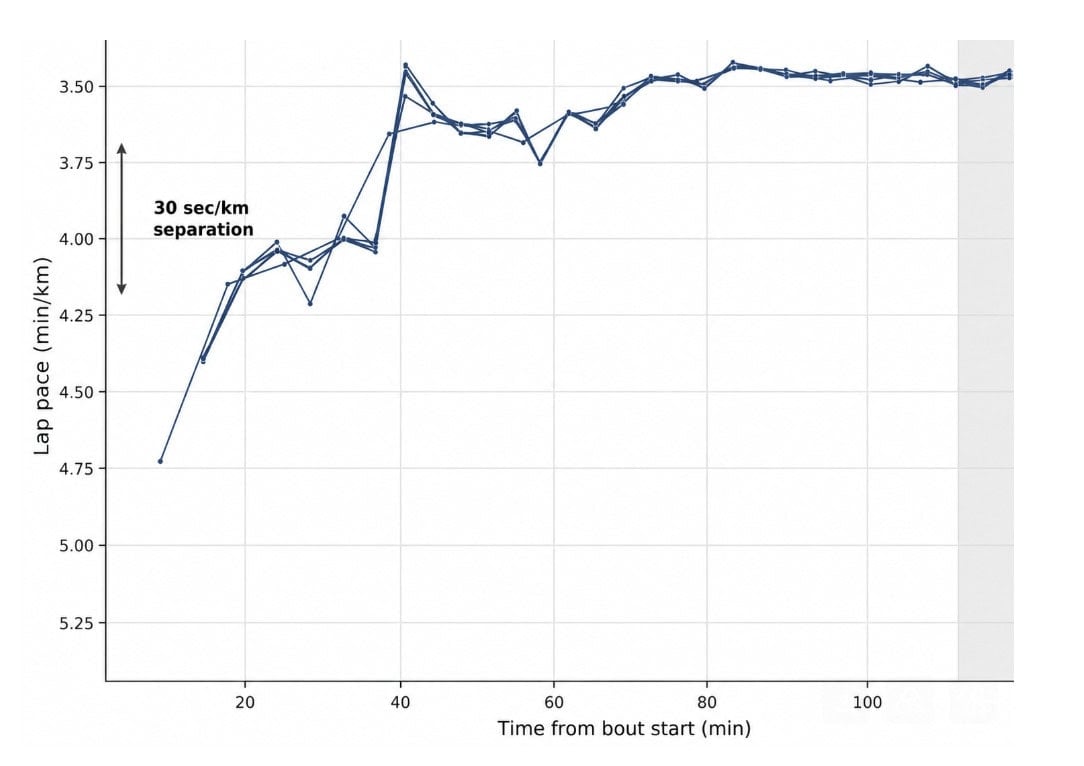
The Ethiopian easy days look even more dramatic … for their slowness. On the Eucalyptus forest trails of Mount Entoto at 9,000 feet, the runners generally averaged 9:00 minutes per mile.
What does all this amount to? According to the study team, the Ethiopian training approach falls into the “same region as published altitude training logs, including the widely-reported logs of Eliud Kipchoge.”
Q&A: Stephen Seiler on What the Ethiopian Data Shows
“No Training Model Should Become A Straitjacket”
Here, Stephen Seiler, PhD, answers questions about the new paper on Ethiopian training. Seiler is a sports science professor at Agder University in Kristiansand, Norway.
You have been a leader in training analysis for several decades and call the Ethiopian paper a “highlight of my career.” Why?
First, it was such a pleasure to watch the development of Abay Yisamaw, the young sport scientist in Addis Ababa. He helped us examine the research questions within the context of Ethiopian culture, constraints, and traditions, not Western/Scandinavian models. Also, we used advanced AI methods in addition to interviews, observations, and traditional quantitative measures. The artificial intelligence helped uncover the coaches’ elaborate approaches, as well as how the athletes adapted the training prescription from day to day.
To what extent do Ethiopian training and this paper support 80-20?
The 80-20 training system is built on stress management. It uses two key training levers — heart rate and lactate, which monitor pace and distance — to achieve high training adaptation with manageable stress. Ethiopian coaches use intensity, altitude, and running surface to manage this, and they closely approximate the basic 80-20 distribution. In some ways, their approach is more sophisticated, because they are not just using HR ranges and lactate profiles. They are including additional factors as well.
You go to great lengths to say the paper isn’t prescriptive or a “formula” for anyone else. But it does seem to support methods like group running, very easy recovery days, and progressively paced long runs, doesn’t it?
Absolutely, they are important. At the same time, you would not be able to reproduce the specific Ethiopian model in Norway, or in Texas for that matter. These athletes grow up at altitude. The coaches must manage up to 70 athletes in a training group. The culture tells the runners: “Keep up during group runs, or ‘You got some explaining to do!’”
What did you find most interesting and important about your results?
Well, AI is here to stay, and it can be a powerful tool for digging into large amounts of data and finding patterns. But AI models 1) cannot see patterns they are not trained to see; and 2) they will tend to regress towards the mean with text, quantitative analytics, or hypothesis generation. Humans need to be more than just “in the loop”; they need to be driving the bus.
Your new paper merged GPS data and observation. New “wearables” can produce much, much more data. Is more better?
In my observation of athlete training, I see an interesting irony, which is that high-performance runners actually are less likely to make training decisions based on wearable data than recreational runners and age groupers. My daughter and I have recently written a paper, currently under journal review, that reveals this clear difference.
If elite endurance athletes are confronted with a mismatch between what their wearable says (“Your sleep quality was down 14% last night from the 30-day rolling average”) and what they perceive (“I feel great, let’s rock this interval session”), then they trust their well-calibrated brains. Lower-level performers tend to get caught up in the numbers from their wearables, even when these are often just algorithmic best guesses.
If you were coaching world-class marathon runners today, what training principles and data would you suggest they focus on? What about cross-training, for example? That’s not even mentioned in the Ethiopia paper.
I think distance running writ large requires doing a lot of things right from the big-picture perspective. We see more care with carbohydrate consumption and better risk management to avoid career-threatening outcomes like stress fractures, Achilles injuries, eating disorders, and/or overtraining.
The challenge then becomes individual optimization. That is where something like cross-training with a step machine might replace some easy runs. Some runners will benefit from this because of their build or bone structure. But others will never find it useful to set a foot inside a gym. No training model should become a straitjacket.
References
RunClub — Free
Join 300,000+ runners in RunClub
Free training plans for every distance, a daily running game, exclusive coaching content, and a real community of runners. Create your free account in 20 seconds — no card.
Already a member? Log in →










Start the conversation