


By Michael Doyle
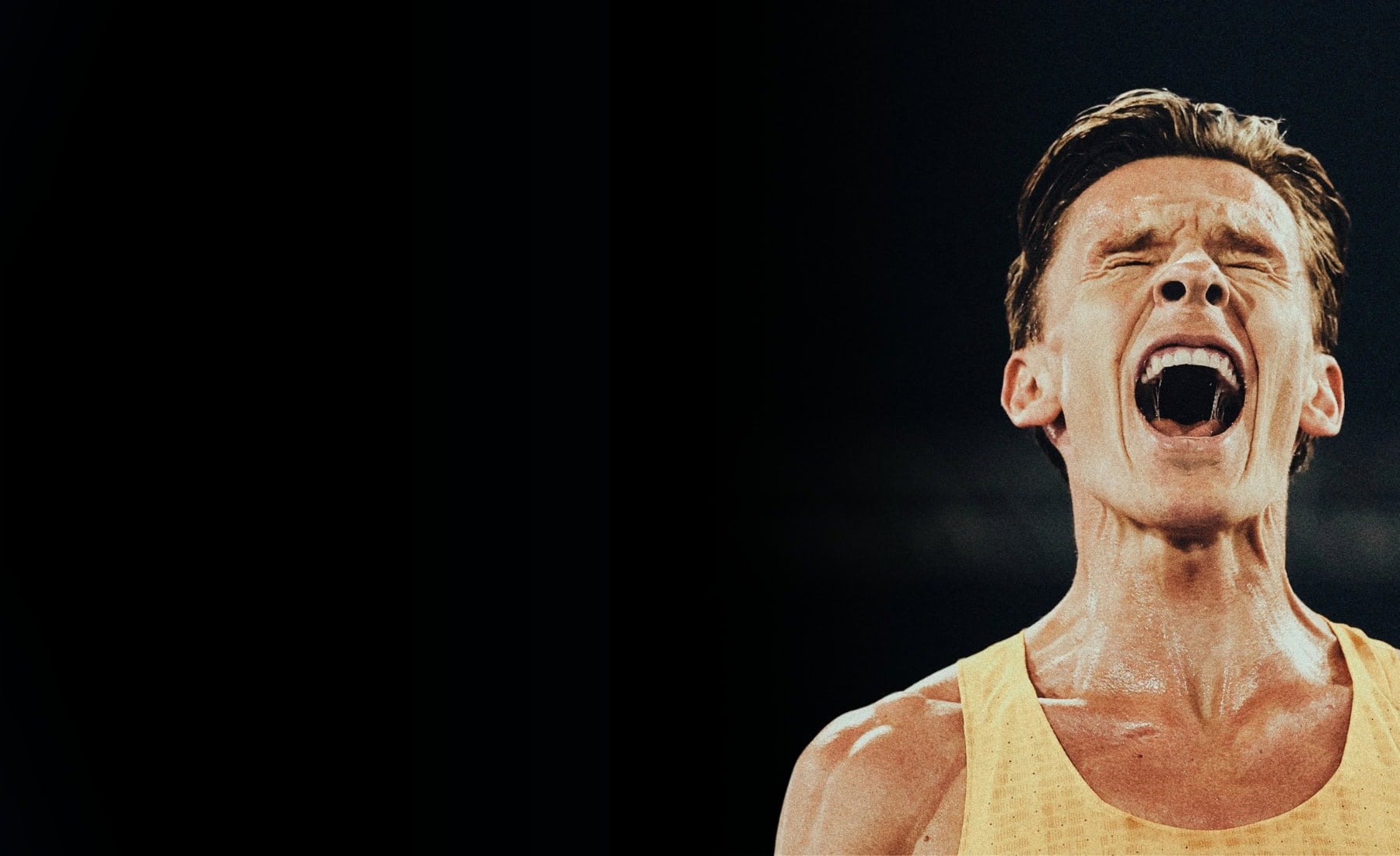
With less than a mile remaining in his first marathon, Andreas Almgren looked over his shoulder on Central Park South and saw Yemaneberhan Crippa about two meters behind him. He said afterward that he had not felt as though he was pushing at that point, and that he accelerated to see how Crippa would respond. The gap between them continued to grow.
Almgren ran the 26th mile in 4:25 and the last 352m in 56 seconds to win the New York City Marathon on Nov. 1 in 2:06:01, 13 seconds ahead of Crippa. According to data from his COROS Pace 4 watch, which COROS provided to Marathon Handbook, he covered the final 600m in 1:34, a pace of 2:37/km (4:12/mile). That was faster than his average pace six weeks earlier, when he won the world half-marathon title in a European record of 58:06.
Almgren writes his own training program, and he planned this marathon block for almost a year. He studied industrial engineering and management at the KTH Royal Institute of Technology in Stockholm and has worked as a data scientist for Svexa, a Swedish sports technology company. He has logged every workout since 2011, has kept his training in spreadsheets since 2018, tests his blood lactate during sessions, and maintains a long-term plan that runs to 2029. His longtime coach, Urban Aruhn, now serves mainly as a sounding board who challenges the plans Almgren writes.
He described this block in detail in interviews while it was underway, including in Entering the Unknown, a documentary series produced by his sponsor Nomio, and in a day-by-day account of one training week for Athletics Weekly, which followed his preparation. He also spoke with Marathon Handbook at length before the race. Read alongside the official splits and his watch data, those accounts trace his preparation from late summer into fall and his race from the start to the finish.
2:06:01, from Staten Island to Central Park
The race replayed from official checkpoint times. Six men were within a second of one another at 35K.
Times: official New York Road Runners checkpoint splits for the top six; positions between checkpoints are interpolated. Heart rate: COROS race data provided to Marathon Handbook (half averages and final-600m peak). Colors run from white to red as pace, heart rate and elevation rise; the course line is colored by each 5K’s pace, and the mark on the heart rate bar is his threshold of 168. Course line and elevation from a published route map, scaled to 42.195 km. Fueling markers show the aid stations where he planned to take bottles and the halfway caffeine gel he planned, not confirmed intake.
Choosing New York
Almgren, 31, decided to make his debut in New York after watching the 2025 race in person during his off-season, and he began planning the training block on his flight home. He also considered the Valencia Marathon, which is held on a flat course in December and is known for fast times. He told several interviewers that he did not expect his first marathon to be his fastest, and that he preferred to race for position at the front rather than run behind a lead group aiming for a world-class time.
The way the New York race is usually run also suited him. The race has no pacemakers, the early miles are often run conservatively, and the decisive moves tend to come in Manhattan in the last five or six miles, which favors a runner with a strong finish. He plans to move fully to the marathon after the 2028 Olympic Games in Los Angeles, when he will be 33, and he wanted this first block to show him what that change would require.
Almgren began his career in middle-distance events. As a teenager he ran a 1:45.59 800m and won a bronze medal at the 2014 World Under-20 Championships. Injuries kept him out of the Olympic Games in Rio, Tokyo and Paris, and after the early setbacks he rebuilt his training around the Norwegian model of high mileage and controlled threshold running. He set a Swedish record in his first race on the new system and has moved up in distance since then.
The Build
The marathon block began in the week after he won the European 10,000m title in Birmingham, England, in mid-August. He has said that he planned his track training that summer with the marathon in mind, partly to make the move from the 10,000m to the longer distance easier.
Over the next 10 weeks he ran 1,246 miles (2,006K), according to his training log. His highest week, beginning on Sept. 7, reached 150 miles (241K). In late August he said that he expected to peak at 220 to 230K per week, and his previous highest week, set the winter before, had been 213K.
Ten weeks, 1,246 miles
Weekly running volume from the week after his European 10,000m title through race week.
Weekly totals from his training log. Race week is his reported estimate and includes the marathon. Dates are the Monday of each week.
He told Athletics Weekly that his mileage was already at the level a marathon required, and that his main concern was durability, which he defined as the ability to keep running fast after an hour and a half of running fast.
Double Threshold Training for the Marathon
Almgren is one of the best-known practitioners of double threshold training, in which an athlete runs two sessions on the same day at a controlled intensity and checks blood lactate readings to keep the effort below a set level. During his track-season base training he runs two of these days each week, on Tuesday and Thursday, with short repetitions in the morning and the afternoon.
For the marathon he changed both sessions. The morning repetitions were replaced by 50 minutes of continuous running at LT1, his first lactate threshold, which is the intensity at which lactate begins to rise above resting levels. The afternoon sessions became longer, such as 16 x 1K, or 5 x 2K followed by 10 x 400m.
Athletics Weekly documented the week that began on Aug. 31 day by day, and it shows the full structure of the block at that stage. In addition to the two threshold days, he ran three 50-minute sessions in a heat chamber set to 38 C (100 F) and 60 percent humidity, keeping his core temperature at about 38.5 C, and on Saturday he ran a 40K progression run. The week totaled 145 miles (233K).
From a track week to a marathon week
His usual base week in a track season, set beside the marathon-block week of Aug. 31 to Sept. 6.
Sources: his own description of his track base week; Athletics Weekly (Aug. 31 to Sept. 6, the week he ran 233K).
His lactate readings show how he was able to sustain that workload. On Sept. 1 he ran the first eight of his 16 x 1K at 2:50/km with a reading of 1.5 millimoles per liter, then ran the last eight at 2:47/km and measured about 2.5 mmol. In a treadmill session filmed for Entering the Unknown, he ran 50 minutes at LT1, finishing at close to 3:00/km with a reading of 1.36 mmol and a heart rate of about 140 beats per minute.
Those readings are near the low end of what he produces in training. In a track session in June he measured 11.7 mmol, and he said that his highest reading in a workout, the year before, was 24.7. He has said that he does not make all-out efforts in training, and that even hard sessions should feel controlled.
The paces he ran in New York, 3:02/km (4:53/mile) in the first half and 2:56/km (4:43/mile) in the second, correspond to the paces at which his training readings were between about 1 and 1.5 mmol.
His race pace, against his training readings
Blood lactate measured in training, by pace. The paces he ran in New York sit where his training readings were between about 1 and 1.5 millimoles.
Sources: Nomio’s Entering the Unknown (LT1 treadmill session); Athletics Weekly (16 x 1K, 10 x 400m); his interviews (other sessions). His highest reading in a workout, 24.7 mmol, is off this scale. Treadmill readings run lower than outdoor readings at the same pace, by his account.
The Long Runs
The most significant change to his training was the long run. Before this block, he said, he had never run farther than about 32K (20 miles), and he had never run that distance at a hard effort. He completed four documented hard long runs during the block, and his average pace improved in each one.
The first, in the week of Aug. 17, covered about 35K at an average of 3:17/km and ended with 10 x 1K alternating with 1K floats, the last of the faster repetitions in 2:47. The second, on Aug. 27, covered 37K at 3:15/km and ended with 4 x 6K that progressed from 3:07/km to 2:58/km. Three days later he won the 10,000m at Finnkampen, the annual track meet between Sweden and Finland.
The third, on Sept. 5, was a 40K (24.9-mile) run on a hilly course chosen to resemble New York’s, divided into four 10K segments of 35:00, 31:20, 29:46 and 28:30. Two weeks later he won the world half-marathon title in Copenhagen, passing Kenya’s Nicholas Kipkorir in roughly the final 150m, by his own account.
Four long runs, each faster than the last
Before this block he had never run farther than about 32K at any effort. Each bar is one run, shaded by pace.
Sources: Nomio’s Entering the Unknown (first run); Athletics Weekly (Sept. 5 run); his interviews (Aug. 27 and Flagstaff runs). Progressive segments are shaded from their reported starting pace to their reported finishing pace. The segments he described for the first run add up to 36K; he called it about 35K.
Flagstaff
Almgren became ill immediately after the race in Copenhagen, and he took three days off entirely. His mileage that week fell to 54 miles (87K). Eight days after the race he ran a 35K long run, followed the next day by a double threshold session, and he said later that he had noticed little loss of fitness.
He spent the rest of the block in Flagstaff, Ariz., at an elevation of about 7,000 feet, on his ninth training camp there. In Flagstaff he replaced the weekly schedule with a five-day cycle consisting of a hard long run, two easy days, a double threshold day and one more easy day. His easy days remained long, with two 10K runs on the day after a long run and a run of 25 to 30K on the second day.
His heaviest period of training covered 265K (165 miles) in eight days, including two 40K long runs and two double threshold days of about 45K each. He held back slightly during the long runs so that he could recover from each one within two days, which allowed him to complete more of them.
The long run that he said convinced him he was ready was on Lake Mary Road, where he ran out and back twice over the road’s hilliest section. After an 8K progressive warmup, he ran 32K at about 3:05/km, with roughly 850 feet (260 meters) of climbing, at altitude. A steady 36K run on the same section with the marathoner Rory Linkletter, also completed out and back twice, included about 980 feet (300 m) of climbing.
He trained on steeper ground than New York’s
New York’s profile, and the climbing per mile in his two documented hilly runs in Flagstaff, which sits at about 7,000 feet.
New York profile measured from a published route map, about 770 feet (235 meters) of climbing. Flagstaff figures as he has described them: about 260 meters on the 32K tempo and about 300 meters on the steady 36K.
The New York course has about 770 feet (235 meters) of climbing over its full distance, based on our measurement of the course profile. On those two runs in Flagstaff, he climbed more per mile than the New York course requires, at a much higher altitude.
Race Week
His last hard long run took place about three weeks before the race, and he reduced his training from that point. When he had the option of running either 25K or 30K for his final long run, he chose 25K, reasoning that the risk of arriving at the race tired outweighed a small loss of preparation.
He traveled to New York a week before the race to readjust to sea level. During that week he ran the final 6K of the course on several days so that he would know its turns and could run the shortest route through them.
He had practiced his race fueling throughout the year, consuming about 120 grams of carbohydrate per hour even on easy long runs. As he has described it, his plan for the race was to take a Maurten bicarbonate drink two hours before the start and a caffeine gel just before it. He planned to take a bottle at each 5K aid station through 35K, each containing about 40 g of carbohydrate, so that he would consume roughly 30 g after accounting for the drink left in each bottle, and to take a second caffeine gel at halfway.
He practiced taking bottles from a table on the track at about 63 seconds per 400m, a pace much faster than his marathon pace. Because he is left-handed, he trained himself to take the bottles with his right hand. On race day he wore the Nike Apex, a racing shoe that Nike plans to release in January.
The Race
The race began at a conservative pace, with the leaders averaging 5:01/mile through 3 miles. Almgren passed 10K in 30:53 and halfway in 1:04:04, three seconds behind Zouhair Talbi. He said that he stayed near the front of the group but allowed other runners to cover the surges.
His heart rate in the first half averaged 156 beats per minute and did not rise above 171, according to COROS. COROS had measured his threshold heart rate at 168 in August.
The pace increased after halfway, with 5K splits of 14:50 from 20K to 25K and 14:45 from 25K to 30K. He said afterward that at around 30K, as the course entered the Bronx, his legs had begun to ache from the climbs, the descents and the hard pavement, and that he had wondered whether he was prepared for it. His split of 15:08 from 30K to 35K was the slowest of his second half.
At 35K, the top 6 runners were within one second of one another. On Fifth Avenue, where the course climbs toward Central Park, Benson Kipruto ran the 23rd mile in 4:38 and Almgren ran it in 4:39. Almgren said that the faster pace restored his energy, and that once he entered the park he responded to every move.
He reached 40K in 2:00:00, one second ahead of Crippa and Kipruto, and ran the final 2.2K in 6:01, an average of 2:44/km (4:25/mile).
His pace held or quickened in every 5K but one
Pace for each 5K segment, over the course profile. The exception was 30K to 35K, through the Bronx, where he said his legs had begun to ache.
Source: official New York Road Runners splits. The final segment is 2.195 km. Elevation from a published route map.
The watch data shows how his running changed as he accelerated. He ran the second half six seconds per kilometer faster than the first, while his average heart rate rose by seven beats per minute, from 156 to 163. His cadence increased from 178 steps per minute in the first half to 183 in the second half and 195 over the final 600m. Over the same three stages his ground contact time decreased from 147 milliseconds to 141 ms and then to 120 ms, a reduction of about 18 percent.
In a video interview in June, Almgren described his stride as elastic when he is fresh. He said that when he is fatigued, it feels as though the energy he puts into the ground is lost. The decrease in his ground contact time in New York is consistent with the first of those descriptions, and it was recorded at the end of the race.
He ran faster and took quicker steps as the race went on
Watch data from his COROS Pace 4 for the first half, the second half and the final 600m.
Source: race data from his COROS watch, provided to Marathon Handbook by COROS. Heart rate for the final 600m is the race peak; the halves are averages. Threshold heart rate of 168 is from COROS’s August analysis. Stride length is derived from pace and cadence.
His heart rate during the race was also moderate compared with his other efforts this year. His second-half average of 163 was close to the 162 that COROS recorded during a January session of 10 x 1K at an average of 2:34/km. His peak of 178 came only in the final 600m, and it was lower than the 180 he averaged over the second half of the European 10,000m final in August.
Both halves averaged below his threshold
His New York heart rate set against his threshold and against other sessions and races in 2026.
Sources: COROS race data provided to Marathon Handbook (New York); COROS’s published analyses (Birmingham, January session, threshold); Nomio’s Entering the Unknown (LT1 session). Single sessions in different conditions; heat, altitude and fatigue all move heart rate.
What Comes Next
At the elite athlete media availability on the Thursday before the race, Almgren told Marathon Handbook that he was considering running the marathon and another event at the 2028 Olympic Games in Los Angeles. He noted that the 10,000m is scheduled for the first day of track and field competition and the marathon for the last day, which could make the double possible. He also repeated that he plans to run the marathon full-time after the Los Angeles Games.
Before the race, he had said that a victory was very unlikely but that one could lead him to reconsider his plans. After the race he said that he would still compete in a track season in 2027, with the goal of winning a world title in the 10,000m, and that he would also run a fast marathon. He said that he would decide later which event, or events, to run in Los Angeles.
In August he had said that his training needed to prepare him to run fast after an hour and a half of fast running. In New York, after more than two hours of racing, he ran his fastest pace of the day over the final 600m.
Running. In Your Inbox, Daily.
Fun and informative running tips, news, hot takes, and shoe reviews — read by 345,000+ runners.
Send Me the Next NewsletterRunClub — Free
Join 300,000+ runners in RunClub
Free training plans for every distance, a daily running game, exclusive coaching content, and a real community of runners. Create your free account in 20 seconds — no card.
Already a member? Log in →






Start the conversation