


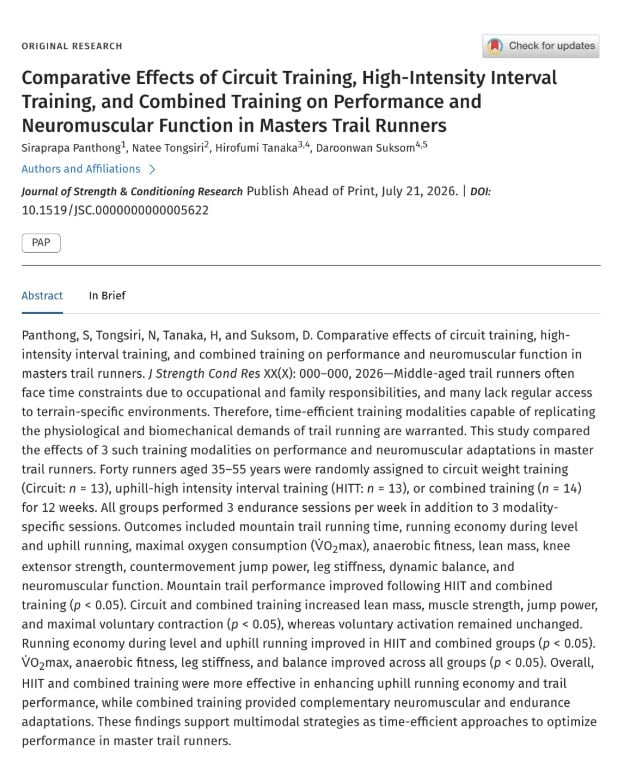
Trail runners need a unique combination of abilities: aerobic power for the climbs, economy across changing grades, strength for force production, and enough neuromuscular control to handle uneven ground. A new study compared three ways to build that skill package in runners ages 35 to 55.1Panthong, S., Tongsiri, N., Tanaka, H., & Suksom, D. (2026). Comparative Effects of Circuit Training, High-Intensity Interval Training, and Combined Training on Performance and Neuromuscular Function in Masters Trail Runners. Journal of Strength and Conditioning Research, 10.1519/JSC.0000000000005622. https://doi.org/10.1519/JSC.0000000000005622

Forty masters trail runners were assigned to 12 weeks of circuit weight training, uphill high-intensity interval training, or a combination of the two. Each group completed three endurance sessions plus three modality-specific sessions per week. The researchers tested mountain-trail performance, level and uphill running economy, VO2 max, anaerobic fitness, lean mass, leg-muscle strength, jump power, leg stiffness, balance, and neuromuscular function.
- Mountain-trail time and running economy on both level and uphill grades improved in the uphill-interval and combined groups.
- Circuit and combined training increased lean mass, strength, jump power, and maximal voluntary contraction.
- All three groups improved VO2 max, anaerobic fitness, leg stiffness, and dynamic balance.
The bottom line: Uphill intervals transferred more directly to uphill economy and trail performance; circuit training improved more of the strength and power outcomes; combining them covered both sides.
What this means for runners
If uphill trail performance is the priority, uphill intervals deserve a place in the plan. If maintaining muscle, strength, and power is the priority, circuit or resistance work adds a different stimulus. A combined approach is attractive because trail running demands both—but only if the total load still allows recovery.
References
RunClub — Free
Join 300,000+ runners in RunClub
Free training plans for every distance, a daily running game, exclusive coaching content, and a real community of runners. Create your free account in 20 seconds — no card.
Already a member? Log in →











Join the conversation
Running uphilll makes you run uphill faster. Lifting weights makes you stronger. Wow, I replicated the study results in 15 seconds.