


The New York City Marathon is a giant endurance laboratory.
More than 50,000 runners. Five boroughs. Bridges, wind, crowding, long pre-race logistics, uneven pacing demands, variable weather, and every kind of runner from world-class professionals to first-time marathoners.
A new systematic review1Knechtle, B., Thuany, M., Nikolaidis, P. T., Forte, P., Leite, L. B., Lepers, R., Chlíbková, D., Weiss, K., Rosemann, T., Vancini, R. L., & Duric, S. (2026). The New York City Marathon: A systematic review of performance, participation, pacing, and health-related outcomes. EXCLI Journal, 25, 591–620. https://doi.org/10.17179/excli2026-9354 compiled the scientific literature on the NYC Marathon, including 76 publications reporting findings on participation, performance, aging, nationality, injuries, environment, pacing, medical outcomes, shoes, and other race-specific features.
A few patterns stand out.
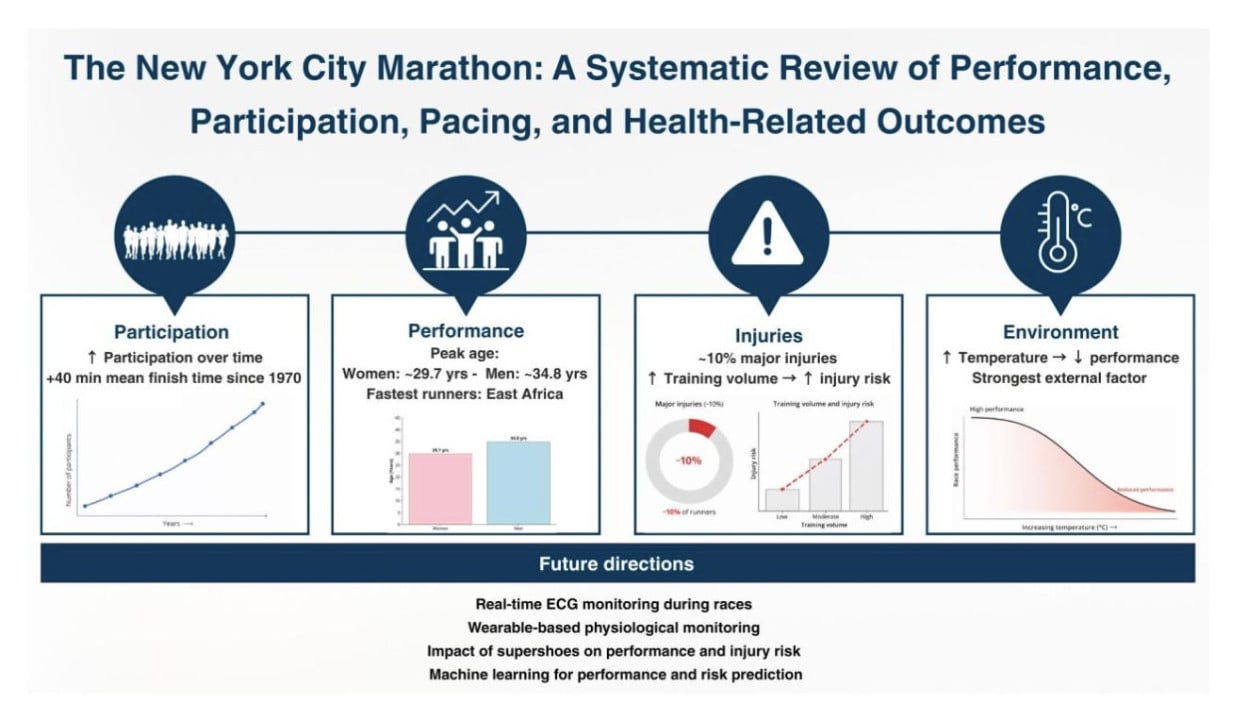
- Participation has exploded, especially among women and masters runners. From 1970 to 2017, the race had 1,174,331 total finishers: 349,145 women and 825,186 men. Women’s participation rose by 74% from 2006 to 2016, compared with a ~17% increase in men during that same time frame.
- Average finish times have slowed by about 40 minutes since the 1970s.
- Peak performance in NYC tends to occur in the early-to-mid 30s. In one-year age intervals, peak performance occurred at 29.7 years in women and 34.8 years in men. In five-year age groups, the fastest groups were 30–34 for women and 35–39 for men.
- Around 9.5 percent of runners experienced major injuries during training or the race that prevented them from starting or finishing. Another 49.2 percent reported minor injuries that interfered with training or race performance. Running-related overuse injuries during marathon preparation ranged from about 36 to 38 percent, and race-day injury affected roughly 14 to 16 percent of runners in some cohorts. Foot, knee, and hip injuries were common.
- Higher training volumes were consistently associated with a higher injury risk. Runners who had completed a half-marathon were less likely to report injuries, and longer training distances were inversely associated with race-day injuries.
- Higher temperatures slowed performance, with one analysis estimating an average performance decrement of about eight minutes on hot days. Slower runners were especially affected, likely because they spend more time on the course and experience more warming later in the day. The temperature-performance relationship was particularly pronounced among men aged 30–64 and women aged 40–64.
- NYC runners generally “adopt” a positive pacing strategy: they slow as the race goes on, often with a small final push to the finish. The fastest split usually occurs between miles 3 and 6, while the slowest occurs from miles 21 to 25.
- Men showed a larger drop from fastest to slowest split than women, 21.1 percent versus 16.7 percent. Older runners tended to pace more evenly than younger runners, and faster runners showed the least variability in pace.
What this means for runners
New York teaches the same lesson most marathons teach: preparation and pacing beat excitement. Build enough long-run durability to handle the distance, but do not confuse high volume with smart training. On race day, adjust for temperature early, not after you are already overheating. And pace the first half like you respect the second half.
References
RunClub — Free
Join 300,000+ runners in RunClub
Free training plans for every distance, a daily running game, exclusive coaching content, and a real community of runners. Create your free account in 20 seconds — no card.
Already a member? Log in →










Start the conversation