


For decades, high-carbohydrate diets have been considered the gold standard for fueling endurance activities, largely due to their ability to optimize muscle glycogen stores.
However, the rise of low-carbohydrate, high-fat diets has sparked debate about whether endurance athletes truly need large amounts of carbohydrates to perform at their best. Advocates of low-carb diets argue that fat adaptation can enhance endurance by increasing fat oxidation.
Critics contend that reduced glycogen availability impairs performance during prolonged, high-intensity efforts. Adding to this controversy are questions about carbohydrate supplementation during exercise, particularly whether minimal carbohydrate intake can deliver performance benefits or if higher intakes are necessary to sustain energy levels and delay fatigue.
A little over a year ago, I wrote about a study that challenged traditional notions about the role of carbohydrates for endurance athletes—the findings suggested that a ketogenic diet was compatible with high-intensity exercise performance and may come with additional metabolic benefits.
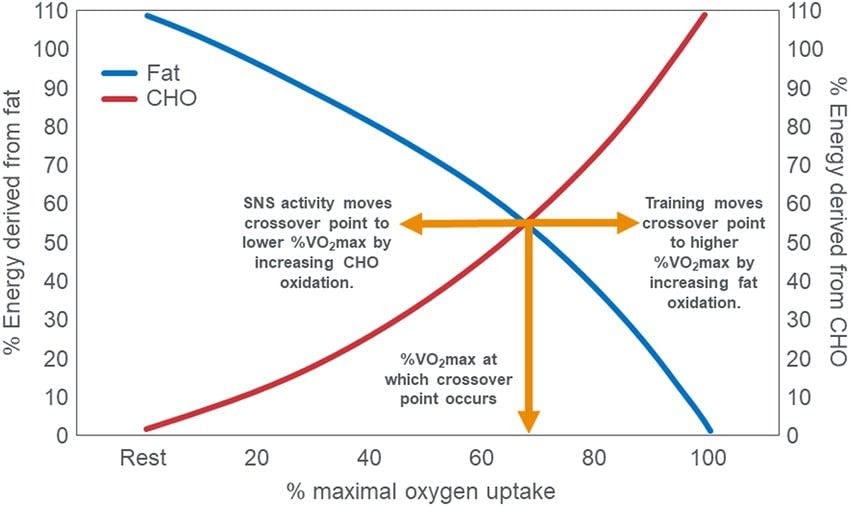
One of the more interesting findings of that study (in my opinion) was the shift in the so-called “crossover point”—the exercise intensity at which the body’s energy needs are supplied by a greater proportion of glucose than fat/lipids. Traditionally, the crossover point occurs at an exercise intensity between 60% and 70% of one’s maximal oxygen uptake, with maximal fat oxidation happening somewhere in this range. In participants adapted to a low-carbohydrate diet, the crossover point occurred much later, and maximal fat oxidation occurred at an exercise intensity above 85% of max.
What does this all mean?
Adapting to a low-carbohydrate diet shifts the way the body uses carbohydrates and fat during exercise. The observation that this occurs in the context of a maintenance of high-intensity exercise performance questions the obligatory role of high dietary carbohydrate availability for athletes, or at least the obligatory role of muscle glycogen for sustained performance.
Beginning exercise with a lower muscle and liver glycogen content—something characteristic of a low-carbohydrate or ketogenic diet—would necessarily reduce prolonged endurance exercise performance. That is, if muscle glycogen truly is obligatory. Not everyone believes this to be true.
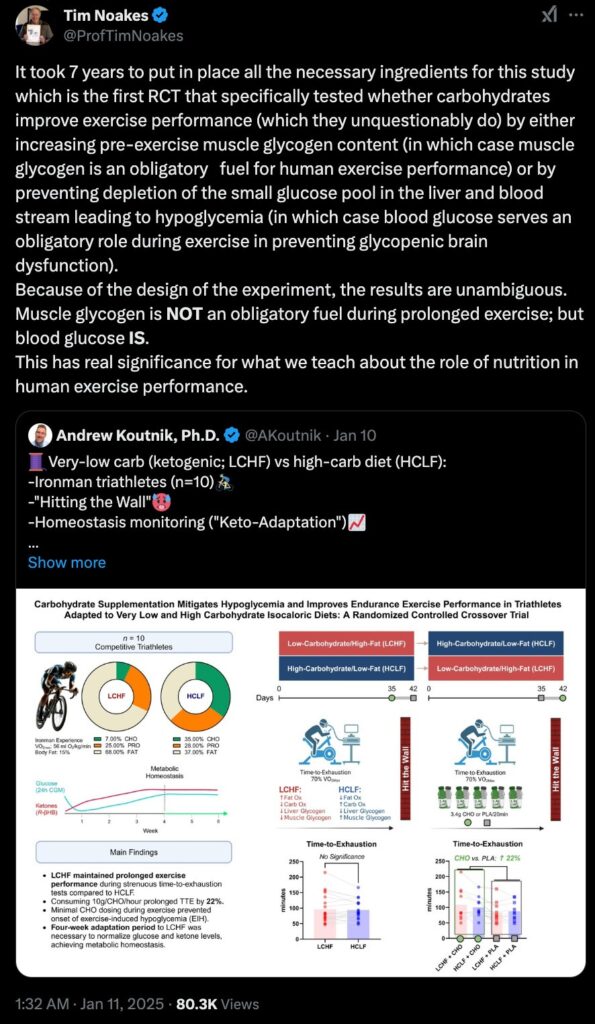
Based on the results of a new study, muscle glycogen may not be the obligatory fuel source during endurance exercise as was once thought. Rather, it might all come down to sufficient levels of blood glucose.
Now, the same research group published another study that challenges dietary dogma (again). It addressed several key questions at the heart of endurance fueling strategies: Is glycogen depletion as critical to fatigue as traditionally believed? Can athletes perform equally well on low-carb and high-carb diets with adequate adaptation? And how effective is minimal carbohydrate supplementation during prolonged exercise?
The study set out with three primary aims:
- To evaluate whether endurance performance (time-to-exhaustion at 70% VO2 max) differs between athletes adapted to low-carb and high-carb diets over six weeks.
- To determine the impact of carbohydrate supplementation during exercise on endurance performance across both dietary patterns. This included investigating whether minimal carbohydrate intake (10 grams per hour) during exercise could enhance performance and mitigate exercise-induced hypoglycemia, regardless of the athlete’s habitual diet.
- To investigate the time course of metabolic and performance adaptations to low-carb and high-carb diets, with a focus on their influence on endurance performance.
The study included a group of healthy, trained endurance athletes with experience in long-duration exercise (triathlon). They were randomly assigned to either a low-carbohydrate (LC) or high-carbohydrate (HC) diet for 6 weeks each before crossing over to the other diet after a 2-week washout period. Both diets were isocaloric, ensuring equal caloric intake across groups despite differences in macronutrient composition. Notably, the low-carb diet comprised less than 50 grams of carbohydrates per day, 70–80% fat, and 20–25% protein, while the high-carbohydrate diet comprised ~380 grams of carbohydrates per day (60–65% of total calories), <30% fat, and 20–25% protein.
Endurance performance was tested through two time-to-exhaustion trials performed at 70% VO2 max, a moderate but strenuous intensity designed to replicate prolonged, glycogen-depleting exercise. These tests were conducted after participants had undergone a six-week adaptation to their assigned diets. To investigate the effects of carbohydrate supplementation during exercise, participants completed the time-to-exhaustion trials under four distinct conditions:
- Low-carb diet with placebo
- Low-carb diet with carbohydrate supplementation
- High-carb diet with placebo
- High-carb diet with carbohydrate supplementation
Carbohydrate supplementation consisted of ingesting 10 grams of maltodextrin (a simple carbohydrate) per hour during exercise, provided in 3.5-gram doses delivered in a standardized solution every 20 minutes. In the placebo conditions, participants consumed a similar solution that contained no carbohydrates.
After each 6-week diet condition, the participants performed the time-to-exhaustion tests twice, one week apart: one with carbohydrates and one without. During each of these testing sessions, two time-to-exhaustion tests were completed (TTE1 and TTE2, respectively), the second test occurring ~20 minutes after the first and involving the consumption of 50 grams of carbohydrate (in the carbohydrate supplementation condition) or the placebo beverage.
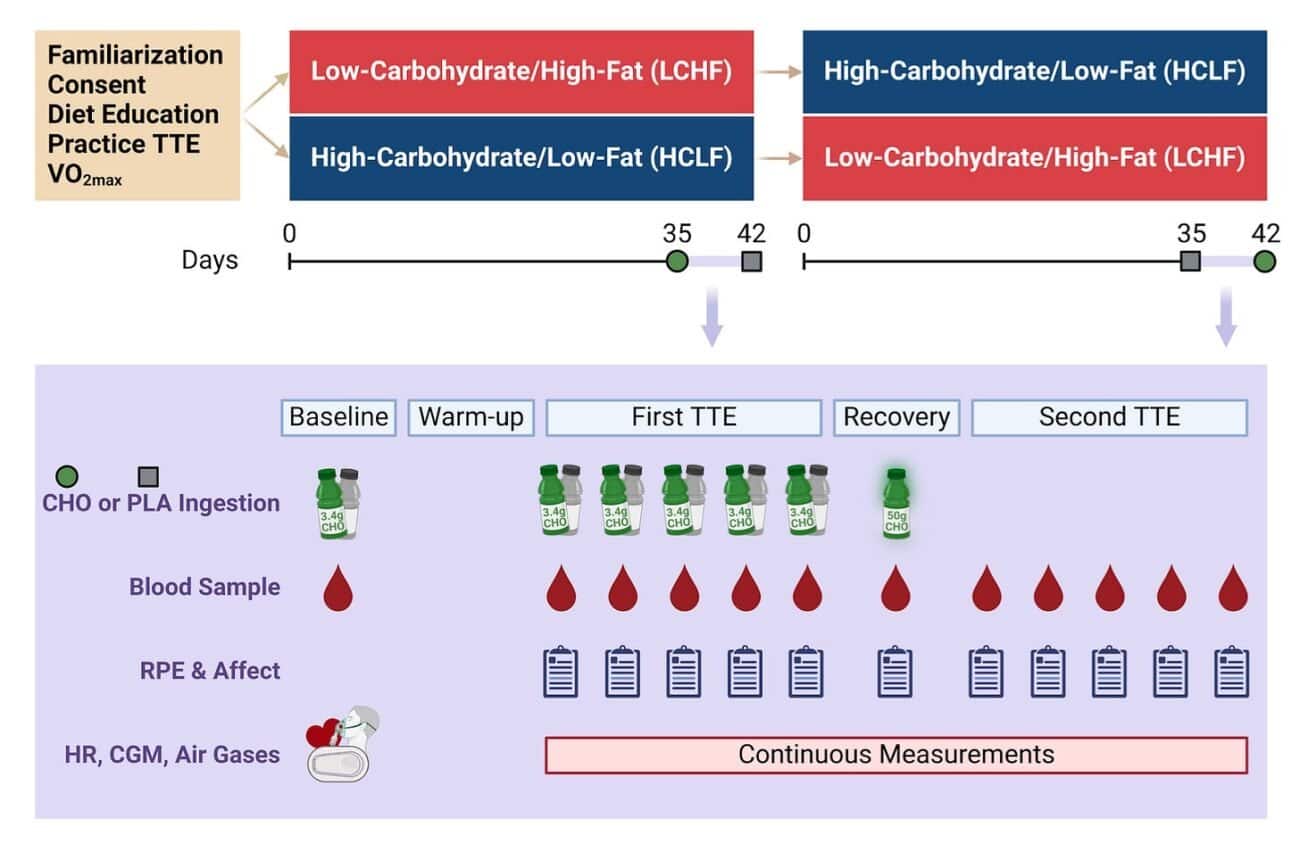
Let’s take a moment to appreciate the methodology here. 10 grams of carbohydrates per hour is 6–12 times lower than the current recommendations of 60–120 grams per hour and is just enough carbohydrate to maintain blood glucose levels. But as it turns out, that was the point. By using such a small amount of carbohydrate during exercise, the researchers tested the hypothesis that, rather than muscle glycogen being the determining factor for fatigue during prolonged exercise, it’s the maintenance of blood glucose/prevention of exercise-induced hypoglycemia that really matters.
Before discussing the performance results, let’s look at some of the dietary differences that were observed (by design) during the study. While energy intake and training load remained consistent across both diet conditions, ensuring any observed effects were diet-specific, significant macronutrient differences emerged:
- During the low-carb diet, participants consumed substantially fewer carbohydrates (-340 grams daily), sugar (-89 grams), and fiber (-19 grams) while increasing protein (+57 grams) and fat (+115 grams) intake compared to the high-carb diet.
- Adherence to the low-carb diet was validated by self-reported intake and a measurable rise in blood ketones. After just one week, circulating levels of R-βHB, the primary ketone, entered the nutritional ketosis range (0.5 ± 0.3 mM) and remained elevated throughout the 42-day intervention (Day 42: 0.6 ± 0.5 mM).
Performance is similar for low-carb and high-carb diets
Time-to-exhaustion results showed no differences in prolonged endurance performance between the low-carb diet and the high-carb diet during the placebo condition (when no carbohydrates were consumed): the participants cycled for ~84 minutes and ~88 minutes after the low-carb and high-carb diets, respectively (we can debate the real-world versus the statistical significance of a 4-minute difference another time).
However, when participants consumed a small carbohydrate solution (10 grams of maltodextrin per hour) during exercise, both diet groups (low-carb and high-carb) experienced a notable performance boost, extending time-to-exhaustion by an average of 19 minutes or 22%!
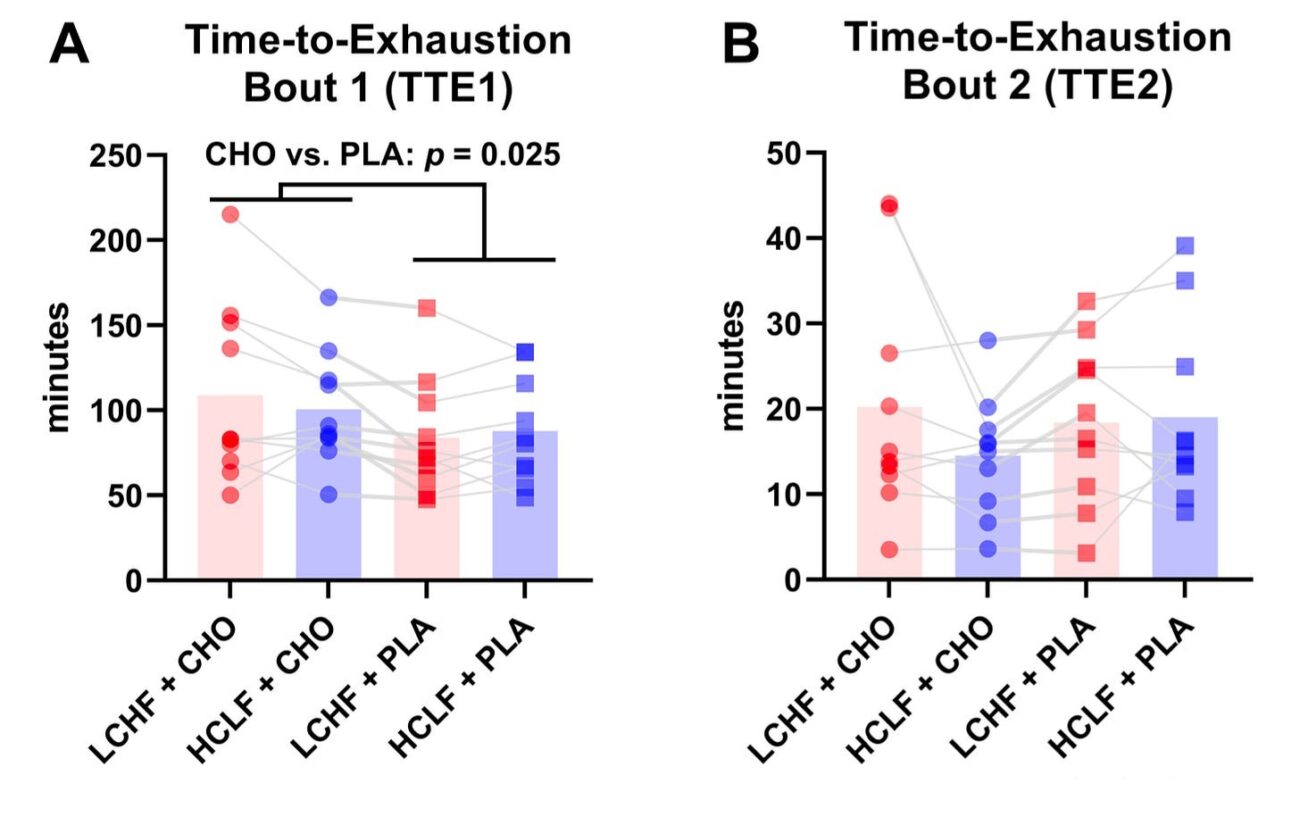
After the low-carb diet, the participants cycled for 109 minutes with carbohydrates compared to 84 minutes without—a difference of 25 minutes that met the threshold of statistical significance. In other words, carbohydrate supplementation benefits athletes who have adapted to a low-carbohydrate diet. After the high-carb diet, the participants cycled for 100 minutes with carbohydrates compared to 88 minutes without—a difference of 12 minutes that, while not reaching statistical significance, is still a relevant performance increase. Again, there was no statistically significant difference in performance between low- and high-carb conditions when carbs were supplemented (even though time-to-exhaustion was ~9 minutes longer in the low-carb condition).
Endurance performance during subsequent exercise tests (TTE2) remained consistent across both diet conditions—time-to-exhaustion was not different between the low-carb diet or the high-carb diet, independent of whether or not the participants supplemented with carbohydrates.
Differences in fat and carbohydrate oxidation emerge post-diet
Despite performance being similar between the diets, fuel utilization during exercise was dramatically different depending on the dietary composition and whether or not carbohydrates were used during exercise.
Carbohydrate oxidation was higher in the high-carb conditions (high-carb with carbohydrate supplementation and high-carb with placebo) compared to low-carb without supplementation (low-carb with placebo), with increases of 32–34% during the first time-to-exhaustion test and 41% during the second test. However, acute carbohydrate ingestion in the low-carb condition shifted substrate utilization toward carbohydrate oxidation, matching levels seen in the high-carb conditions. In contrast, fat oxidation was consistently higher in the low-carb condition without supplementation. During both time-to-exhaustion tests, low-carb with placebo resulted in 32–47% greater fat oxidation than the high-carb conditions.
When paired with the results of the 2023 study discussed at the beginning of this post, these findings challenge the long-held notion that high-carbohydrate diets are inherently superior for endurance performance due to their role in maximizing muscle glycogen stores (which were not measured in this study but were assumed to be lower…something I take minor issue with).
Unlike previous studies with shorter interventions (typically less than four weeks), which often concluded that low-carb diets impair performance, the current study’s longer adaptation period likely allowed for more complete metabolic adjustments like increased fat oxidation efficiency to offset reduced glycogen availability.
Another noteworthy observation was the potential role of ketones in mitigating the effects of reduced carbohydrate availability during low-carb conditions. Participants in the low-carb group had substantially elevated blood ketone levels during exercise, which appeared to act as a metabolic buffer, preventing severe hypoglycemia and enabling sustained exercise performance.
Traditionally, muscle glycogen has been considered the central determinant of prolonged exercise performance. However, glycogen stores, while important, may not be the sole driver of endurance capacity. Indeed, even small amounts of carbohydrates during exercise—as little as 3.5 grams every 20 minutes or ~10 grams per hour—significantly enhances endurance performance simply by mitigating exercise-induced hypoglycemia. This effect was observed regardless of pre-exercise glycogen levels or dietary background, highlighting the role of intra-exercise carbohydrate supplementation well below the current recommendations of 90–120 grams per hour for elite endurance athletes.
Does this mean we need to rethink our carbohydrate guidelines?
If as little as 10 grams per hour is sufficient to produce a significant performance benefit, this raises important questions about whether higher rates of carbohydrate ingestion (i.e., 90—120 grams per hour) provide meaningful advantages, particularly given the potential for gastrointestinal discomfort during exercise.
Of course, this study did not investigate whether higher doses of carbohydrate provided an extra advantage—that will have to wait until another time. 10 grams per hour can hardly be seen as the level where optimal performance occurs; however, it does hint that strategic, rather than maximal, carbohydrate supplementation may be a more practical and effective approach for many athletes.
This study won’t be the nail in the coffin for high-carbohydrate fueling—many athletes (including myself) are starting to embrace the power of carbs for performance and experimenting with newer and bolder fueling strategies. There are many questions left unanswered and more studies to be done before we can unambiguously say that endurance performance just comes down to “preventing low blood sugar.” I have a feeling it’s way more nuanced than that.
RunClub — Free
Join 300,000+ runners in RunClub
Free training plans for every distance, a daily running game, exclusive coaching content, and a real community of runners. Create your free account in 20 seconds — no card.
Already a member? Log in →












Join the conversation
Many years ago, prior to gels, I used glucose pills (4 grams of CHO) every couple of miles during marathons. Seemed to help at the time and this study might explain.
Thank you for the article. I have been very low carb now for over 3 years after being a high carb athlete most of my life. I do events like the UTMB and CCC on about 10-20gm/hr of carbs and have been winning my age class in the last two years. It works for me, but took 6 months to fully adapt my fat burning underlay. My energy is steady in events now and I do not bonk.
As a woman who has been low carb for almost 9 years and sick of hearing coaches and podcasters insist I have to eat carbs to run, this is so refreshing to read. Thank you for posting.
Clearly the low carb diet with 10 gm carb supplements out performed. My guess. Better fat adaptation is an advantage in endurance performance but carbs are still necessary. I would like to see what would happen with higher carb supplementation or those on low card diets that carb load prior to an event.