


Two recent studies from the University of Texas describe simple ways to improve your running economy. While the changes don’t promise huge benefits, why turn away from any efficiency gains?
After all, running economy is a key to endurance running performance.
A decade ago, few runners had a clear understanding of running economy. It sounded like a discount store that sold running.
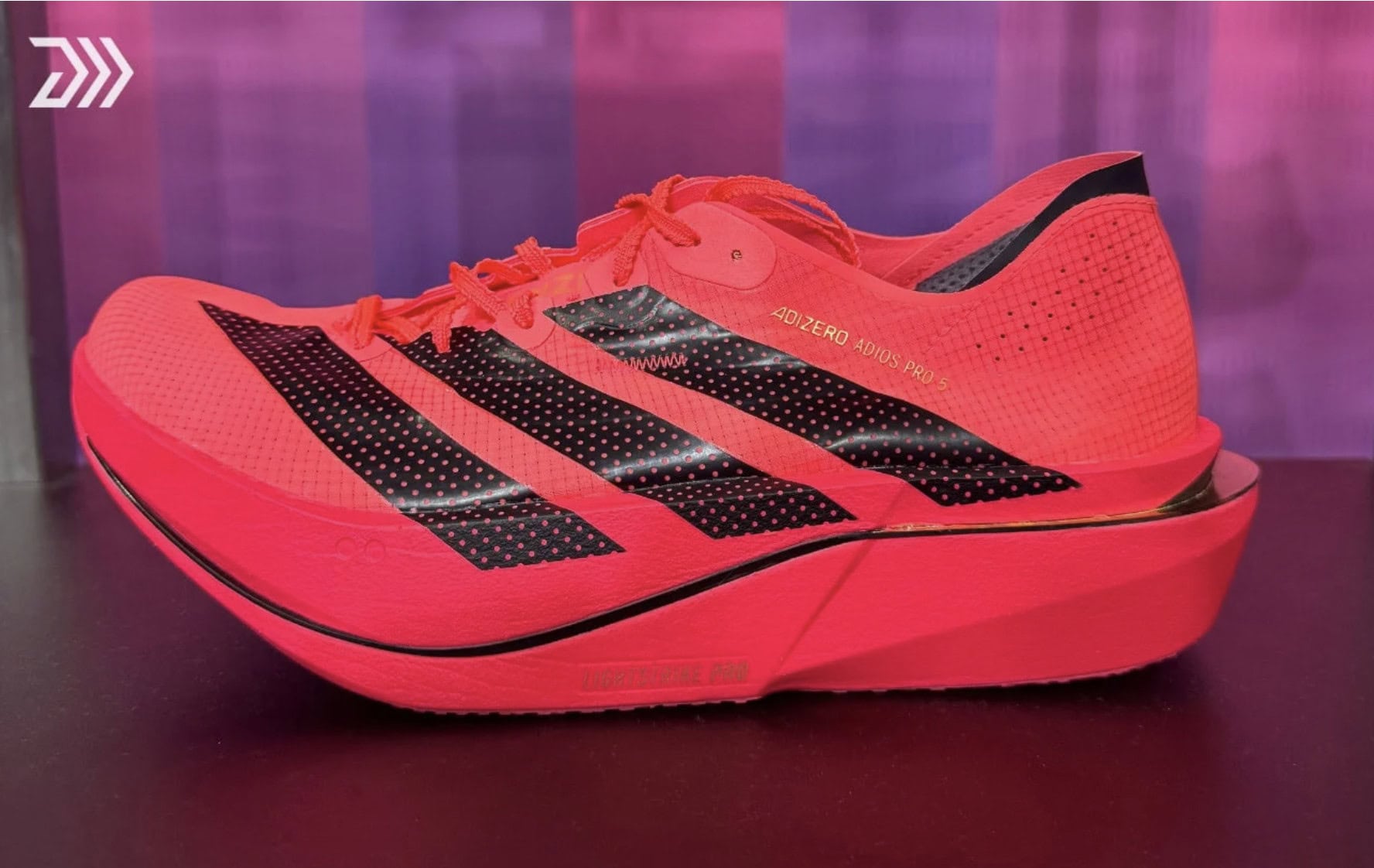
Then super shoes came along and clarified the matter, particularly Nike’s Zoom Vaporfly 4%, which actually incorporated running economy into the shoe name. The “4%” indicated that these shoes improved a runner’s economy (efficiency) by four percent.
Suddenly, runners wanted super shoes or any other device that might improve their running economy. A higher running economy allows you to run faster with lower oxygen consumption. It’s roughly analogous to a car that gets more miles per gallon.
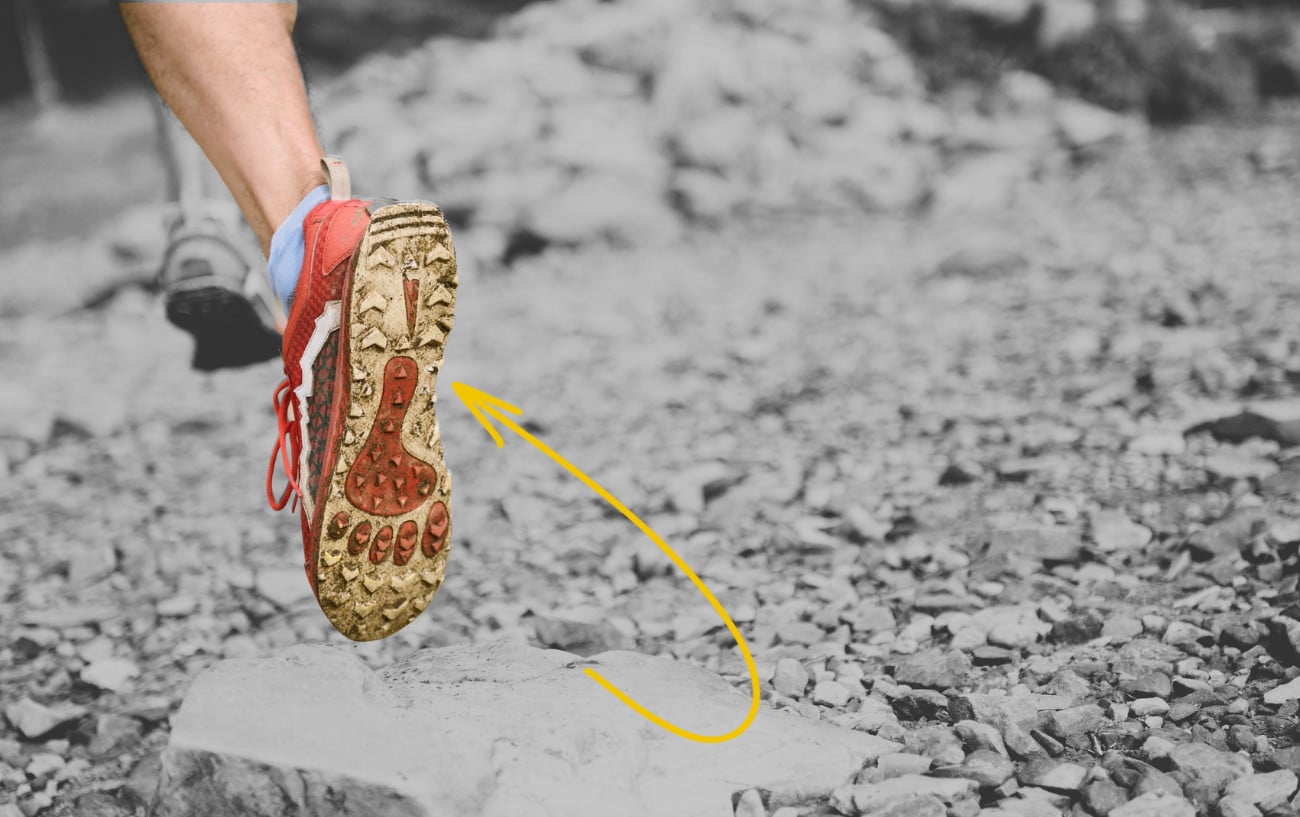
How Zero-Drop Running Shoes Improve Running Economy
Brady Holmer has already discussed one of the new Texas papers at MarathonHandbook.com, where he termed the experimental trial “clever.” It was also the first research to analyze how heel-toe drop affects running economy — good, bad, or ugly.
Researchers Kaleigh Renninger (now a Saucony employee) and Owen Beck concluded that zero-drop shoes are 1.6% more economical than shoes with a 20mm heel-toe drop. Why? Possibly because zero-drop shoes let the calf muscles operate at longer, more economical lengths, while trimming wasteful knee motion — so the same running costs less energy.
The zero-drop report also notes that certain exercises can help you develop your Achilles-gastroc length and power. Beck doesn’t mention any, but other running experts note that such exercises could include eccentric heel-drop strengthening exercises, and stretches (like inclined-board, and wall stretches) that lengthen your back-of-leg structures.
In a year-earlier paper, researcher Owen Beck completed another running-economy study. His findings were reported in the Journal of Experimental Biology (free, full text here).1Tang, H., & Beck, O. N. (2025). Wrapping the transverse foot arch improves running economy. Journal of Experimental Biology, 228(15). https://doi.org/10.1242/jeb.250566
Basically, Beck concluded that wrapping a runner’s transverse arches with readily available tape reduced “net metabolic power” by an average of 0.9% in 16 runners. This lower metabolic cost should translate into a better running economy. The tape stiffens the foot, which increases the efficiency of the ankles and lower-leg muscles.
The transverse arch curves across the bottom of the midfoot, from just behind the base of the big toe to just behind the base of the little toe.
Boost Your Running Economy At Practically No Cost
I consider this result particularly intriguing because you don’t have to spend $300 on new shoes. Instead, you’ve got a quick, dead-simple, low-risk running “hack:” Just wrap some inexpensive tape around your forefeet. Beck wrapped the transverse arches twice around.
Below, Owen Beck, Ph.D., answers questions about his work on running economy. He is an assistant professor in the Department of Kinesiology and Health Education at The University of Texas at Austin and director of the Human Locomotion Lab.
MH: Why do you think your experiment with low-drop shoes improved running economy?
OB: Primarily, we think that reducing heel-toe drop elicits better running economy by enabling calf muscles to operate at longer, more economical lengths. This confirmed an effect we found previously.2Beck, O. N., Trejo, L. H., Schroeder, J. N., Franz, J. R., & Sawicki, G. S. (2022). Shorter muscle fascicle operating lengths increase the metabolic cost of cyclic force production. Journal of Applied Physiology, 133(3), 524–533. https://doi.org/10.1152/japplphysiol.00720.2021 Also, a lower heel-toe drop reduces knee extensor moments, contributing to a lower metabolic cost.
MH: How did your conclusions compare with other similar studies?
OB: We aren’t aware of other studies that examined running economy in as wide a range of heel-toe drop conditions in the same shoe as we did. Other studies have evaluated biomechanics changes with different footwear conditions. One 2019 paper reported that running in a 4 mm heel-toe drop condition vs 8 & 12 mm heel-toe drop conditions yielded greater ankle moments and lower knee moments.3Richert, F. C., Stein, T., Ringhof, S., & Stetter, B. J. (2019). The effect of the heel-to-toe drop of standard running shoes on lower limb biomechanics. Footwear Science, 11(3), 161–170. https://doi.org/10.1080/19424280.2019.1630016
That’s consistent with our findings. Also studies in walking have found that higher-heel shoes increase the metabolic cost of walking, which is consistent with our results.
MH: Let’s be clear that this was not a super-shoe study, right? You studied shoes with conventional EVA midsoles. Why didn’t you use super shoes?
OB: No, we did not study super shoes. We wanted to vary just one independent variable (heel-toe drop) to gain mechanistic insight on how it affects running economy. In this case, we happened to inherit older, EVA shoes, all the same model, with systematic changes in heel-toe drop. This made them perfect to test our research questions.
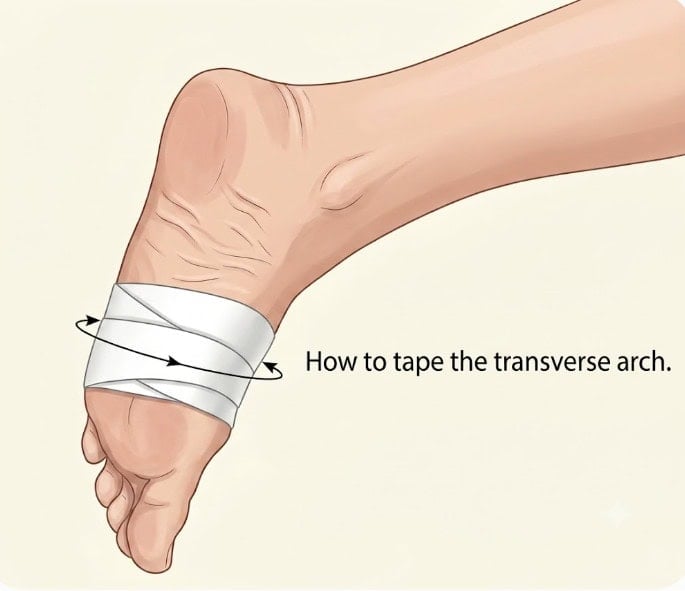
Tape It Over … Your Midfoot, That Is
MH: Do you think your results would be similar if you used super shoes with a plate and super foams?
OB: I think our results would be fairly consistent across footwear designs and running speed. Fundamentally, a lower heel-toe drop in super shoes would still place calf muscles at more economical positions and reduce the force required by knee extensor muscles.
MH: If zero-drop shoes are more economical, why haven’t elite athletes discovered this advantage? Most of the super shoes they race in have a 4 to 8mm drop.
OB: Great question. I’m not sure. Perhaps there’s a relatively small effect size in changing heel-toe drops between 0-10 mm. Worth noting: We added weight to our lower heel-toe shoes so all the shoes would weigh the same. But in the real world, a lower drop shoe would weigh less than a high-drop shoe, so the metabolic benefit would be greater, since every 100 gram increase in shoe weight increases metabolic cost by about 1 percent.
MH: Why does taping the transverse arch improve running economy? Would it be better to use a traditional, “stiff” athletic tape, or a more elastic tape?
OB: We think the arch wrap works like carbon fiber plates. Wrapping the forefoot increases the stiffness of the entire foot (including the medial longitudinal arch). During running, this increased foot stiffness enables the ankle to produce force using slower, more economical contractions.
In our study, we used an elastic self-adhesive wrap like Coban tape. I think tight elastic wrap is ideal for comfort reasons. In theory, stiffer athletic tape should work, but it might be too uncomfortable.
Use The Force To Improve Your Running
Running economy comes from efficient movement, starting at the foot and climbing the full length of the body. If your arms swing wildly, that’s wasteful. It’s also easy to see.
Other wasteful motions are not so readily apparent to the naked eye. For example, any side to side movements at the knee. Whether seen or not, they “leak” energy from your running.
Foot movements are the hardest to discern accurately. And yet forces developed (or not) at the foot, your only contact point with the ground, can strongly affect your running economy.
That’s why it’s worth checking out if zero- or low-drop shoes can improve your performance. The same holds true for taping your transverse arches.
Each may help your feet transmit and utilize force more efficiently, and thereby assist your running.
References
RunClub — Free
Join 300,000+ runners in RunClub
Free training plans for every distance, a daily running game, exclusive coaching content, and a real community of runners. Create your free account in 20 seconds — no card.
Already a member? Log in →








Join the conversation
That\'s interesting! I think I will try this. I tend to get a blister from a bunion and so maybe the tape would help prevent that as well! I just wonder how the tape will hold up in an ultra...
Sports Science? First we are told that the big heel toe drop and tip is integral to the minimal improvement most runners will get from super shoes and then we are told that if they take the tip away we will get quicker still. Just like run recover and always run slightly fatigued. I ran with a Japanese gentleman once in over 65 marathon and he virtually shuffled but very quickly short stride. I finished 3:37 but he was 15 minutes quicker.