


Runners are used to thinking about fuel in terms of totals.
How many calories did I eat? How many did I burn? Did I replace what the long run took out of me?
And of course, getting enough energy (calories) is important.
If too little energy remains after training, the body begins cutting costs. Processes essential for immediate survival take priority, while longer-term investments such as growth, reproduction, and bone remodeling may receive less. This is the physiology underlying low energy availability and Relative Energy Deficiency in Sport, or REDs.
But calorie balance may not tell the whole story.
When runners eat less than their training demands, they often consume less carbohydrate at the same time. Sometimes that is intentional. More often it happens quietly as mileage rises, appetite or meal planning fails to keep pace, and a diet that looked adequate during an easy week becomes inadequate during a high-volume one.
That creates two shortages at once. There is an energy shortage, and there may also be a carbohydrate shortage.
A new study asks whether the body can tell the difference.

Energy availability is the energy left for the rest of the body after the energetic cost of exercise has been subtracted:
Energy availability = (energy intake − exercise energy expenditure) ÷ fat-free mass
Imagine a runner with 60 kilograms of fat-free mass who eats 2,500 calories and expends 1,000 calories during training. Their energy availability is 25 calories per kilogram of fat-free mass per day—a level low enough to produce measurable physiological changes within days.
The important point is that low energy availability does not necessarily mean someone is eating very little. A runner can consume what looks like a substantial amount of food and still end the day with too little energy available because the training bill is so large.
Carbohydrate availability is a separate calculation:
Carbohydrate availability = carbohydrate intake − carbohydrate used (oxidized) during exercise
Two runners can therefore finish a day with the same energy availability but very different carbohydrate availability. One may replace most of the carbohydrate used during a long workout. The other may consume the same number of calories but obtain more of them from fat. Their energy budgets match, but their carbohydrate budgets do not.
Carbohydrates support moderate- and high-intensity exercise, but their role is not limited to just fuel. Carbohydrate availability also interacts with endocrine signals involved in growth, tissue repair, appetite regulation, bone health, and metabolism.
So when several hormones fall during low energy availability, how much of that response comes from the calorie deficit itself—and how much comes from low carbohydrate layered on top of it?
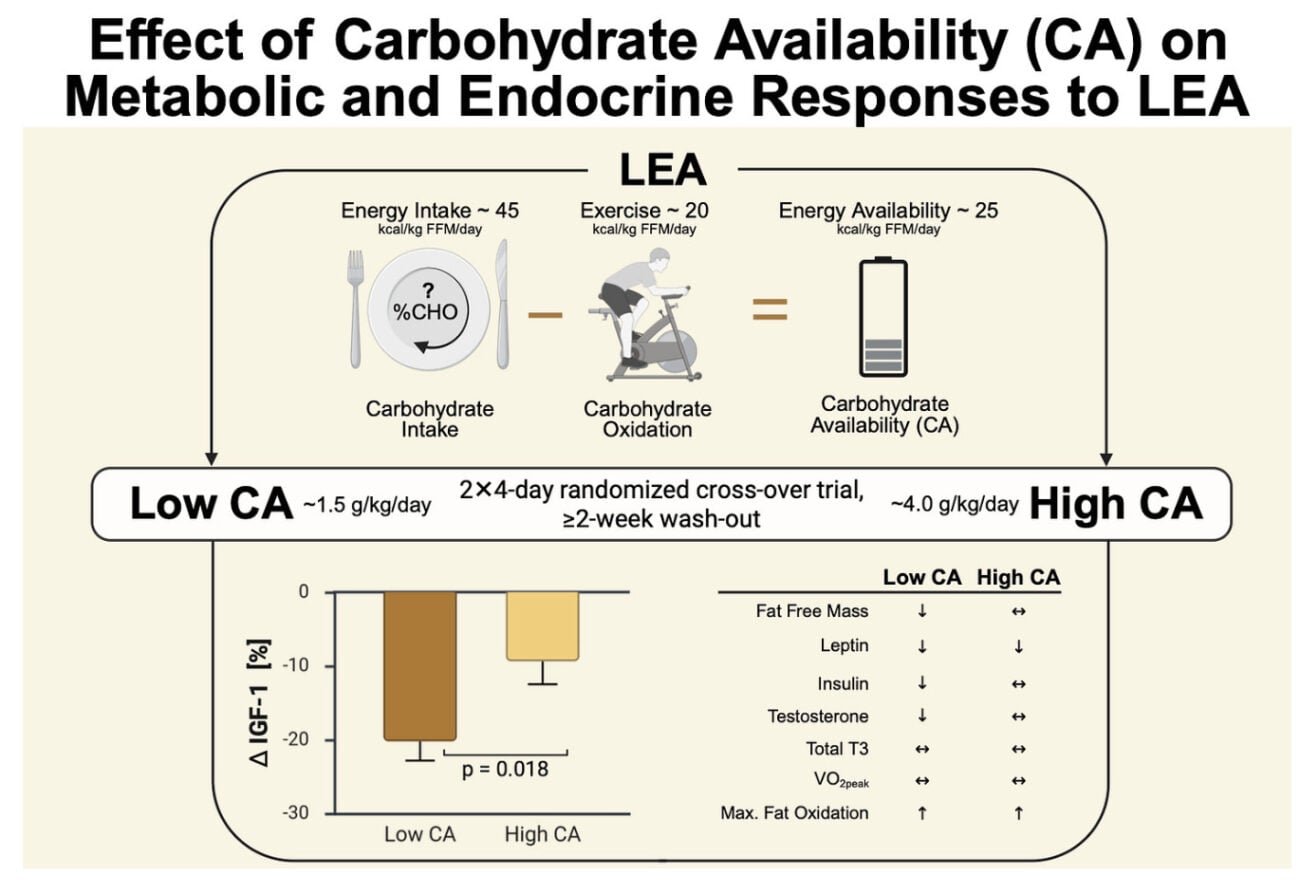
Separating calories from carbohydrates
The new randomized crossover study recruited 16 young, recreationally active adults: nine women and seven men.1Nusser, V., Teubner, J., Buerger, S. A., Frodl, A., Rainsberger, K., Braunsperger, A., Wasserfurth, P., Hackney, A. C., & Koehler, K. (2026). Increased Carbohydrate Availability Partially Attenuates Endocrine Suppression in Response to Low Energy Availability. Journal of Applied Physiology. https://doi.org/10.1152/japplphysiol.00207.2026
Each participant completed two four-day periods of low energy availability. In both conditions, energy availability was held at about 25 calories per kilogram of fat-free mass per day. Participants ate roughly 2,600 calories but also completed enough stationary cycling at 60% of peak oxygen uptake to expend around 1,150 calories—or approximately two hours of exercise—each day.
The calorie shortage was essentially the same in both trials. The carbohydrate remaining after exercise was not.
- In the lower-carbohydrate-availability condition, participants consumed 4.2 grams of carbohydrate per kilogram of body mass per day. About 1.4 grams per kilogram per day remained after exercise.
- In the higher-carbohydrate-availability condition, participants consumed 6.7 grams per kilogram per day. About 3.7 grams per kilogram per day remained after exercise.
Notice that 4.2 grams per kilogram per day does not sound like an especially low-carbohydrate diet. It became low relative to the workload. Nearly two hours of cycling every day changed the meaning of the number.
Energy and protein intake were closely matched. To raise carbohydrate without raising total calories, the researchers reduced fat: carbohydrate supplied 46% of energy in the lower-carbohydrate condition and 73% in the higher-carbohydrate condition, while fat supplied 37% and 11%, respectively.
Before and after each trial, the researchers measured body composition, resting metabolism, fasting hormones, fuel use, blood lactate, peak oxygen uptake, and maximal cycling power.
- Both conditions produced nearly identical body-mass losses of about 1 kilogram, or 2.2 pounds, across four days. Resting metabolic rate did not change.
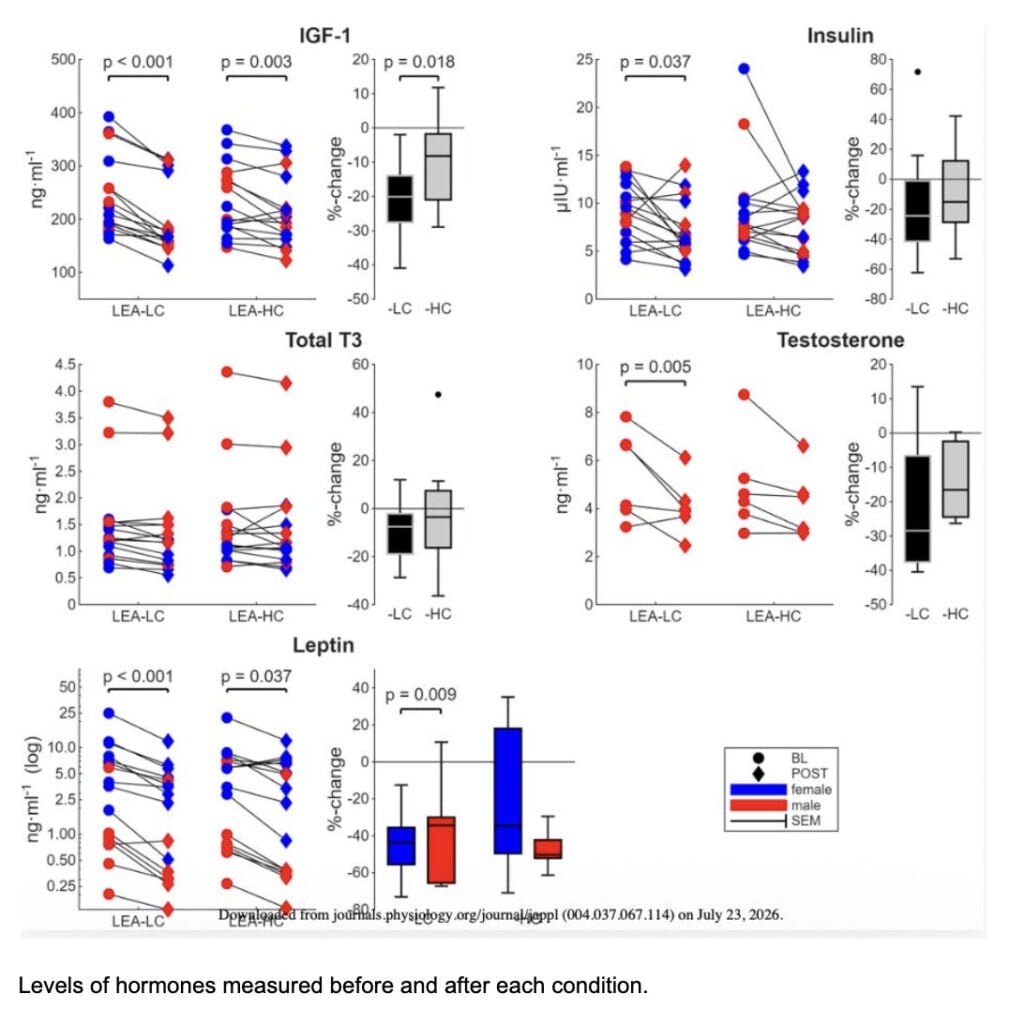
- The most convincing difference appeared in insulin-like growth factor 1, or IGF-1, a hormone involved in growth and tissue repair. IGF-1 fell by 20.2% when carbohydrate availability was lower, compared with 9.4% when it was higher.
In other words, preserving more carbohydrate cut the decline roughly in half. It did not prevent it. IGF-1 still fell despite the higher-carbohydrate diet because the participants were still under-fueled.
Several other hormones appeared to tell a similar story at first glance.
- Insulin and testosterone declined significantly during the lower-carbohydrate condition but not during the higher-carbohydrate condition
- Leptin (a hormone involved in appetite regulation) appeared to fall less in women when more carbohydrate was available.
A “better” lactate curve that probably wasn’t better
The exercise data contain another finding runners should notice.
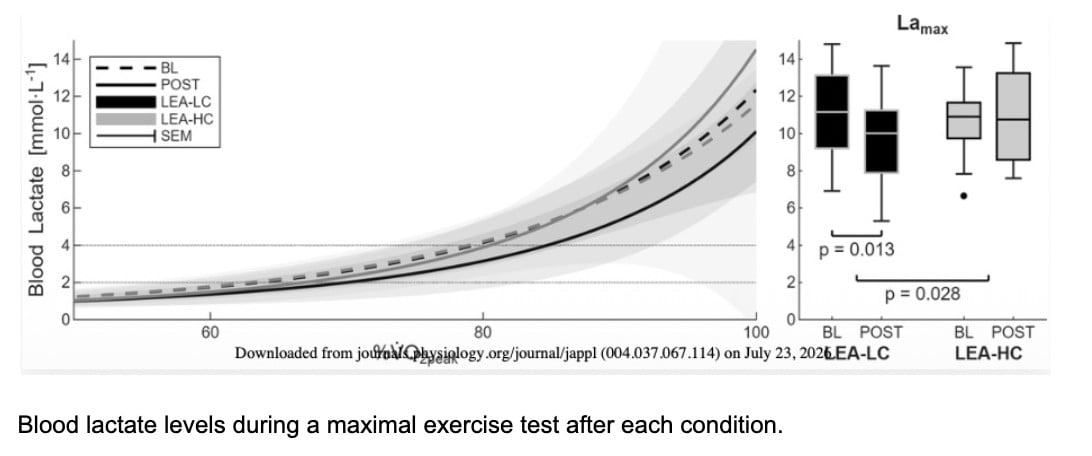
After the lower-carbohydrate trial, maximal blood lactate during a maximal exercise test fell by 1.2 millimoles per liter. It was essentially unchanged after the higher-carbohydrate trial. The lactate curve also shifted to the right only when carbohydrate availability was lower.
At first glance, we might interpret a given lactate concentration occurring at a higher percentage of peak oxygen uptake as an improved lactate threshold.
That is almost certainly the wrong lesson after four days of under-fueling.
The lower maximal lactate concentration is more consistent with a reduced ability to use carbohydrate rapidly and generate lactate during hard exercise. Higher carbohydrate availability appeared to preserve more of that glycolytic contribution. The curve looked different, but not because four days of low energy availability produced a sudden fitness breakthrough.
This is also a useful reminder for runners who undergo lactate testing. A lactate curve is partly a reflection of the athlete and partly a reflection of the conditions under which the athlete arrives. Recent training and carbohydrate availability can change what the test appears to say.
Still, the physiological difference did not translate into a measurable performance difference here. Peak oxygen uptake and maximal cycling power were unchanged in both conditions.
Low energy availability also shifted participants toward greater fat use at rest and during submaximal exercise. Keeping carbohydrate availability higher did not clearly prevent that shift. The energy deficit was still exerting a strong metabolic effect even when more carbohydrate remained available.
What this means for runners
This was a small, short study in recreationally active adults, not a training study in runners. The exercise mode was cycling, the intervention lasted only four days, and the performance outcomes were peak oxygen uptake and maximal cycling power rather than time-trial or race performance.
Most importantly, a four-day change in fasting IGF-1 is not the same thing as a clinical outcome.
This study cannot tell us whether preserving carbohydrate prevents menstrual disturbances, impaired bone health, recurrent injury, illness, or declining performance during chronic low energy availability. Nor did it test carbohydrate timing around exercise. Those are longer-term questions that require studies in athletes.
The result is best understood as an acute physiological signal: the macronutrients inside a calorie deficit are not interchangeable, but carbohydrate cannot erase the deficit itself.
But that doesn’t mean the findings aren’t useful.
The first lesson is that carbohydrate needs must be interpreted relative to training.
A fixed intake can be adequate on a recovery day and inadequate during a long run, double-session day, or high-mileage block. The lower-carbohydrate condition in this study still provided 4.2 grams per kilogram per day. It became low because participants were exercising for nearly two hours daily. That is a level many of you reading might normally engage in.
The useful question here is not simply, “Do I eat a lot of carbohydrates?”
It is, “Do I eat enough carbohydrate for the work I am asking my body to do?”
Second, protecting carbohydrate may be valuable when a short-term energy mismatch is difficult to avoid.
During a sudden increase in mileage, a training camp, travel, or a few demanding days when total intake has not caught up, preserving carbohydrate across the highest-demand days is a reasonable priority. Timing carbohydrate around key workouts may also make practical sense, although this study did not test timing.
Third, carbs are not a cure.
Higher carbohydrate availability softened the decline in IGF-1 and preserved blood lactate responses, but body mass still fell, IGF-1 still declined, and whole-body fuel use still shifted. The participants remained in low energy availability.
Runners often want nutrition problems to have a single-variable solution: more calories, more carbohydrates, better timing. Physiology is less tidy. Total energy determines how much remains for the body after training. Carbohydrate availability helps determine which fuel remains ready for the work and may shape some of the signals produced by that shortage.
If you cannot immediately correct a brief mismatch between intake and training, protecting carbohydrate is probably worthwhile. But the best solution to low energy availability is still to restore energy availability by eating enough to support the work you are doing.
References
RunClub — Free
Join 300,000+ runners in RunClub
Free training plans for every distance, a daily running game, exclusive coaching content, and a real community of runners. Create your free account in 20 seconds — no card.
Already a member? Log in →












Start the conversation