


Vitamin D is usually discussed in runner circles through the lens of bone health, immune function, and maybe muscle function. A new study looked at a different angle: whether vitamin D status is associated with a more or less favorable lipid profile among elite athletes.1 (2026). Mdpi.Com. https://www.mdpi.com/2072-6643/18/12/2013

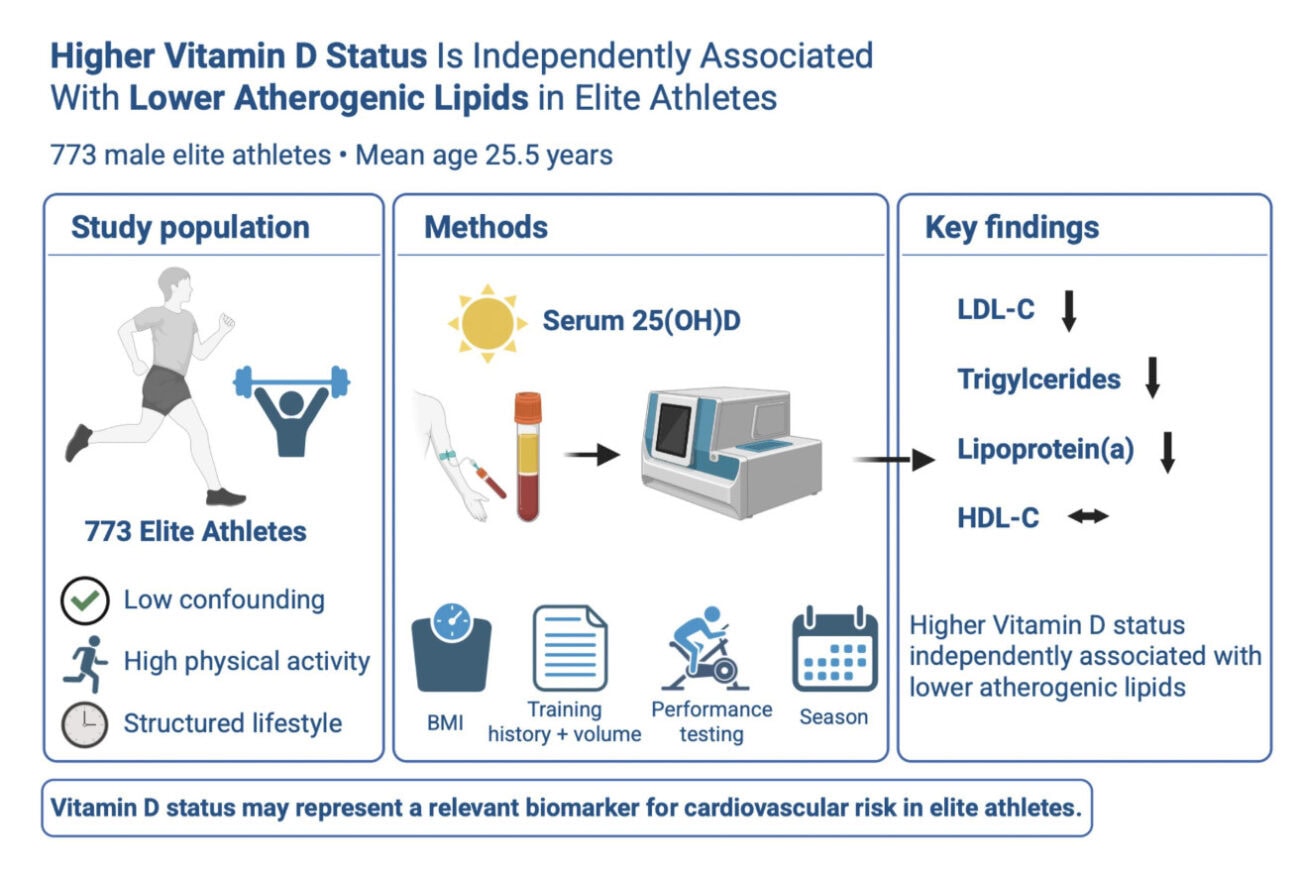
The researchers analyzed 773 male professional athletes from German team sports, including handball, basketball, ice hockey, and soccer. The athletes were young, healthy, highly trained, and not taking regular medications. They also weren’t runners, but I still think we can learn something here.
They measured serum 25-hydroxyvitamin D and lipid markers, including LDL cholesterol, HDL cholesterol, triglycerides, and lipoprotein(a).
- Athletes with vitamin D levels at or above 30 ng/mL had lower LDL cholesterol than those below 30 ng/mL: 95 vs. 101 mg/dL.
- They also had lower triglycerides: 96 vs. 105 mg/dL.
- Lipoprotein(a) also differed, with lower values in the vitamin D-sufficient group.
- Athletes with sufficient vitamin D also had higher peak exercise performance during a cycling test: 4.29 vs. 3.36 Watts per kilogram.
This was cross-sectional. It does not prove that vitamin D lowered LDL, triglycerides, or lipoprotein(a), and it definitely does not prove that taking vitamin D will improve cycling watts per kilogram.
Higher vitamin D may be a marker of other things: more outdoor training, better nutrition, seasonal timing, healthier overall physiology, or sport-specific differences. The authors adjusted for a lot, but observational data cannot fully solve this.
What this means for runners
I would not read this as a reason to megadose vitamin D to chase lower LDL or Lp(a). That is not what the study tested. But I would read it as another reason to know your vitamin D status, especially if you train indoors, live far from the equator, avoid sun exposure, have a history of stress injuries, or get bloodwork showing low levels in winter. For runners, vitamin D remains most relevant for bone and general health. Any lipid connection is interesting, but for now it is a signal to monitor rather than a treatment strategy.
References
RunClub — Free
Join 300,000+ runners in RunClub
Free training plans for every distance, a daily running game, exclusive coaching content, and a real community of runners. Create your free account in 20 seconds — no card.
Already a member? Log in →











Start the conversation