


Hoka vs Brooks is one of the biggest rivalries in running shoes right now — and if you’re trying to choose between these two brands, the Bondi 9 and Ghost 16 are likely on your shortlist. The Hoka Bondi is the brand’s max-cushion icon; the Brooks Ghost is the industry’s best-selling running shoe. Both are beloved, but they run very differently.
Here’s the short version: the Hoka Bondi 9 offers dramatically more cushioning with a rocker-assisted ride, while the Brooks Ghost 16 is lighter, more versatile, and better for runners who want to occasionally pick up the pace.
The Honest Truth: Bondi vs Ghost Is About Cushioning Philosophy
Hoka Bondi and Brooks Ghost get compared often because they both market as cushioned daily trainers — but they’re built around fundamentally different philosophies. Bondi maximises stack and rocker; Ghost optimises for versatility at a lower stack. The biomechanics literature gives a sharper buying signal than spec-sheet comparisons.
1. Stack height — 39 mm vs 35 mm changes everything
The Bondi 9 sits at roughly 39 mm under the heel; the Ghost 16 around 35 mm. Lab work on midsole thickness shows that taller stacks reduce peak vertical loading rates and shift force distribution distally — toward calf and forefoot — while lower stacks preserve more proprioceptive feedback1Chambon N, Delattre N, Guéguen N, et al. Is midsole thickness a relevant parameter to control running shoe comfort? Footwear Science. 2014;6(1):S3–S5.. The Bondi’s extra 4 mm and aggressive Meta-Rocker reduce ankle range of motion at toe-off, which is friendlier on Achilles and calf complaints but takes more push-off feedback away than the Ghost’s flatter platform.
2. Rocker vs flat last — different muscle recruitment
EMG studies on rocker shoes consistently find meaningfully less calf-soleus activation during push-off compared with flatter-lasted shoes2Sobhani S, van den Heuvel ER, Bredeweg SW, et al. Effect of rocker shoes on plantar pressure pattern in healthy female runners. Gait & Posture. 2014;39(3):920–925.. So if you’re managing recurrent Achilles or calf flare-ups, the Bondi rocker is friendlier; if those tissues are healthy and you want to actively load them, the Ghost is the better stimulus. Neither is universally better — they suit different injury histories.
3. Foam: EVA blend vs nitrogen-infused EVA
The Bondi 9 uses a soft EVA blend tuned for impact protection; the Ghost 16 uses Brooks’s nitrogen-infused DNA Loft v3, which feels softer underfoot but rebounds slightly more. Energy-return measurements show DNA Loft v3 returning a small but consistent bit more energy per stride than the Bondi’s foam3Worobets J, Wannop JW, Tomaras EK, Stefanyshyn DJ. Softer and more resilient running shoe cushioning properties enhance running economy. Footwear Science. 2014;6(3):147–153.. So at marathon pace and faster, the Ghost is the more economical platform; the Bondi’s foam advantage is in absolute impact protection, not propulsion.
4. Weight gap is meaningful at faster paces
The Bondi 9 weighs around 10.4 oz; the Ghost 16 around 9.0 oz (men’s 9). The roughly 1% economy cost per 100 g of added shoe mass means the Bondi is roughly 0.5–0.7% less efficient than the Ghost at threshold pace4Hoogkamer W, Kipp S, Frank JH, et al. A comparison of the energetic cost of running in marathon racing shoes. Sports Medicine. 2018;48(4):1009–1019.. Small for easy mileage; meaningful for tempo days. So if you run mostly easy and want max plush, Bondi; if you want a more versatile single-shoe pick that can handle some speed work, Ghost.
5. Last shape — both wider than industry average
Both Hoka and Brooks daily trainers tend to use wider forefoot lasts than ASICS or Nike equivalents. Restricted toe-splay during loading is associated with progressive bunion and metatarsalgia risk, so the wider last is well-suited to runners with naturally wide forefoot or a history of pinky-toe rubbing5Goldmann JP, Sanno M, Willwacher S, Heinrich K, Brüggemann GP. The potential of toe flexor muscles to enhance performance. Journal of Sports Sciences. 2013;31(4):424–433.. Both ship in genuine wide-fit SKUs — use those rather than sizing up if you need more forefoot volume.
6. The clean rotation answer
If you can only own one, the Ghost 16 is the more versatile pick — light enough for tempo work, cushioned enough for daily mileage. The Bondi 9 earns its keep as the second shoe in a rotation: long runs, recovery days, post-race shakeouts, and the days your legs need maximum impact protection. Owning both rather than picking one is supported by the literature on multi-shoe rotations and injury reduction. If you’re still mapping picks to a goal race, the best marathon running shoes guide works through the model-level picks across both brands.
Hoka Bondi vs Brooks Ghost: Quick Verdict
Choose the Hoka Bondi 9 if maximum cushioning is your top priority. It’s built for runners who want the most impact protection possible — heavier runners, those with joint issues, or anyone who prioritizes comfort above all else on easy runs.
Choose the Brooks Ghost 16 if you want a balanced daily trainer that works across a range of paces and distances. The Ghost is the safer, more versatile pick for most runners — especially if it’s your only training shoe.
Key Specs Compared
| Spec | Hoka Bondi 9 | Brooks Ghost 16 |
|---|---|---|
| Weight (Men’s) | 10.8 oz / 306g | 9.9 oz / 280g |
| Heel-Toe Drop | 4mm | 12mm |
| Stack Height | 38mm / 34mm | 35mm / 23mm |
| Midsole | Compression-molded EVA | DNA LOFT v2 |
| Rocker Geometry | Yes (Meta-Rocker) | No |
| Best For | Max cushion, easy runs | All-purpose daily training |
| Price | $165 | $140 |
Cushioning: Bondi Wins (By A Lot)
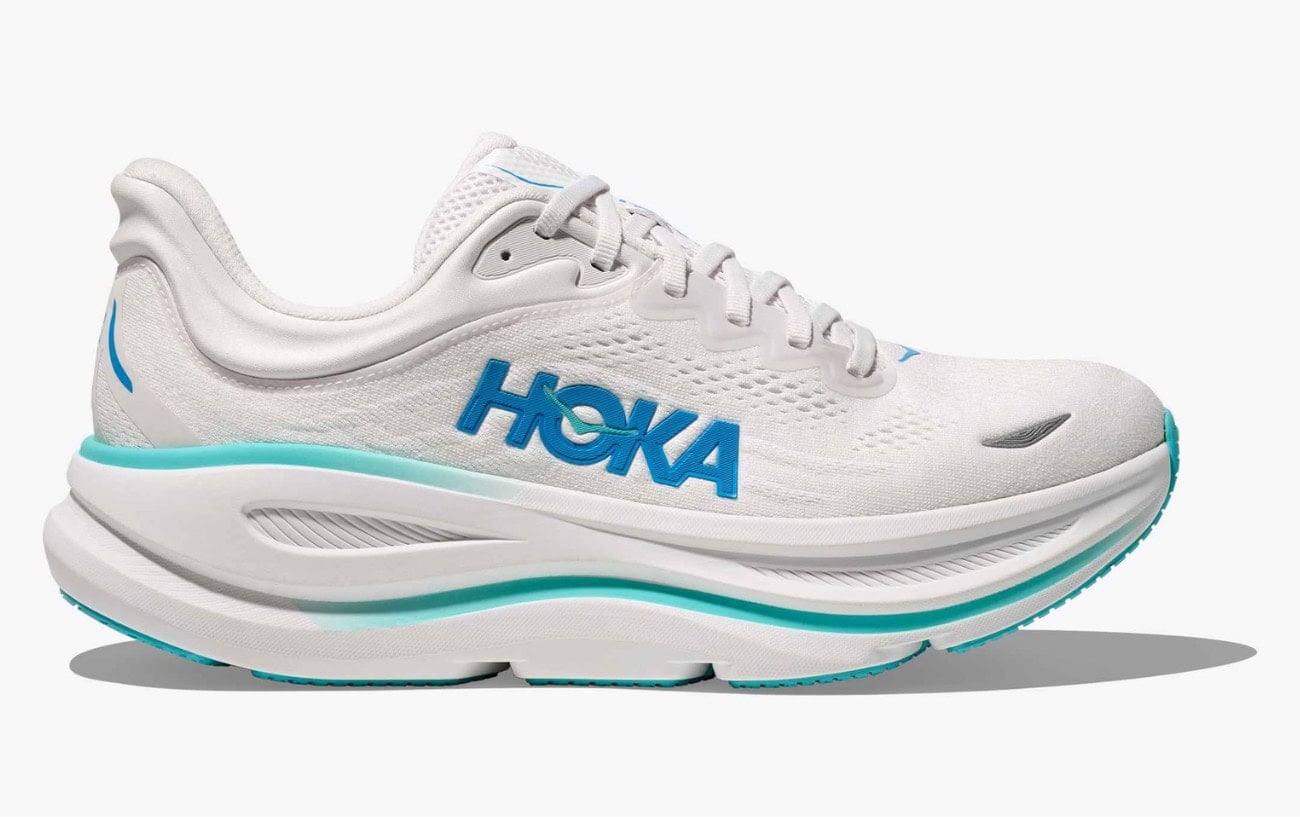
The Bondi 9’s stack height of 38mm at the heel dwarfs the Ghost’s 35mm — but the numbers don’t tell the full story. The Bondi uses softer foam and Hoka’s distinctive rocker geometry, which together create a marshmallow-soft, rolling ride that’s completely different from anything Brooks makes.
The Ghost 16 uses Brooks’ DNA LOFT v2, which is cushioned but noticeably firmer. It absorbs impact well without the same sink-into-it softness. Many runners actually prefer this — softer isn’t always better if you want feedback from the road.
Ride Feel: Completely Different
This is where brand philosophy really shows up. The Bondi’s Meta-Rocker design means the shoe is curved from heel to toe, creating a rolling motion that propels you forward. The low 4mm drop puts you in a flatter foot position. It feels like running on a curved board — smooth, effortless, almost automatic at easy pace.
The Ghost has a traditional 12mm heel-toe drop and no rocker. It feels more conventional — heel strikes land on a cushioned platform, and you push off the forefoot with your own power. Runners coming from other traditional shoes will find the Ghost immediately familiar; the Bondi takes some adjustment.

Versatility: Ghost Wins
The Ghost 16 comfortably handles everything from recovery jogs to moderate tempo efforts. Its firmer platform provides enough energy return for faster running without feeling sloppy. It’s a true daily trainer that can serve as your only running shoe if needed.
The Bondi is really a one-pace shoe. Try to run fast in it and the soft foam absorbs your energy instead of returning it. The rocker helps somewhat, but this is a shoe for easy and moderate running only. It excels in its lane but can’t venture outside it.
Weight: Ghost Wins
The Ghost 16 at 9.9 oz is nearly a full ounce lighter than the Bondi 9 at 10.8 oz. Combined with its more responsive platform, the Ghost feels meaningfully more nimble and athletic on foot.
Price: Ghost Wins
At $140, the Ghost 16 is $25 cheaper than the $165 Bondi 9. For the more versatile shoe at a better price, the Ghost represents considerably better value.
Durability: Ghost Outlasts the Bondi
The Ghost is the more durable shoe, typically lasting 400-500 miles compared to the Bondi’s 300-400. Brooks DNA LOFT foam resists compression better than Hoka’s softer PEBA-based midsole, which means the Ghost maintains its ride character longer. Both shoes use quality rubber outsoles, but the Ghost’s firmer compound holds up better on abrasive pavement. For high-mileage runners, this durability difference translates to meaningful cost savings over time.
Fit and Upper: Different Philosophies
Hoka and Brooks take different approaches to fit. The Bondi has a wider platform with more volume in the toe box, accommodating wider feet comfortably. The Ghost has a more traditional fit that hugs the midfoot and heel, providing a locked-down feel. The Ghost’s engineered mesh upper is more breathable, while the Bondi’s padded collar provides a plusher step-in feel. Both come in multiple width options, which is appreciated by runners who struggle with standard sizing.
Best For Different Runners
The Bondi is the better choice for runners who prioritize maximum cushioning above all else — especially heavier runners, those with joint issues, or anyone who wants their easy runs to feel effortless. The Ghost is the better all-around daily trainer, handling everything from recovery jogs to moderate tempo efforts with ease. If you run most of your miles at an easy pace and want a cloud-like ride, go Bondi. If you want one shoe that adapts to whatever your training plan demands, go Ghost.
Price Comparison
The Bondi costs roughly $15-20 more than the Ghost at retail. Combined with the Ghost’s better durability, the Ghost offers significantly more value per dollar. However, both shoes frequently go on sale in previous-season colorways, narrowing the price gap.
FAQs
Is Hoka Bondi or Brooks Ghost better for walking?
The Bondi is generally better for walking due to its maximum cushioning and rocker geometry that promotes a smooth heel-to-toe transition. The Ghost works well for walking too, but the Bondi is specifically popular in the walking community.
Are Hoka Bondi and Brooks Ghost good for heavy runners?
Both are good options for heavier runners, but the Bondi provides more cushioning and impact protection. The Ghost offers a more moderate level of cushioning with better responsiveness. Runners over 200 lbs often prefer the Bondi.
Can you run fast in Hoka Bondi or Brooks Ghost?
The Ghost handles faster paces much better than the Bondi. The Bondi feels sluggish above tempo pace due to its weight and maximal cushioning. For speed work, the Ghost is the clear winner, though neither is a true speed shoe.
Do Hoka Bondi and Brooks Ghost come in wide sizes?
Yes, both shoes are available in wide (D for women, 2E for men) and extra-wide (2E for women, 4E for men) options. Hoka also tends to run slightly wider in standard sizing than Brooks.
Which is better for standing all day: Bondi or Ghost?
The Bondi is the better choice for all-day standing due to its superior cushioning and wider platform. Many healthcare workers and professionals who spend long hours on their feet choose the Bondi specifically for this purpose.
The Bottom Line
The Brooks Ghost 16 is the smarter choice for most runners. It’s lighter, cheaper, and far more versatile. The Hoka Bondi 9 is a specialist — an incredible easy-day shoe with unmatched cushioning, but limited beyond that. If you want one shoe for everything, go Ghost. If you want the plushest ride possible for easy runs and can pair it with something faster for workouts, the Bondi is hard to beat at what it does.
Shop The Hoka Bondi 9
Shop The Brooks Ghost 16
More Shoe Roundups From Marathon Handbook
- Best Hoka Running Shoes
- Best Running Shoes for Beginners
- Best Daily Running Shoes
- Best Running Shoes Reviewed
More Shoe Comparisons From Marathon Handbook
- Hoka Clifton vs Bondi
- Brooks Glycerin vs Ghost
- Nike Vomero vs Pegasus
- ASICS Gel Nimbus vs Kayano
- Brooks Ghost vs Nike Pegasus
- Hoka Clifton vs Brooks Ghost
- New Balance 1080 vs Brooks Glycerin
- Hoka Clifton vs Nike Pegasus
- ASICS Gel Nimbus vs Brooks Glycerin
- Brooks Glycerin vs Hoka Bondi
- New Balance 1080 vs Hoka Clifton
- Brooks Ghost vs ASICS Gel Nimbus
References
RunClub — Free
Join 300,000+ runners in RunClub
Free training plans for every distance, a daily running game, exclusive coaching content, and a real community of runners. Create your free account in 20 seconds — no card.
Already a member? Log in →







Start the conversation