


The question hanging over Josh Kerr’s 3:42.66 is how long it survives, and the evidence points one way: nowhere near 27 years. The old record’s longevity was built on conditions that no longer exist, and when those conditions change, middle-distance records have a documented habit of falling in bunches.
The founding case, the one that gives the Bannister effect its name, is 1954. The romantic version says Roger Bannister broke a psychological barrier on May 6 and belief did the rest: John Landy ran 3:58.0 just 46 days later, and per the ratified progression, a record that had sat untouched at 4:01.4 for nine years then fell four more times in four years, reaching Herb Elliott’s 3:54.5 by 1958.
The skeptical version, argued at length at Science of Running, holds that the nine barren years were mostly World War II: Gunder Hagg and Arne Andersson traded records in neutral Sweden, were banned for professionalism in 1945, and the rest of the world’s milers spent the 1940s otherwise occupied. The readings disagree about the mind and agree about the pattern. Long stagnations end in clusters, because whatever ended the stagnation, war’s end or belief, applies to everyone at once.

That pattern is the threat to 3:42.66, because Saturday’s race published its method in full. The pacing architecture, the Wavelight settings, the spike, the sanctioned-spectacle model Michael Doyle described before the race, and the even-split blueprint are now available to every federation, brand, and agent in the sport. The recent record book already behaves this way. Yared Nuguse’s world indoor mile record at the 2025 Millrose Games lasted five days before Jakob Ingebrigtsen took it. The two-hour marathon barrier, once it finally fell in a legal race in April, fell for two men in the same morning.
The Queue Behind 3:42.66
The chasers are real, and young. Ingebrigtsen’s 3:43.73 from 2023 made him the only man in 27 years to get within a second of El Guerrouj; he has been sidelined since February Achilles surgery, a procedure with a recovery that typically runs close to a year. Nuguse, at 3:43.97, now sits closer to the new record than most of history got to the old one. Cole Hocker, the Olympic 1,500m champion, set the American indoor mile record of 3:45.94 in February. Cameron Myers, who is 20, won this year’s Bowerman Mile in an Australian record of 3:46.06. Niels Laros beat Nuguse by a hundredth at the 2025 edition. Sam Ruthe broke four minutes at 15. Set against the all-time list, this is the deepest mile generation since Coe, Ovett, and Cram were trading the record in the early 1980s.
The honest counterweight: in the 27 years the old record stood, exactly three men broke 3:45, and on Saturday a flawless production moved exactly one man under the old mark while six ran personal bests well short of it. The method spreads faster than the physiology. A repeat of 1954’s five-seconds-in-four-years is fantasy; 3:42.66 surviving to 2053 is a bigger one. The realistic version of a new Bannister effect is measured in single-digit years, and it shortens sharply the day Ingebrigtsen returns whole.

The Stretch Case for a Women’s Four-Minute Mile
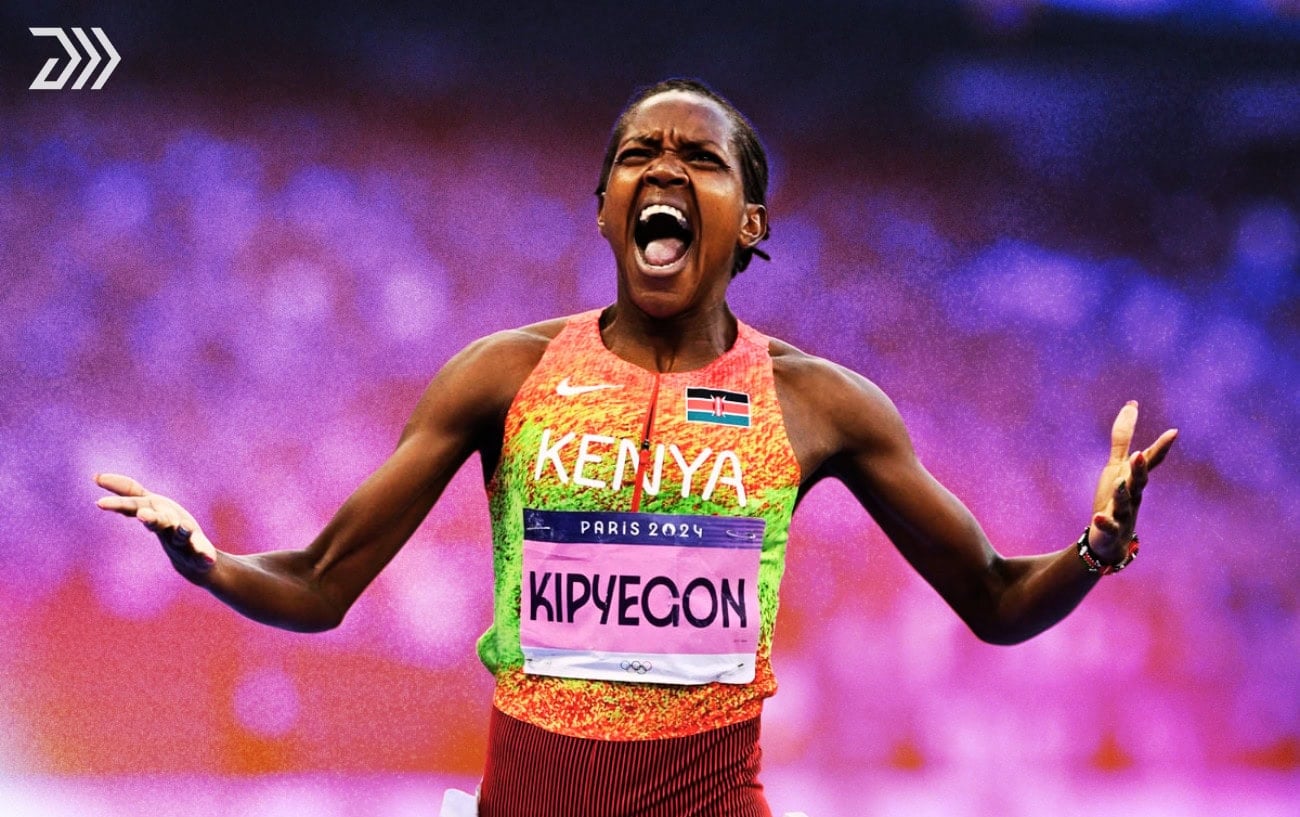
The outer edge of the argument belongs to the women’s mile, and it should be labeled plainly as speculation. Faith Kipyegon’s official record is 4:07.64. Her engineered 4:06.42 in Paris did not count. But a February 2025 study in Royal Society Open Science modeled what optimal drafting, one pacer ahead and one behind for the full race, could be worth to her, and arrived at 3:59.37, Bannister’s own time to the hundredth. What Kipyegon lacked in Paris was legality; Kerr just published the template for running an engineered attempt inside the rules. What she still lacks is what he had in Nuguse. The second-fastest woman in history, Sifan Hassan, is more than four seconds back at 4:12.33; the men’s record fell with a rival on the leader’s shoulder, and Kipyegon does not yet have one within range.
El Guerrouj’s mark waited 27 years for the sport to assemble the tools, the money, and the field to challenge it. All three now exist and are documented in public. The first serious examination even has an approximate date: Ingebrigtsen’s recovery from February surgery points at a return in 2027, and Nuguse has already run closer to the new record than anyone else alive.
RunClub
Get more running stories — join RunClub
Daily running news, a community of 300,000+ runners, free training plans for every distance, and a daily running game. Free to join — no card.
Already a member? Log in →








Join the conversation
The new record - and those to follow - should be noted with asterisks. Modern technology and scientific aids have made it possible after 27 years. Shoes designed just for this runner and his pace? Improved track surfaces? More aerodynamic running suit? How is that an apples to apples comparison to the real record set 27 years ago?
Seems like a hollow victory.
but it has been forever thus. The running spikes Bannister used would likely have looked different to those in the 1930s. The cinder track at Iffley road was a dedicated athletics track when earlier records may have been on grass venues or those used for other sports.
Should there be asterisk if they use pacemakers.. other sports don\'t allow drafting whereas in both Bannisters and Kerr\'s record there was, I could argue a 3.59 with no pacemakers should be the real record.
sport has always gone hand in hand with tech and science innovation. Governing bodies have to be careful (see swimming super suits) in treading the line but I don\'t see how the shoes are a much bigger innovation than that of lycra and lightweight clothing and definitely less than the impact of prize money and professionalism. There are big jumps when these things come in and then it all settles down a bit.