


The Cloudmonster and the Gel Nimbus are the most cushioned daily trainers from On and ASICS — both stack 35–42 mm of foam and market themselves as max-cushion daily workhorses. They’re built around different cushioning technologies (CloudTec pods vs FF Blast+ Eco with Gel) and reward different gaits in different ways.
Cloudmonster vs Nimbus: Quick Verdict
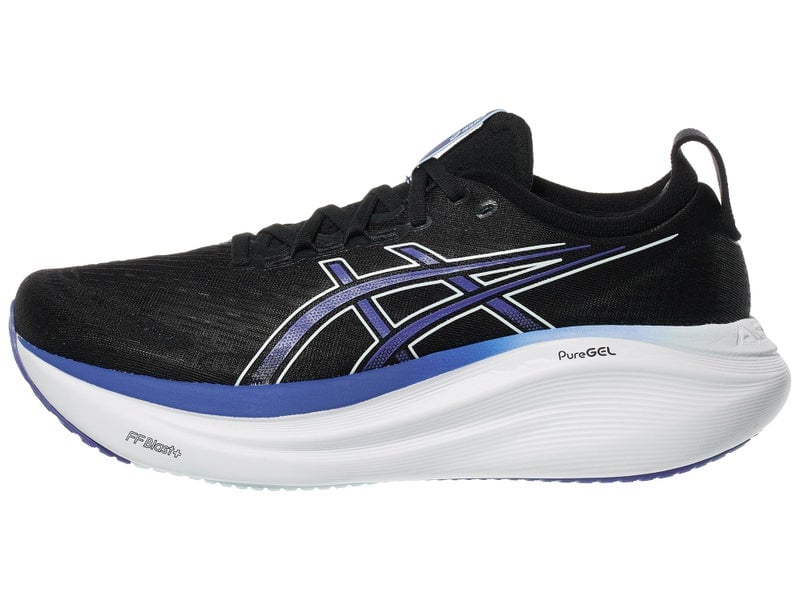
For runners who want bouncy, energy-returning cushioning across daily mileage, the On Cloudmonster 2 wins — its CloudTec Phase pods rebound rather than just absorb. For runners who want plush, layered cushioning with localised gel impact protection at the heel, the ASICS Gel Nimbus 27 wins — its FF Blast+ Eco midsole plus PureGEL pad delivers maximum forgiveness on heel strike.
The Honest Truth: Two Premium Daily Trainers, Two Different Rides
Both shoes sit at the top of their brand’s daily-trainer lineup. The differences come down to foam choice, stack height, and whether you want a more responsive or more cushioned ride.
1. CloudTec pods vs FF Blast+ Eco + PureGEL
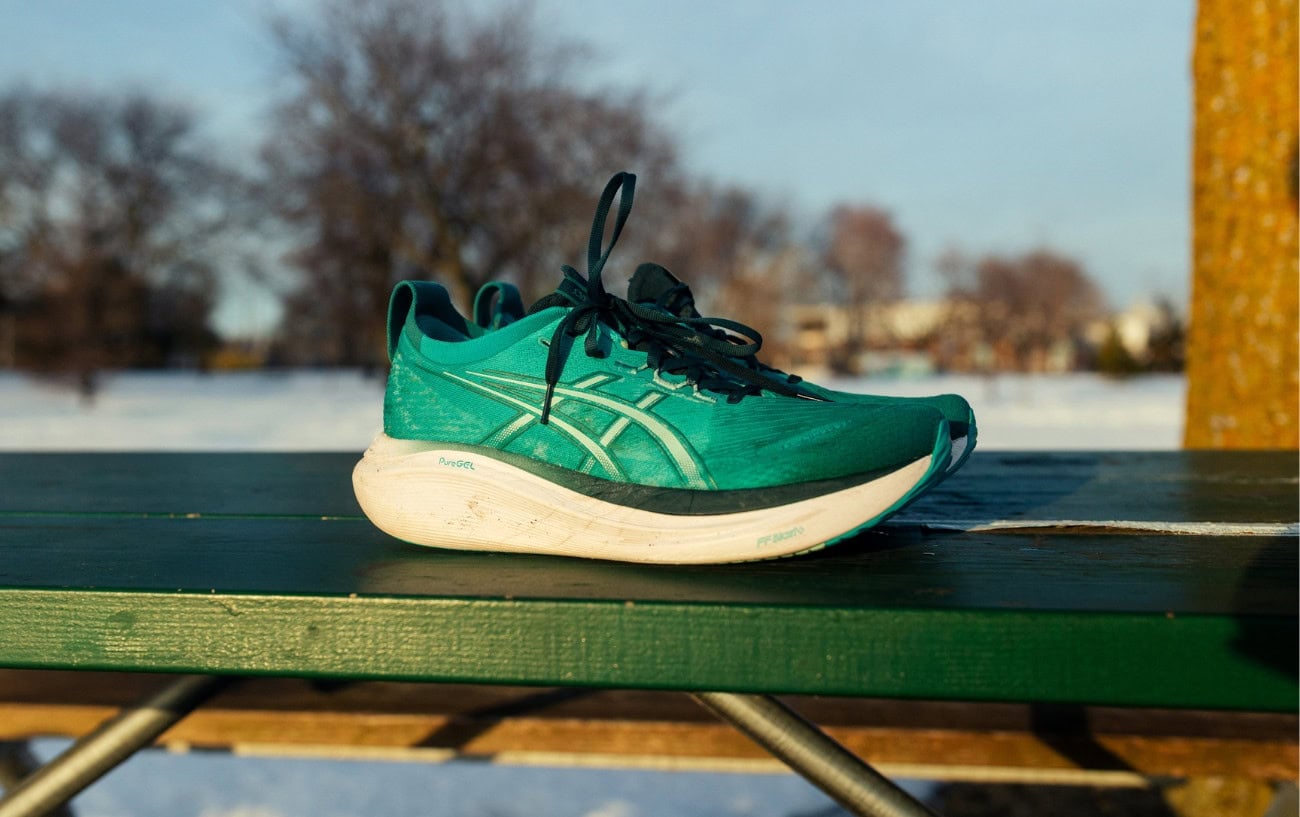
The Cloudmonster 2 uses 14 hollow CloudTec Phase pods that compress and rebound, plus a Helion superfoam core. The Nimbus 27 uses ASICS’s FF Blast+ Eco — a nitrogen-infused EVA blend — with a PureGEL pad embedded in the heel for localised impact absorption. Lab energy-return measurements show CloudTec returns slightly more energy per stride at marathon pace; the Nimbus delivers more localised heel-strike absorption1Worobets J, Wannop JW, Tomaras EK, Stefanyshyn DJ. Softer and more resilient running shoe cushioning properties enhance running economy. Footwear Science. 2014;6(3):147–153.. So if you’re a heel-striker who wants absolute heel cushioning, Nimbus; if you want responsive cushioning across the whole foot, Cloudmonster.
2. Stack and drop
The Cloudmonster 2 sits at 35 mm under the heel with a 6 mm drop; the Nimbus 27 at 41.5 mm with an 8 mm drop. The Nimbus is the taller, more cushioned platform; the Cloudmonster is the lower, more grounded one. Lab work on stack height shows that taller midsoles reduce peak vertical loading rates while preserving slightly less ground feel2Chambon N, Delattre N, Guéguen N, et al. Is midsole thickness a relevant parameter to control running shoe comfort? Footwear Science. 2014;6(1):S3–S5.. The 6.5 mm gap is meaningful — these feel like different shoes despite similar marketing.
3. Weight — Cloudmonster wins
The Cloudmonster 2 weighs around 9.7 oz (men’s 9); the Nimbus 27 around 10.5 oz. The roughly 1% economy cost per 100 g of added shoe mass means the Cloudmonster is roughly 0.3% more efficient at threshold pace3Hoogkamer W, Kipp S, Frank JH, et al. A comparison of the energetic cost of running in marathon racing shoes. Sports Medicine. 2018;48(4):1009–1019.. Combined with the higher energy return, the Cloudmonster is more versatile across pace ranges; the Nimbus is the better pure recovery and easy-day shoe.
4. Last shape and forefoot fit
On daily trainers traditionally use a slightly narrower European-shaped last; ASICS Nimbus uses a more anatomically narrow last that suits lower-volume European feet but runs snugger than Brooks or Hoka. Restricted toe-splay during late-stance loading is associated with bunion progression and metatarsalgia4Goldmann JP, Sanno M, Willwacher S, Heinrich K, Brüggemann GP. The potential of toe flexor muscles to enhance performance. Journal of Sports Sciences. 2013;31(4):424–433.. Wide-footed runners may struggle with both — consider Hoka or Brooks instead. For narrow to medium feet, both fit well.
5. Pick by use case
For runners who want energy return and a versatile platform across both easy and steady-state efforts, the Cloudmonster wins. For runners who run high mileage easy and want maximum impact protection — particularly heel strikers — the Nimbus is the more forgiving pick. Multi-shoe rotations beat single-shoe training in injury-rate studies; if you’re building for a marathon, owning one of each gives you more options across a training week. If you’re still mapping picks to a goal race, the best marathon running shoes guide covers the model-level picks across both brands.
Cloudmonster vs Nimbus: Side-by-Side Specs
| Spec | On Cloudmonster 2 | ASICS Gel Nimbus 27 |
|---|---|---|
| Weight (men’s 9) | ~9.7 oz | ~10.5 oz |
| Stack heel | 35 mm | 41.5 mm |
| Heel-toe drop | 6 mm | 8 mm |
| Foam | CloudTec Phase + Helion core | FF Blast+ Eco + PureGEL heel |
| Best for | Versatile bouncy daily | Heel-strike comfort + recovery |
Cloudmonster vs Nimbus: Pros & Cons
On Cloudmonster 2
- ✅ Lighter (~9.7 oz)
- ✅ Higher energy return from CloudTec
- ✅ More versatile across paces
- ✅ Lower drop suits posterior chain
- ❌ Less heel cushioning than Nimbus
- ❌ Pods can collect small stones
ASICS Gel Nimbus 27
- ✅ Maximum heel cushioning
- ✅ PureGEL pad protects heel-strikers
- ✅ Taller stack absorbs more impact
- ✅ Best pure recovery shoe in the lineup
- ❌ Heavier (~10.5 oz)
- ❌ Less responsive at faster paces
- ❌ Narrow last for wide feet
Frequently Asked Questions
Is the Cloudmonster or Nimbus better for marathon training?
For most runners, the Cloudmonster is the more versatile single-shoe marathon trainer because of its bouncier ride and lighter mass. The Nimbus is the better pure recovery and easy-day shoe in a marathon-block rotation. Most committed marathoners benefit from owning one of each: Nimbus for recovery and easy mileage, Cloudmonster for steady-state and tempo days.
Are these shoes good for heavier runners?
Yes — both are designed for max cushioning, which is exactly what heavier runners (75 kg+) typically need. The Nimbus has a slight edge because of its taller stack and PureGEL heel pad — the additional impact absorption matters more at higher body weights. Both shoes hold up well at high body weight; expect 600–700 km of useful life rather than the 800+ km lighter runners get.
Do Cloudmonsters get stones stuck in the pods?
Sometimes, particularly on gravel paths or worn road shoulders. They typically pop out with the next stride or a quick shake. On has redesigned the geometry across generations to minimise this; the Cloudmonster 2 is much less prone than earlier CloudTec models. The Nimbus has no equivalent issue thanks to its solid midsole.
Are these wide enough for wide feet?
Standard widths run narrow on both. ASICS offers a genuine 2E (wide) version of the Nimbus, which fits much more comfortably for wide-footed runners. On does not offer a wide version of the Cloudmonster — wide-footed runners typically do better in Hoka or Brooks at this stack height.
How long do these shoes last?
500–700 km for the Cloudmonster, 600–800 km for the Nimbus. The Nimbus has the slight durability edge because solid foam compresses more uniformly than CloudTec pods, and PureGEL holds its impact-absorption properties indefinitely. Watch the cushion underfoot, not the outsole — once the bounce or plushness fades, the foam has compressed and impact protection is degraded.
Where to Buy
More Shoe Roundups From Marathon Handbook
- Best Daily Running Shoes
- Best Marathon Running Shoes
- On Cloudmonster vs Hoka Bondi
- ASICS Nimbus vs Kayano
- On vs Hoka
References
RunClub — Free
Join 300,000+ runners in RunClub
Free training plans for every distance, a daily running game, exclusive coaching content, and a real community of runners. Create your free account in 20 seconds — no card.
Already a member? Log in →



Start the conversation