


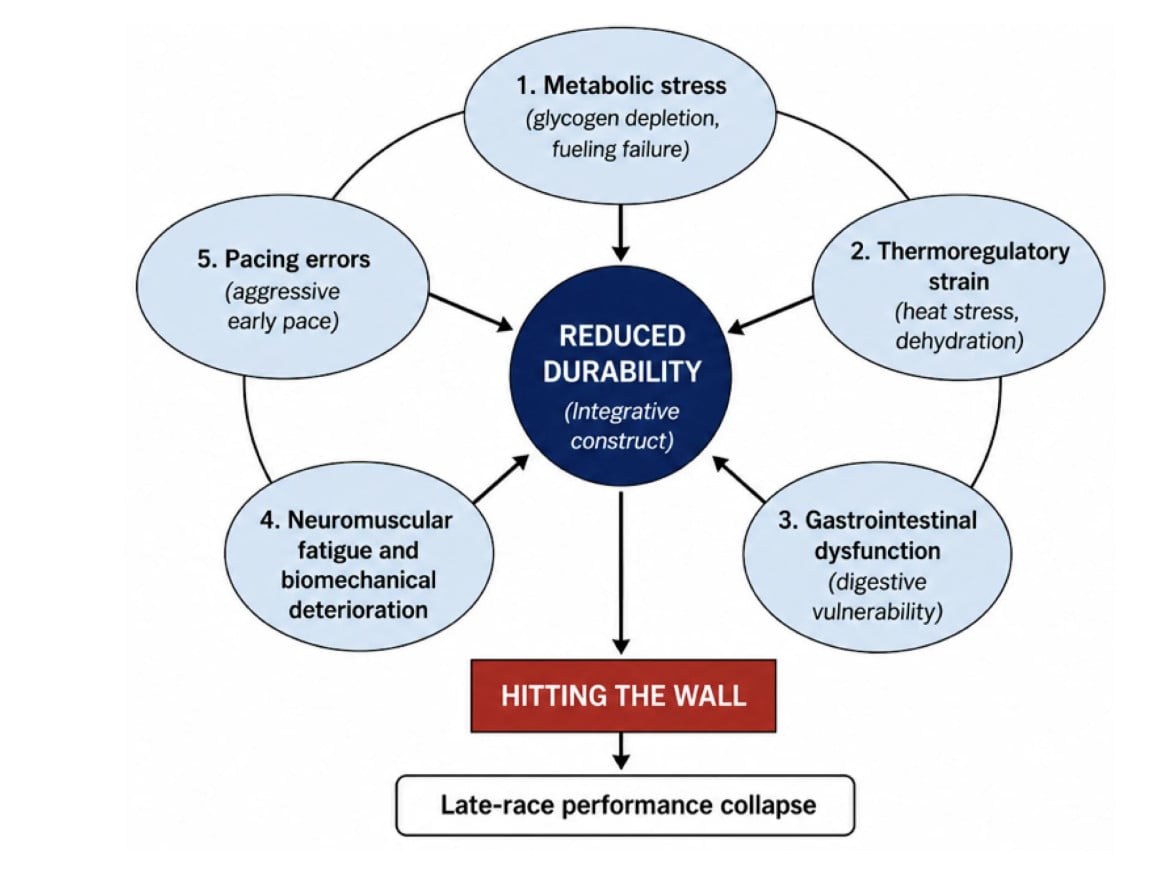
When runners fall apart late in a marathon, glycogen (our body’s stored form of carbohydrate) usually gets the blame. That explanation is often partly right—but a new review argues that “the wall” is better understood as several problems converging at once.

This was a narrative review rather than a new experiment. The authors integrated research on carbohydrate depletion, heat and dehydration, gastrointestinal distress, neuromuscular fatigue, biomechanical deterioration, pacing errors, and perceived effort. Their central idea is “durability”: the ability to resist physiological and performance deterioration as fatigue accumulates.1(2026). Mdpi.Com. https://www.mdpi.com/2411-5142/11/3/291
In that model, low glycogen does not act alone. Heat strain can raise cardiovascular demand. Dehydration can magnify that strain. Gastrointestinal symptoms can reduce carbohydrate and fluid intake. Neuromuscular fatigue can make each stride less economical. An aggressive early pace can accelerate all of it.
By roughly 18–21 miles (30 to 35 kilometers)—a conceptual “critical zone”—those stresses may push perceived effort past what we can reasonably sustain.
The review still treats fueling as foundational. It supports carbohydrate loading and early, regular intake during the race, generally around 60 to 90 grams per hour using multiple types of carbohydrates. Intakes approaching 120 grams per hour may work for selected, highly trained athletes, but only after deliberate gut training.
The key point is that perfect fueling cannot fully compensate for poor pacing, inadequate long-run durability, unprepared legs, heat strain, or a gut that has not rehearsed race nutrition.
What this means for runners
Keep practicing your carbohydrate plan, but train the other systems that keep the wall away. Progressive long runs, marathon-pace work under fatigue, hills or strength training, heat acclimation when relevant, and repeated gut training all build different pieces of durability.
Pacing is the thread connecting them. Starting slightly too fast raises carbohydrate use and heat production early, leaving less room when your mechanics and perceived effort begin to deteriorate. A well-rehearsed, even effort gives every subsystem a better chance to hold together.
References
RunClub — Free
Join 300,000+ runners in RunClub
Free training plans for every distance, a daily running game, exclusive coaching content, and a real community of runners. Create your free account in 20 seconds — no card.
Already a member? Log in →












Start the conversation