


It’s time again for that big quadrennial question: Isn’t there a better alternative to the U.S. Olympic Marathon Trials? The answer is yes.
World Athletics has announced qualifying procedures for the 2028 Olympic Marathon, and USA Track & Field has selected St. Louis for the U.S. Marathon Trials on March 25, 2028.
The Trials have traditionally picked the three American male and female runners who advance to the Olympics. But this one-day, winner-take-all approach falls short of what the primary goal should be.
The Trials fail to give U.S. runners their best shot in the Olympics. Instead, the Trials diminish Olympic prospects.
Once, the Marathon Trials were the uncontested 24-carat diamond of American road racing, but that was then, and this is now.
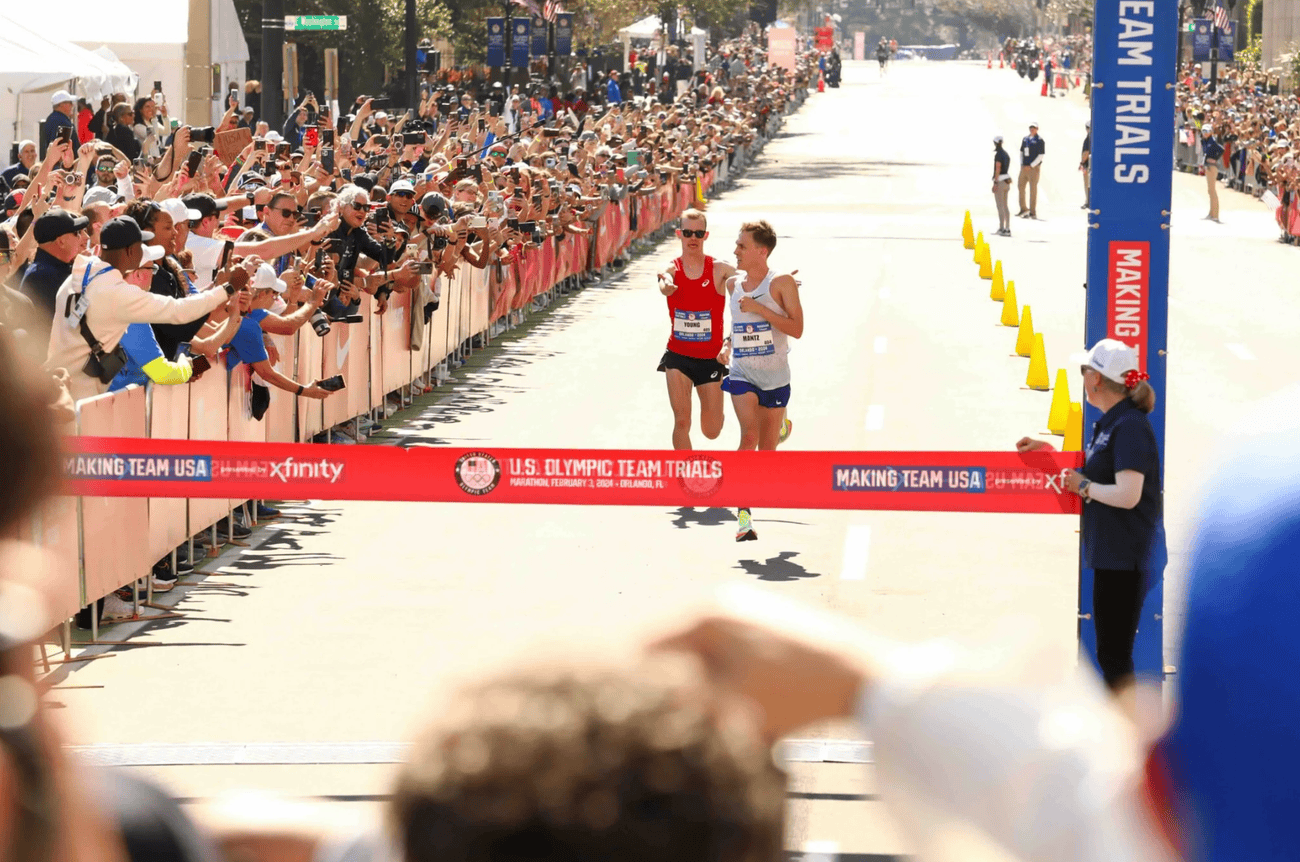
Global marathon running hasn’t simply evolved in recent years; it has leaped ahead. The Trials need to change with the times (pun intended). Consider these key, but conflicting factors:
1. United States Track & Field (USATF) is addicted to the Marathon Trials. A pinnacle event that garners months (even years) of fan interest, national TV coverage on race day, and revenue for its thin coffers.
2. World Athletics (WA) wants smaller, more competitive Olympic events. The 2028 LA Olympic marathons will have just 70 starters each, down from 80 in 2024. And you can’t run the Olympics without an Olympic qualifier.
That bears repeating: You can’t run in the Olympics if you haven’t first gained qualifier status (explanation below). This criterion now supersedes the Marathon Trials outcome.
3. The American public wants the fastest, most-proven USA runners in the Olympics. And these athletes deserve the opportunity to race at their best once they get to the Games.
4. The Marathon Trials force the best USA runners to compete in a knock-yourself-out race that few other global marathoners face in their Olympic buildups. This inevitably puts USA runners at a disadvantage in the Olympics. Plus, the one-day Trials race puts too much emphasis on having a good day vs. a good year (or two).
For decades, these forces coexisted in an uneasy truce. You ran the Trials, finished in the top three, and booked your ticket to the Games—as long as you had a reasonable qualifying time.
However, in 2028 and beyond, “coexistence” and “reasonable” no longer apply. Instead, we face a cratering chasm. That’s why change must come.
What It Takes To Land An Olympic Qualifying Slot
Let’s take a step back and see how American runners can notch an Olympic qualifier before the Marathon Trials.
There are three roads to a qualifier. Here they are, ordered from simplest to understand (but most difficult to achieve) to most complicated and unknowable (but simplest to achieve)
1. Run under 2:05:00 (men) or 2:22:20 (women) on an eligible course between Nov. 1, 2026, and March 19, 2028. The problem: Only Conner Mantz has ever done this among American men, and that was two years ago. It doesn’t do him any good now.
A number of American women have broken 2:22:20, but only Emma Grace Hurley in the last two years. It’s more doable than 2:05:00, but nonetheless a steep hill to climb.
2. Place in the top 5 of a “Platinum Label” marathon like one of the World Marathon Majors or a handful of other big events such as Valencia, Xiamen (China), Osaka Women, Seoul, and Amsterdam.
Jess McClain did this at the recent NYC Marathon, but it’s super difficult in most major marathons because so many fast East Africans run the big, financially rewarding races.
3. Rank among the world’s top 55 marathon runners in the World Athletics “Road To L.A.” ranking system on March 19, 2028. This would be virtually impossible if it included all top runners, but it doesn’t. It allows only three runners per country, thus eliminating dozens of Ethiopians, Kenyans, and Japanese.
Four years ago, in the final “Road To Paris” ranking, the 55th time sat at 2:07:37 for men and 2:24:51 for women. These are clearly softer targets compared to under 2:05 and 2:22:20, which makes a ranking qualifier more accessible than a fast-time qualifier (option #1).
But it’s also an unknown quantity. How much faster is world marathon racing today than it was four years ago? How much faster are the shoes, gels, bicarb supplements, and other legal performance enhancers?
No one can answer these questions. Yet every American runner and coach must guesstimate and grapple with them during Olympic preparation.

This Weirdness Could Actually Happen At The 2028 Marathon Trials
The next U.S. Olympic Marathon Trials (for both men and women) will take place in St. Louis on March 25, 2028. That might seem far off, but it’s not for top American runners, because they can enter only two, maybe three, marathons a year.
For these athletes, planning for the 2028 Olympics started yesterday. They have to decide when and where to chase that all-important Olympic qualifier. Then they must peak again for the Marathon Trials. And then, whew, it hurts just to think about all this — they have to prepare for the big prize: the 2028 Olympic Marathon itself.
Consider this scenario for the men’s Marathon Trials. It’s purely hypothetical, but also possible. On race day, only three American men — Zouhair Talbi, Conner Mantz, and Clayton Young — have earned an Olympic qualifier.
In the Trials race, the three fast guys finish fourth, fifth, and sixth behind three podium placers who run in the 2:09s. Now, who’s going to the Olympics — the Trials winners or the Olympics-qualified runners just behind them?
Answer: The Trials winners. Why? That’s where things get interesting.
Under World Athletics’ regulations, the three Olympic qualifying slots don’t actually belong to the runners who earned them: Talbi, Mantz, and Young. Instead, the qualifiers belong to USATF.
And USATF can dole them out however it wants. Since USATF values the Marathon Trials above all else, it will “reallocate” the Olympic slots to the first-, second-, and third-place finishers. (Note: USATF has yet to publish its Olympic Marathon selection process, but has always followed a winners-first system. Runners are only eligible for a “reallocation” spot if they have run sub-2:11 or sub-2:29.)
A similar fate could befall Jess McClain. She’s the only American with an Olympic Marathon qualifier, but she won’t keep it. If McClain finishes fourth in the Marathon Trials, USATF will give her qualifier to a podium finisher.
And Now It’s Time For A Solution
Of course, there’s no quick, universally-endorsed fix at hand. World Athletics and USATF have sharply different priorities. They are on a collision course.
USATF hopes to maintain the primacy and excitement of the U.S. Olympic Marathon Trials. The Trials have survived this long because they are simple, ruthless, and undeniably American: Show up on one day, beat everyone else, and advance to the Olympics.
Beautiful. You can’t beat the simplicity and drama.
Defenders of the status quo will note that there’s no evidence the U.S. Olympic Marathon Trials have failed to pick the best runners. So why change?
Answer: Because global marathoning has gotten much faster and more competitive. And who will argue that an extra race, the Marathon Trials, sharpens U.S. runners for the Olympics? In marathoning, less is more.
The 2028 Marathon Trials are mostly a done deal. Things won’t change in the short term.
Beyond 2028, a few alternatives exist. Here are three.
1. Select the U.S. team based on objective/subjective data. Tell American runners to run when and where they want in the year before the Olympics. Publish clear criteria that include fast times, competitive excellence, consistency, and recent form. The runners who best meet these goals get selected to the Olympic Team.
Yes, a committee will be involved. Deal with it. Form the committee with at least 50% past U.S. Olympic marathoners, along with several top sports scientists and veteran coaches. Make their voting public and transparent.
2. Pick the Chicago Marathon or Houston Marathon as the Marathon Trials. Both are big, flat, fast, and six to 10 months before the Summer Olympics. The top two finishers are guaranteed spots on the U.S. team. The third-place finisher gets high priority, but not a guarantee. A committee picks the third Olympian.
3. Hold a traditional Marathon Trials, but modify the Olympic selection. Only the winner of the Marathon Trials gets a guaranteed Olympic position. The second and third Olympians are picked with a strong nod to their Trials performance, but without a guarantee. A committee (see above) evaluates all the evidence.
None of these proposals will win unanimous approval, but each rests on solid ground. More importantly, each serves the one goal that should outrank all others: sending our top marathoners to the Olympics with a real chance to run well.
Let’s be honest. American marathoners are not world beaters. They’re good, sometimes very good, but they need all the help we can give them.
A do-or-die Marathon Trials does the opposite. It treats the selection as the main event.
That’s wrong. The Olympic Marathon is the big goal. Let’s build a system that acknowledges this essential truth.
RunClub — Free
Join 300,000+ runners in RunClub
Free training plans for every distance, a daily running game, exclusive coaching content, and a real community of runners. Create your free account in 20 seconds — no card.
Already a member? Log in →











Join the conversation
This misses the point. The Olympics are perform on demand. You want someone who can show on on the day that it counts. Not someone who managed to hit the time on a good day after 2-3 unsuccessful tries. The pressure is what does it. If Mantz comes 4th at the trials he doesn\'t deserve to be at the Games (not picking on him just using the example above). The US has enough depth that you can safely assume the top three at the trials can compete at the Olympics. This is also the most fair approach. How do you compare times from Chicago to Houston to Berlin? You can\'t. Top three across the line. Like it or lump it.
My half marathon 1:18 m