


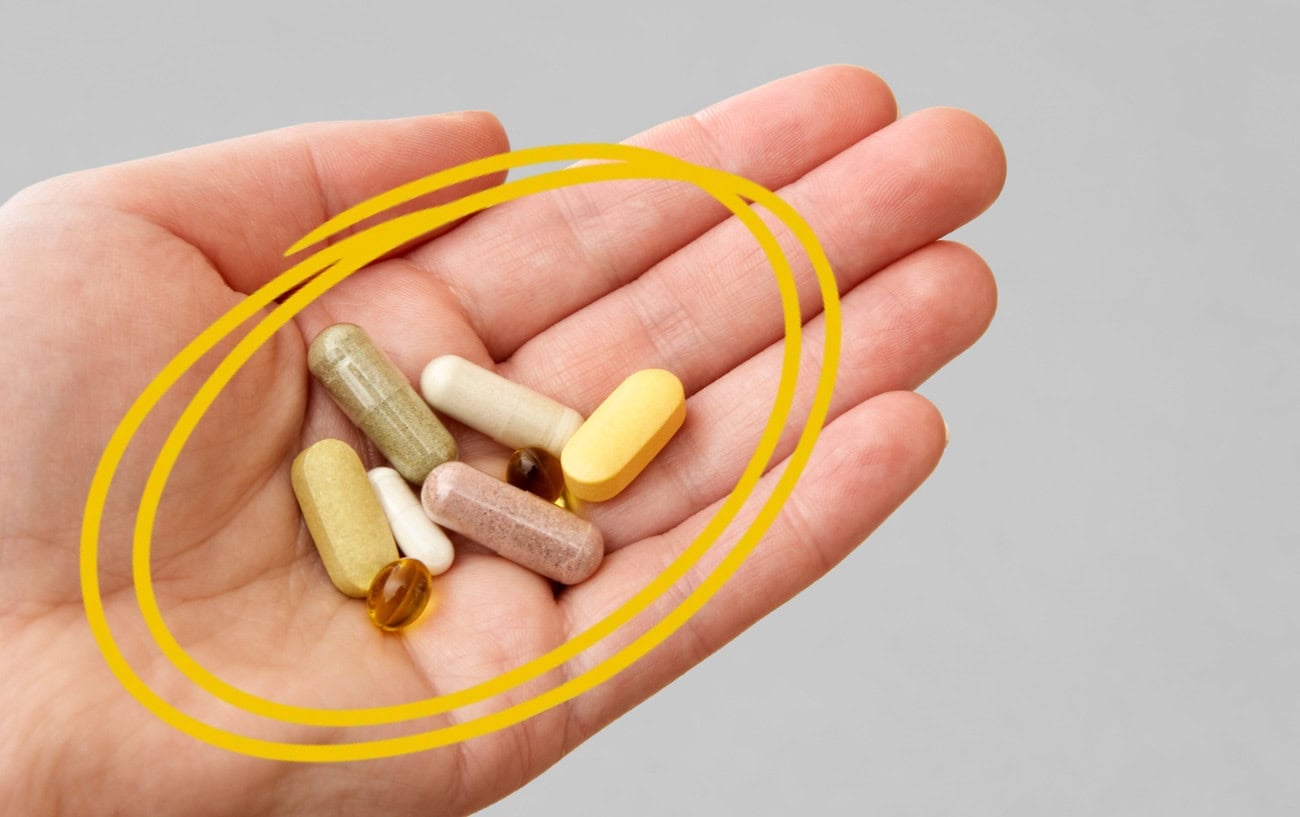
The supplement aisle offers plenty of possible recovery solutions for runners: creatine, fish oil, magnesium, tart cherry juice, curcumin, and an expanding collection of powders promising to speed things along.
The difficult part is figuring out what “speed things along” actually means… “recovery” is a broad term.
Does the supplement make your legs less sore? Help your muscles produce force again? Change a blood marker associated with muscle damage? Allow you to train more consistently and ultimately run faster?
Those are different outcomes. A supplement can improve one without improving the others.
A new review by Federica Conti, Dan Garner, and Andrew Galpin examines these questions across a wide range of nutritional strategies.1Conti, F., Garner, D., & Galpin, A. J. (2026). Train hard, recover smart: The supplement framework to enhance exercise recovery in recreational and elite-level athletes. Journal of the International Society of Sports Nutrition, 23(1), 2763838. https://doi.org/10.1080/15502783.2026.2763838 Its most useful contribution is a hierarchy that puts supplements into the larger recovery picture.
Before we consider what belongs in the shopping cart, it helps to understand that hierarchy.
The Recovery Pyramid: Start With the Basics, Not the Supplements
The authors organize recovery practices into five layers. The broad base contains the behaviors and nutritional requirements that support everything above it. Moving upward brings us to increasingly optional additions.
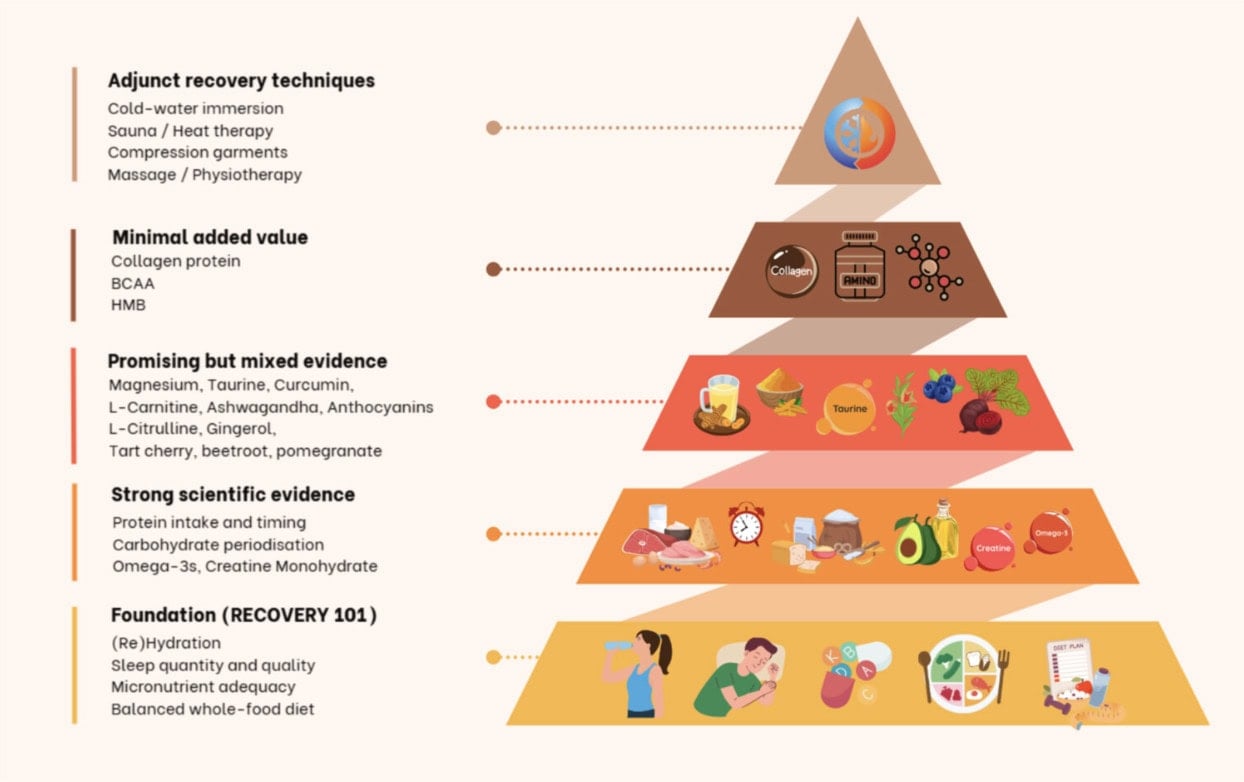
The foundation is sleep, hydration, and nutritional adequacy. Recovery requires enough sleep, replacement of fluid losses, sufficient energy intake, and a diet that supplies essential vitamins and minerals. These are recurring requirements, whether you supplement or not.
For runners, that means looking beyond whether a diet appears “healthy.” A varied diet can still provide too little food for a heavy training schedule. Likewise, eating plenty of vegetables doesn’t compensate for repeatedly missing sleep.
This layer also distinguishes nutritional adequacy from nutritional excess. Correcting an insufficient intake can help restore normal function. Adding more of a nutrient once requirements are met may produce little additional benefit.
The next layer: carbohydrate, protein, and better-supported supplements. Carbohydrate helps replenish glycogen, the stored fuel used during running. Protein provides amino acids for repair and remodeling. Their amounts and timing should reflect the work being done and how soon the next demanding session arrives.
The authors place creatine and omega-3 fatty acids in this same broad tier because they consider them among the better-supported supplemental options. However, sharing a tier doesn’t make them equally necessary. Every runner needs adequate carbohydrate and protein; whether to add creatine or fish oil depends on the individual.
The middle layer: promising but mixed evidence. This includes magnesium, taurine, curcumin, L-carnitine, ashwagandha, anthocyanins, citrulline, ginger, and several fruit or vegetable juices.
These compounds have plausible mechanisms and, in some cases, encouraging human trials. The uncertainty concerns how consistently they work, which outcomes they improve, and whether the benefit extends to runners who already eat well and train regularly.
The next layer: uncertain added value. Collagen, branched-chain amino acids, and HMB appear here. The central question is whether they improve recovery beyond what adequate complete protein already provides.
The top: additional recovery techniques. Cold-water immersion, heat exposure, compression garments, massage, and physiotherapy occupy the final tier. They fall outside the review’s main nutritional focus and may have different purposes depending on the athlete and situation.
I would read their placement as a reminder to establish the foundation before investing heavily in extras. You don’t need to collect something from every layer. The useful task is identifying where your current recovery practices leave a meaningful gap.
Recovery Has Several Meanings
The authors distinguish biochemical changes, perceived recovery, restoration of function, and longer-term adaptation.
Creatine kinase, for example, is an enzyme whose activity in blood can rise after muscle-damaging exercise. Lower activity after supplementation can be informative, but it doesn’t establish that your legs can produce more force or that your next workout will go better. It’s a biomarker, not a functional outcome.
Soreness is meaningful, too. Yet feeling better and regaining physical capacity don’t necessarily occur on the same schedule.
This is why the review gives greater weight to outcomes such as strength, power, and force recovery than to blood markers alone.
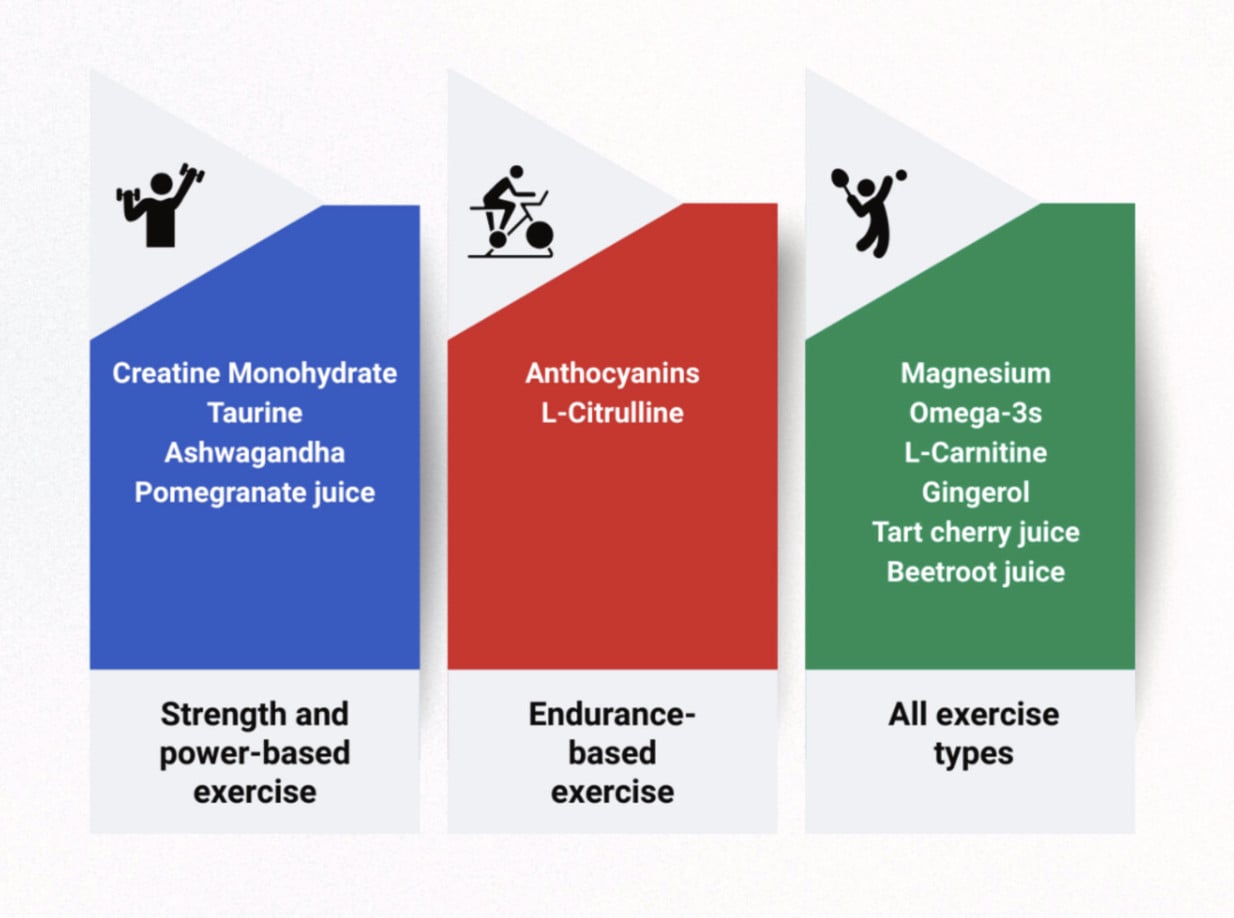
With that framework in place, here’s how I would interpret the individual options. The doses below describe studied protocols, not universal prescriptions.
Creatine Monohydrate
Creatine helps rapidly regenerate ATP, the immediate energy source for muscular work. Its benefits for strength and high-intensity exercise are well established, and some trials also suggest improved recovery of muscle function.
In one trial included in the review, researchers analyzed 40 men and women taking 3 grams daily or placebo for 28 days before an exercise challenge and five days afterward. Creatine improved recovery of maximal force and reduced muscle fatigue.2Yamaguchi, S., Inami, T., Nishioka, T., Morito, A., Ishiyama, K., & Murayama, M. (2025). The effects of creatine monohydrate supplementation on recovery from eccentric exercise-induced muscle damage: A double-blind, randomized, placebo-controlled trial considering sex and age differences. Nutrients, 17(11), 1772. https://doi.org/10.3390/nu17111772
In a trial involving 23 professional cyclists, adding 20 grams daily to a carbohydrate-and-protein recovery drink did not improve soreness or fatigue during a six-day training camp.3Barranco-Gil, D., Alejo, L. B., Revuelta, C., Górriz, M., Pagola, I., Ozcoidi, L. M., Lucia, A., & Valenzuela, P. L. (2024). High-dose short-term creatine supplementation without beneficial effects in professional cyclists: A randomized controlled trial. Journal of the International Society of Sports Nutrition, 21(1). https://doi.org/10.1080/15502783.2024.2340574
The review discusses ongoing intake of 3–5 grams daily, with muscle stores building over several weeks. Creatine is worth considering for runners who also strength train, but expectations about faster recovery from mileage should remain more modest.
Omega-3 Fatty Acids
EPA and DHA, the long-chain omega-3s found in oily fish, contribute to cell membranes and signaling processes involved in inflammation.
Some studies report less soreness or better preservation of muscle function after supplementation. Others find no meaningful differences.
I would consider omega-3s in the context of the overall diet, with a possible recovery benefit. The evidence doesn’t establish that fish oil reliably resolves post-run soreness.
Creatine and omega-3s both receive an evidence score of 2 in the review, where 1 represents the strongest category. Even the leading options retain important uncertainties.
Magnesium
Magnesium participates in energy metabolism and muscle function. Small trials have reported improvements in soreness or perceived recovery, including one involving nine male recreational runners.
Nuts, seeds, legumes, and leafy vegetables are sensible places to start. Supplementation has a clearer rationale when intake is inadequate than when an adequately nourished runner simply wants faster recovery.
The review also describes a trial in which topical magnesium gel did not improve the measured recovery outcomes. In other words, the evidence for swallowing a nutrient shouldn’t automatically be transferred to applying it to the skin (or taking an Epsom salt bath).
Taurine and L-carnitine
These compounds participate in different physiological processes, but both have attracted interest as metabolic recovery aids.
Taurine helps regulate cellular fluid balance and calcium handling, among other functions. The review describes reductions in muscle-damage markers, soreness, or force loss in some trials, often following supplementation over days or weeks. Much of the evidence comes from small studies in young men, and a consistent benefit for endurance-training recovery remains uncertain.
L-carnitine helps transport long-chain fatty acids into mitochondria for energy production. In a five-week trial of 73 adults, supplementation with 2 grams of L-carnitine daily improved perceived recovery and reduced losses in strength and power after a demanding exercise challenge.
Ashwagandha
Ashwagandha has been studied for effects on stress, perceived recovery, and exercise-related muscle damage.
Several trials described in the review used approximately 600 milligrams daily over four to eight weeks. Some found improvements in recovery questionnaires or muscle-damage markers.
Safety deserves consideration here: the review notes rare reports of liver injury and thyroid dysfunction, alongside limited evidence about prolonged use. I would be cautious about treating it as a routine addition to every runner’s recovery plan.
Curcumin
Curcumin is a compound found in turmeric with anti-inflammatory activity. Some trials report less soreness, favorable changes in muscle-damage markers, or improved recovery of muscle function.
Curcumin remains a plausible option in selected circumstances, but the evidence doesn’t yet provide a clear, standardized recovery protocol for runners.
Anthocyanins and Tart Cherry
Anthocyanins are pigments found in foods such as berries, blackcurrants, and cherries. Some studies of anthocyanin-rich foods or extracts have examined outcomes particularly relevant to runners.
In one trial involving 30 young men, participants consumed an anthocyanin-rich juice twice daily for nine days, with a 30-minute downhill run on day five.4Lima, L. C. R., Barreto, R. V., Bassan, N. M., Greco, C. C., & Denadai, B. S. (2019). Consumption of an anthocyanin-rich antioxidant juice accelerates recovery of running economy and indirect markers of exercise-induced muscle damage following downhill running. Nutrients, 11(10), 2274. https://doi.org/10.3390/nu11102274 The oxygen cost of running at a fixed speed returned to baseline within 24 hours in the juice group, compared with 72 hours in the placebo group. Soreness was lower, and knee-extensor force recovered sooner.
Tart cherry has a similarly mixed record: encouraging results in some studies, no clear benefit in others.
Timing matters. Many protocols begin several days before demanding exercise and continue afterward. Their findings don’t establish that one serving taken after soreness appears produces the same effect.
The review lists protocols using about 60 milliliters of concentrate daily, split between morning and evening.
I see a reasonable case for considering tart cherry around unusually demanding events when rapid recovery has particular value. Regularly eating colorful fruit fits comfortably within the dietary foundation.
Pomegranate
Pomegranate contains polyphenols, including ellagitannins and anthocyanins, that may influence inflammatory and oxidative responses.
Some trials report better strength recovery or less soreness after resistance exercise. Others find no meaningful differences. Much of the evidence concerns weightlifting or laboratory muscle-damage protocols, leaving limited direct evidence for distance runners.
Pomegranate can be part of a varied diet. The stronger claim—that a particular juice or extract reliably accelerates running recovery—still needs better support.
Beetroot and L-citrulline
Both are associated with nitric oxide availability, which helps regulate blood-vessel dilation.
Beetroot has been studied extensively for performance applications. Its recovery evidence is less consistent. The review describes benefits after some jumping and sprinting protocols, alongside a marathon study in which post-race beetroot juice did not improve recovery.
Citrulline findings also vary. One half-marathon trial reported less soreness after runners consumed citrulline-enriched watermelon juice, without a corresponding improvement in jump performance.
Ginger
Ginger’s bioactive compounds, including gingerols, have anti-inflammatory properties. Some studies report less muscle soreness or lower inflammatory markers after supplementation.
Results in runners are mixed. A small pilot study found modestly lower soreness after a long training run, while another trial in recreational distance runners did not demonstrate improved physical-performance recovery.
BCAAs, Collagen, and HMB
The review is particularly cautious about the additional recovery value of these products when protein intake is already adequate.
BCAAs—leucine, isoleucine, and valine—are already supplied by complete protein foods. Some trials find less soreness or lower muscle-damage markers with supplementation, but comparisons against adequate complete protein are often missing.
Collagen studies also produce mixed findings. HMB, a metabolite of leucine, has shown favorable results in some settings, but recovery findings are inconsistent, and its additional value beyond sufficient protein remains uncertain.
For runners, the first priority is meeting protein needs consistently. Specialized products need to demonstrate what they add.
Vitamins C, E, and D
Vitamin adequacy belongs near the base of the pyramid. More is not automatically better.
The distinction is especially relevant for vitamins C and E. In an 11-week endurance-training trial, high-dose supplementation blunted some cellular adaptations, although improvements in VO₂ max and running-test performance were similar between groups.5Paulsen, G., Cumming, K. T., Holden, G., Hallén, J., Rønnestad, B. R., Sveen, O., Skaug, A., Paur, I., Bastani, N. E., Østgaard, H. N., Buer, C., Midttun, M., Freuchen, F., Wiig, H., Ulseth, E. T., Garthe, I., Blomhoff, R., Benestad, H. B., & Raastad, T. (2014). Vitamin C and E supplementation hampers cellular adaptation to endurance training in humans: A double‐blind, randomised, controlled trial. The Journal of Physiology, 592(8), 1887–1901. https://doi.org/10.1113/jphysiol.2013.267419
Vitamin D deserves attention when status is insufficient. The review describes potential benefits for muscle repair and recovery, particularly in people starting with low levels. That supports addressing insufficiency; it doesn’t establish additional recovery benefits from taking progressively larger doses.
What About CoQ10, Probiotics, and Everything Else?
The review also considers compounds such as coenzyme Q10, quercetin, probiotics, rhodiola, spirulina, and various herbal extracts.
The evidence for exercise recovery is generally limited, inconsistent, or indirect. A product that influences immune function, sleep, or an oxidative-stress marker hasn’t necessarily been shown to restore running performance.
These distinctions also explain why combining multiple promising ingredients doesn’t create a proven recovery formula. Most studies examine individual interventions, and interactions between supplements remain poorly characterized. And most certainly aren’t additive.
What this means for runners
The hierarchy gives us a useful order of decisions.
First, identify what is limiting recovery. Consistently underfueling, sleeping too little, and experiencing soreness after an unfamiliar downhill race are different situations. A supplement should address a recognizable need.
Second, strengthen the foundation. Match food intake to training demands. Make carbohydrate and protein accessible after demanding sessions. Replace fluid losses appropriately. Give sleep and the training schedule the same attention you would give a supplement protocol.
Those steps remain relevant whether you take supplements or not.
Third, choose an outcome that matters. Less soreness can be worthwhile, but consider it alongside muscle function, fatigue, and the ability to sustain appropriate training. An isolated improvement in a blood marker cannot tell the whole story (though that doesn’t make it useless).
Fourth, consider the calendar. During normal training, the objective is to adapt over time. During closely spaced competitions, restoring function quickly may take greater priority.
That distinction creates a reasonable case for selective use of certain recovery aids. However, the review acknowledges that direct research on scheduling supplements around training phases remains limited.
Finally, make any experiment specific. Use a formulation and schedule reasonably close to the supporting research, introduce one change at a time, and choose independently tested products. Judge whether the result justifies continuing.
My interpretation is that creatine deserves consideration when strength training is part of the program; omega-3s and magnesium should be considered in relation to dietary intake; and tart cherry may be worth exploring around particularly demanding events. The case for routinely adding the remaining compounds is less convincing.
The recovery pyramid is most useful when it helps you set priorities. Its purpose isn’t to make your routine more elaborate.
Start with the requirement. Identify your gap. Then ask what a “recovery supplement” would actually add.
References
RunClub — Free
Join 300,000+ runners in RunClub
Free training plans for every distance, a daily running game, exclusive coaching content, and a real community of runners. Create your free account in 20 seconds — no card.
Already a member? Log in →










Start the conversation