


Will I make it to the start line healthy? It’s a question many of us ask before starting on a training block.
For some runners, the fear is acute—nagging knee pain, a tight calf that won’t loosen, a hip that feels “off” during long runs. For others, injuries appear suddenly on race day, often late in the race, as fatigue exposes every weak link in the system.
A new comprehensive review1Perugini, J. M., Touhey, D. C., Brophy, R. H., & Knapik, D. M. (2025). Lower Extremity Musculoskeletal Injuries Associated with Marathon Running. Current Reviews in Musculoskeletal Medicine, 19(1). https://doi.org/10.1007/s12178-025-10000-z pulls together decades of race-day and training data to assess what lower-body injuries actually happen in marathon running, and why? Here were some of the principal, relevant findings.
Marathon participation continues to grow, but the “average” runner looks very different from it did 30 years ago. Today’s marathoners are older, slower, more recreational, and more likely to run for fun rather than to chase performance goals. Women now make up over half of participants, and many runners travel long distances to race—bringing sleep disruption, schedule stress, and unfamiliar terrain into the mix.
Against that backdrop, race-day injury rates have climbed. Early marathon data suggested around 6% of runners sought medical care during races; more recent events report 17–30% of runners experiencing an injury on race day. Importantly, musculoskeletal injuries account for the majority of these encounters, far outpacing issues like dehydration or blisters.
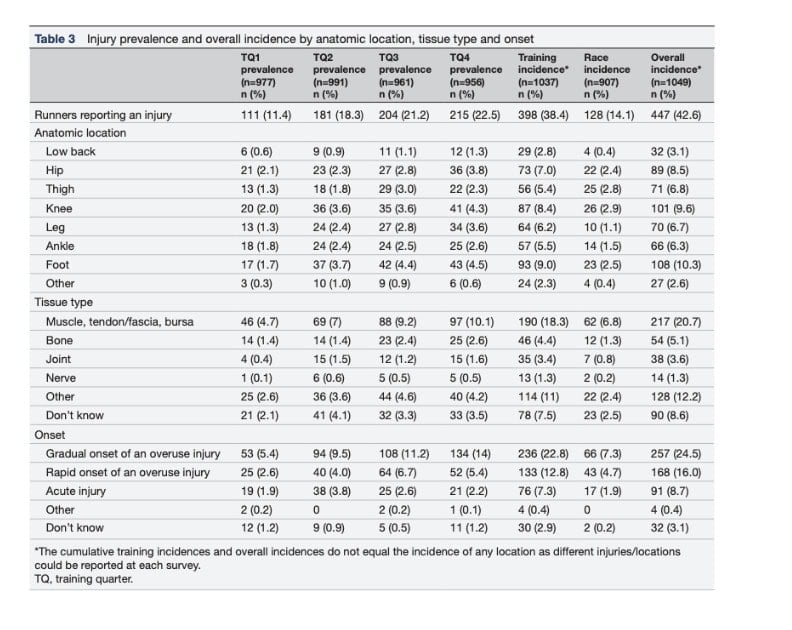
The knee is the most commonly injured region, followed closely by the thigh, lower leg/calf, ankle, and foot. Hip injuries, once less common, now account for nearly one-fifth of reported race-day injuries in some events.
Knee injuries frequently include iliotibial band syndrome, patellofemoral pain, patellar tendinopathy, meniscal irritation, and stress reactions. Thigh injuries are dominated by hamstring and quadriceps strains. Calf strains and medial tibial stress syndrome are common lower-leg complaints, while Achilles tendinopathy and plantar fasciitis round out the ankle and foot injuries.
When it comes to injury risk factors, some are non-modifiable, and some are under our control. Older runners face higher rates of joint-related injuries, while sex differences are consistent: men experience more calf injuries, while women have higher rates of hip-related problems. Prior injury stands out as one of the strongest predictors of future injury—if you’ve been hurt in the last year, your risk goes up meaningfully. Experience matters, too. Runners with more years in the sport—and those who’ve completed half marathons before attempting a full—are less likely to get injured.
Longer long runs during training are associated with a lower risk of injury on race day. Inadequate preparation, insufficient recovery, and illness in the weeks leading up to the race all increase risk. Alcohol consumption—even at surprisingly low levels—has been associated with higher injury incidence in marathon runners. Strength training stands out as a protective factor. Regular resistance training is associated with roughly a 24% reduction in lower-extremity injuries.
Technology introduces a newer layer of complexity. Carbon fiber–plated shoes reduce the metabolic cost of running and improve performance, but they may increase the risk of bone stress injuries, particularly in the foot. Wearables present a similar paradox. Some data suggest real-time feedback lowers injury risk by helping runners manage load. Other studies show higher injury rates among runners who use smartwatches, possibly because athletes override internal cues in favor of pace or metrics.
What this means for runners
This review reinforces a hard truth: marathon injuries are rarely bad luck. They’re the predictable result of tissue load, preparation, recovery, and decision-making layered over individual anatomy and history. For runners, the takeaway isn’t to fear training—but to respect it.
RELATED ARTICLE:
References
RunClub — Free
Join 300,000+ runners in RunClub
Free training plans for every distance, a daily running game, exclusive coaching content, and a real community of runners. Create your free account in 20 seconds — no card.
Already a member? Log in →












Start the conversation