


Protein supplements are one of those things that feel so obviously “athletic” that we stop questioning them. Endurance runner? Protein. Strength athlete? Protein. Busy human who trains? Definitely protein. And to be fair, protein is foundational, but there’s a difference between meeting your needs and supplementing to boost performance.

A recent meta-analysis is basically a reality check for that second belief: it asks whether protein supplements actually improve athletic performance and post-exercise recovery outcomes in athletes (that means you!)1Zhao, S., Zhang, X., Liang, T., Ng, S., Liu, Y., & Ning, Z. (2025). The effectiveness of protein supplements on athletic performance and post-exercise recovery − a Bayesian multilevel meta-analysis of randomized controlled trials. Journal of the International Society of Sports Nutrition, 23(1). https://doi.org/10.1080/15502783.2025.2605338
Researchers ran an analysis of 75 randomized trials with 1,206 athletes. The sample skewed male (roughly 916 men vs 220 women, with some studies not reporting sex), and the sports were all over the map—cycling and team sports were common, with some running and mixed endurance groups included.
They grouped outcomes into four buckets:
- Endurance performance
- Muscle strength
- Glycogen resynthesis
- Fatigue recovery
Importantly, they spent a lot of effort looking at moderators that athletes actually care about: protein source (whey vs soy vs others), timing (day vs night), extra protein dose, total daily protein intake, fasted vs fed testing, acute vs chronic use, and—critically—whether energy intake was matched between groups.
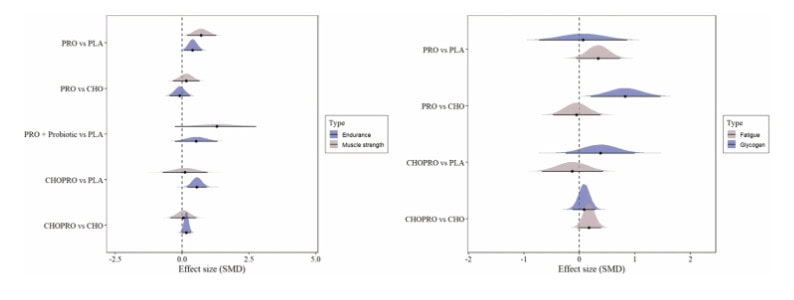
Protein supplementation showed a small average effect on endurance performance, while muscle strength, glycogen resynthesis, and fatigue recovery didn’t show clear overall effects. And results varied a lot depending on study design and context.
When they broke things down by supplement strategy, you start seeing apparently “meaningful” effects:
- Protein vs. placebo: small improvements in endurance and bigger-looking effects for strength
- Protein+carbs vs. placebo: moderate endurance benefits
- Protein vs. carbohydrate (recovery): glycogen resynthesis benefits
But there’s a crucial nuance: every statistically credible benefit clustered in trials where energy intake wasn’t matched between protein and control conditions. Significant effects on endurance and strength were observed only when the protein group received more calories than the control group. When calories were controlled, the performance edge largely disappeared.
That’s the classic supplement mirage: if you give one group extra protein but don’t replace calories elsewhere, you’re not just testing protein—you’re testing more food.
A few other details runners will care about:
- Protein source: Whey was the only source that consistently showed credible performance effects.
- Dose: Extra protein of 0–1 g/kg/day from supplements was the only dose range that showed a reliable endurance signal. Higher supplemental doses didn’t look better.
- Timing: “Daytime” protein showed a small endurance benefit; pre-sleep timing didn’t stand out as a performance lever in these data.
- Evidence quality: They rated endurance evidence as low quality and strength/glycogen/fatigue as very low overall—mostly because of inconsistency and small, messy trials.
What this means for runners
If you’re already eating enough total calories and you’re in a sensible protein range, don’t expect protein powder to be a performance hack; most benefits in the literature look suspiciously like the benefit of simply getting more energy. The most practical move is to use supplements as a convenience tool—hit your daily protein target, especially during heavy training or mild energy restriction, and prioritize carbs when the session demands it—rather than treating protein as a direct endurance enhancer. If you want a number to anchor to, many athletes do fine around ~1.6–2.0 g/kg/day total protein, but the performance edge from supplements is likely to show up only when they fix an overall fueling gap, not because the protein itself has magical “speed” properties.
References
RunClub — Free
Join 300,000+ runners in RunClub
Free training plans for every distance, a daily running game, exclusive coaching content, and a real community of runners. Create your free account in 20 seconds — no card.
Already a member? Log in →












Join the conversation
Not sure how anyone got the idea protein is an endurance supplement. Protein is all about muscle gains and muscle repair. I have _never_ read anything anywhere that indicated there was anything to protein for running endurance enhancement. But protein has a place after a long run to aid in recovery following carbs.