


Heat training seems to be all the rage among runners right now.
We’re working out in heat suits or multiple layers and measuring our core body temperatures in the hopes of eking out any last performance edge we can. Not as a shortcut… but rather as a way to maximize the training that’s already being done.
And the promises of heat training are compelling—more gains in fitness by simply adding an extra stressor on top of a workout. But that “extra stress” is part of the problem. Heat training is hard, adds extra training load, and (if not done smartly) can wreck your legs and ruin training progress.
That’s where passive heat training comes into play. Instead of grinding out extra intervals or embracing the discomfort of multiple layers, we can sit in a hot bath or a sauna and let physiology do the work. It’s an idea borrowed from altitude training and the “live high, train low” method: runners live at altitude to reap some of the benefits of a lower-oxygen environment, but train mostly at sea level where they can run fast and push their bodies to the limit.
I’ve been fascinated with the idea of passive heat training for a while. If we could nudge VO₂max and performance up with thermal stress instead of mechanical stress, that’s a big deal.
A new paper in The Journal of Physiology tests that idea directly in well-trained runners: can long-term passive heat acclimation, via hot-water immersion, actually increase VO₂max and not just make you feel more comfortable in the heat, but also in relatively mild conditions? And if it does, how is it working?
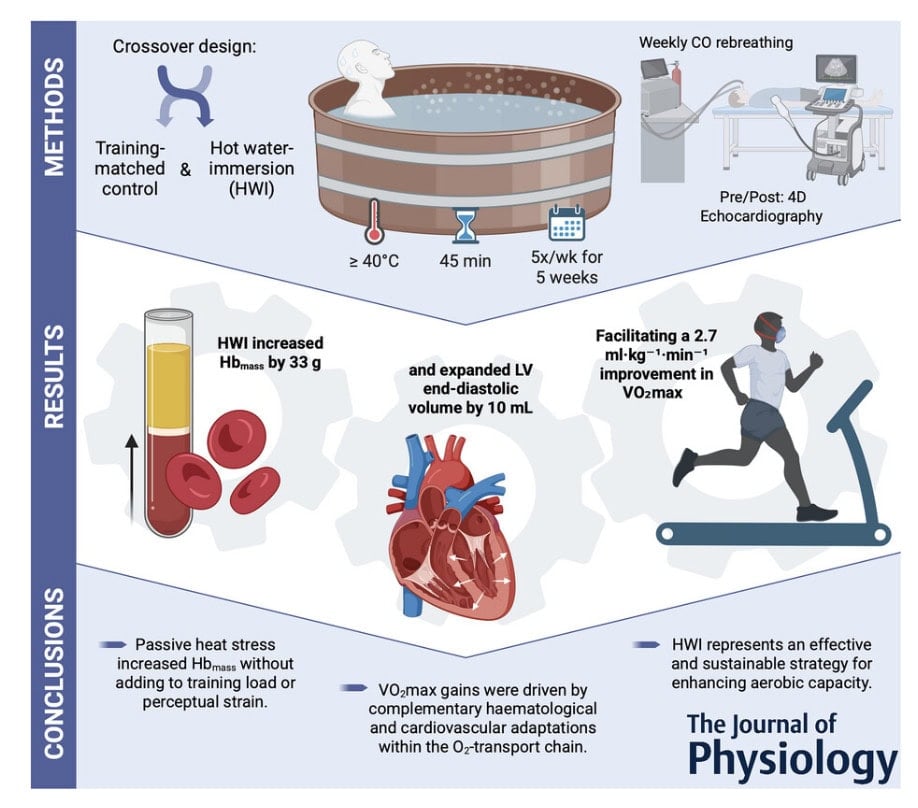
Ten endurance-trained runners (nine men, one woman; average VO₂max ~65 mL/kg/min—so very fit) completed two five-week blocks in a counterbalanced crossover design (that simply means that all runners did both of the training blocks):
- Hot-water immersion: Five days per week, 45 minutes per session, starting at 104℉/40°C and gradually progressing to ~107°℉/42°C by week 5. Most did the baths right after their usual run.
- Control: same training as usual, no heat exposure.
Crucially, training volume, intensity (time in heart rate zones), and daily well-being (fatigue, soreness, mood, sleep, stress) were the same between conditions. So any changes are very likely coming from the heat, not extra training.
Before and after each five-week block, researchers measured dozens of blood markers, the runners’ heart structure and function, and even performance via a treadmill VO₂max, running economy, and lactate threshold test.
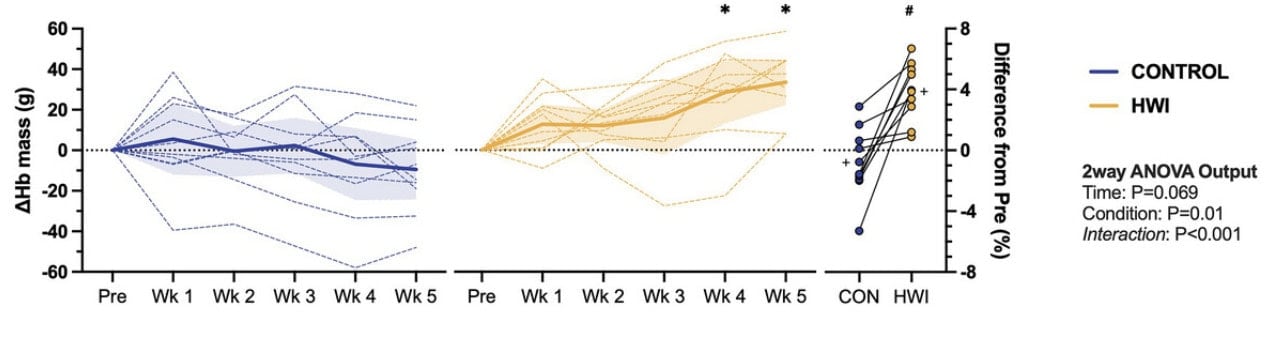
The baths weren’t just a feel-good recovery hack; they remodeled the blood. After 5 weeks of hot water immersion, hemoglobin mass (hemoglobin is the oxygen-carrying protein in our blood) increased by nearly 4%. The runners also had a higher total blood volume and more red blood cells after the training intervention.
But these changes didn’t happen all at once. They followed a very specific (and physiologically compatible) time course. Weeks 1–2 were characterized by a big jump in plasma volume that made the blood thinner (hematocrit, the percent of red blood cells that make up your total blood volume, declined by nearly 2%). During weeks 4–5, plasma volume started to drift toward pre-training values, while red blood cell volume and hemoglobin levels started to rise.
That staggered response fits the something the authors call the “kidney critmeter” idea: first, you expand plasma, which lowers haematocrit and oxygen content (the “diluting” effect observed in weeks 1–2); the kidneys sense that and turn up EPO and red blood cell production to restore an optimal haematocrit. You end up with more total blood and more haemoglobin on board without permanently thinning or thickening the blood.
Interestingly, haemoglobin concentration didn’t really change during the study, because both plasma and red cells increased. As we’ll see, this led to some notable changes in the runners’ oxygen-carrying capacity.
What changed in the heart?
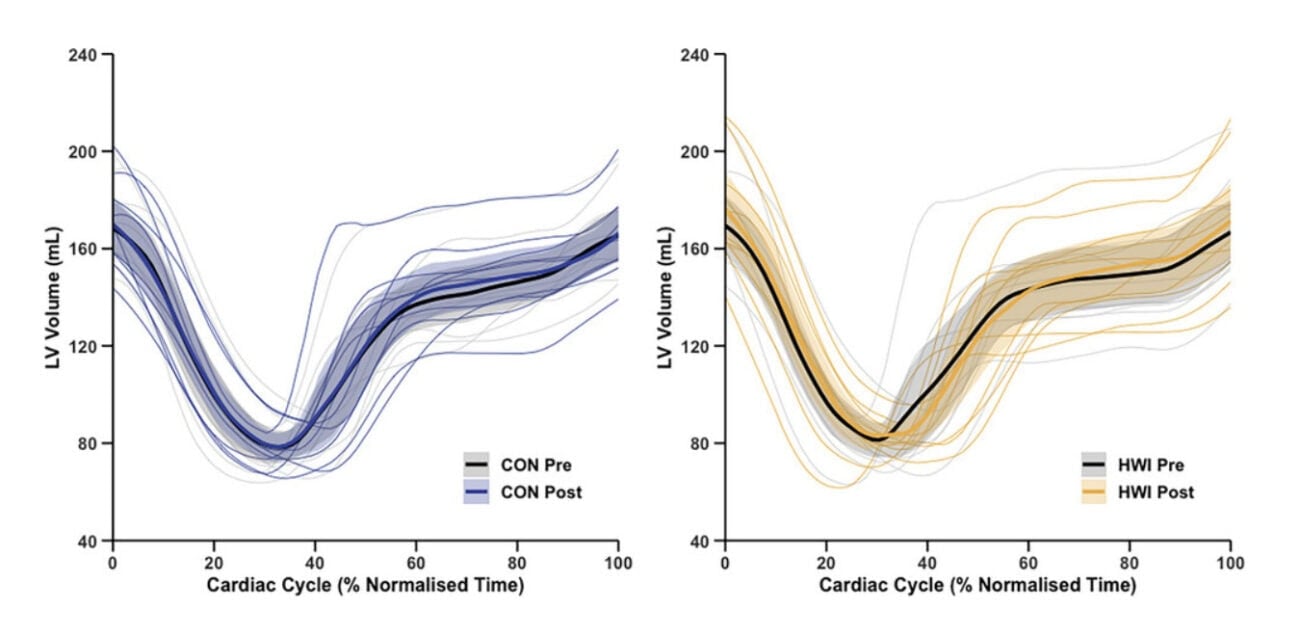
The heart also adapted without any extra “hard” training stimulus. The runners’ hearts were able to store more blood in the “relaxed” state (known as diastole), as shown by an increase in their left-ventricular end-diastolic volume or LVEDV, which rose by 10 mL after the hot water immersion condition but didn’t change after the control condition (even with training). The runner’s stroke volume—how much blood their hearts could pump with each beat—increased by 7 mL, and their resting cardiac output rose by 0.6 liters per minute.
On the other hand, the mass of their left ventricle (the main pumping chamber of the heart) or other measures of heart function didn’t change much. So we’re not seeing a thicker, more muscular heart, but rather, more of a bigger, better-filled reservoir. With more blood volume returning to the heart, it stretches more, fills more, and pumps more per beat.
The authors even estimate that, if the stroke-volume increase at rest carries over to maximal exercise, the heart could deliver ~200 mL or more oxygen per minute at maximal effort—enough to explain the VO₂max gains they observed.
Did heat training actually improve performance?
It did, but in a very specific way.
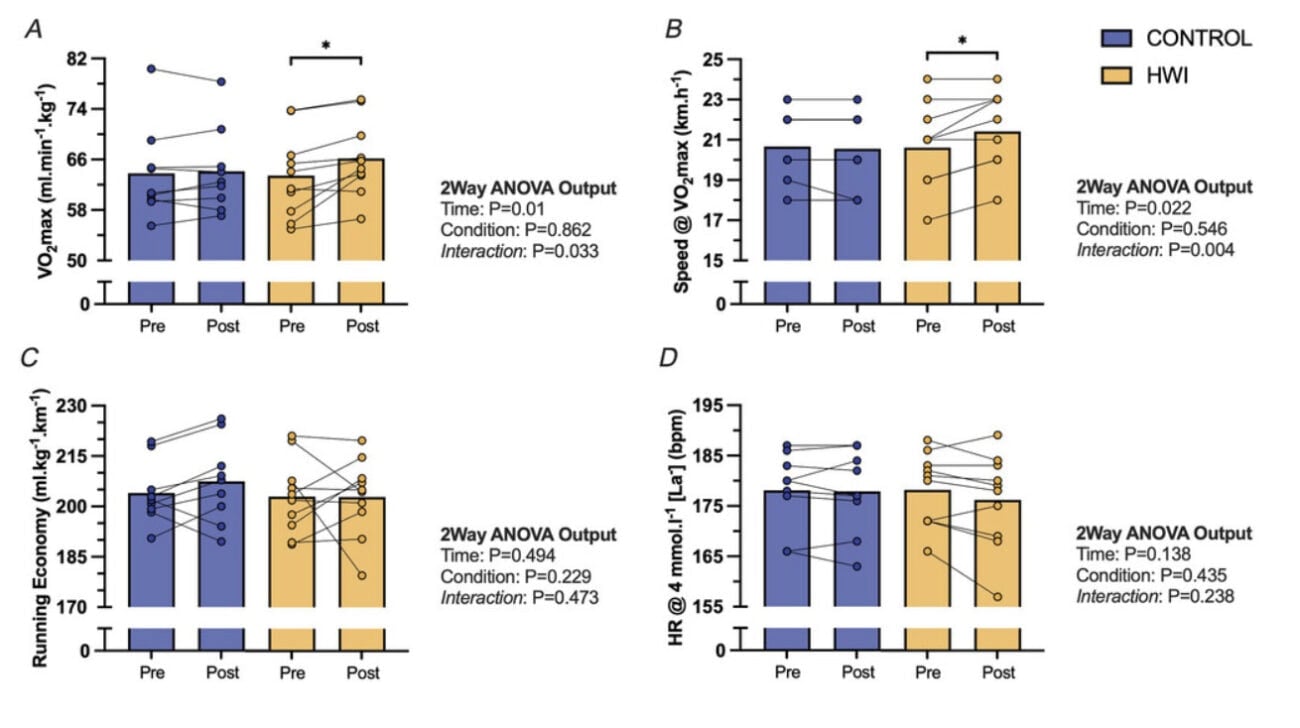
The runners’ relative VO₂max increased by 2.7 mL/kg/min (about ~4.4%). That’s the kind of VO₂max bump you might hope for from a well-designed altitude camp, and it happened with zero added mileage and no change in workout intensity.
The runners also improved their running speed at VO₂max by 0.5 mph or 0.8 km/h. Simply put, they could run at a faster “all-out” speed after the five weeks than they could before.
But here’s the nuance: running economy didn’t change, nor did speed or heart rate at lactate threshold—two crucially important pieces of running performance. The heat didn’t make these runners more economical or shift their threshold; it mainly raised the ceiling.
The authors ran an analysis to see which variables “explain” VO₂max changes best, and two stood out: hemoglobin mass and heart function. Each 1 g increase in hemoglobin mass was associated with a 3.8 mL/min increase in VO₂max, while each 1 mL increase in LVEDV was worth 11.7 mL/min of VO₂max.
Together, these two explained about 82% of the variance in VO₂max across all measurements. In their words, the VO₂max gains after hot water immersion can be “largely explained” by simultaneous adaptations in blood and heart volume. Passive heat training seems to act on both sides of the determinants of VO₂max: more oxygen in the blood and a bigger pump to deliver it.
What this means for runners
The authors lean pretty hard into a “heat instead of altitude” framing, and I think they’re mostly justified. The adaptations they report, such as a ~4% increase in hemoglobin mass and a ~4–5% increase in VO₂max, are right in the ballpark of classic “live-high-train-low” altitude camps.
But heat has some obvious practical advantages over altitude. For one, it’s cheap and local—you can do it in a bathtub or sauna instead of flying to Flagstaff. Second, passive heat training (as the name suggests) allows you to keep your normal training intensity and volume, instead of being limited by hypoxia or heat during workouts.
That said, this is a 10-person study, mostly male, over five weeks, in highly trained runners. We don’t know how this scales yet for recreational runners with lower starting VO₂max. That being said, my hypothesis is that lesser-trained runners may benefit even more. That’s because highly trained athletes have very little room for cardiac adaptations like an increase in the size and pumping ability of their heart… but that’s exactly what this study showed. Even a 4% increase in maximal oxygen uptake in well-trained runners with a passive heat stimulus is quite remarkable, in my opinion.
For runners, this study suggests that a structured block of passive heat training—something like 4–5 hot soaks per week, 30–45 minutes at 104–107℉/40–42°C, ideally after your normal run—can meaningfully bump VO₂max without adding mechanical training stress or hurting perceived recovery. Fair word of warning: this temperature is hot, and doing it for ~45 minutes at once is extremely difficult. So feel free to modify the protocol (frequency, duration, temperature) to make the hot baths bearable and scale up as you adapt. This isn’t meant to be torture. However, you do have to stress the body a bit if you want to see gains comparable to those in this study. It’s also not meant to be “easy.”
Where do I see hot baths fitting into a runner’s routine? All of the time, if you want to maintain year-round heat adaptations in general. But as an add-on in the 4–6 weeks prior to a key race (especially if you’re near your limit for mileage or intensity), passive heat looks like a realistic way to squeeze out some extra aerobic capacity.
Sometimes, in running, the answer to “How can I run faster?” is simply “run more.” But if running more isn’t feasible, the next best answer may be “get hot.”
RunClub — Free
Join 300,000+ runners in RunClub
Free training plans for every distance, a daily running game, exclusive coaching content, and a real community of runners. Create your free account in 20 seconds — no card.
Already a member? Log in →







Start the conversation