


CBD has become one of those supplements that lives in the gray zone between “maybe useful” and “mostly vibes.” Runners swear it helps them relax, sleep, recover, and sometimes even race better. Skeptics (often rightly) point out that most claims are way ahead of the data.
A new pilot study1Bell, E. R., Elias, B., Gutierrez, S. M., & Stewart, L. K. (2025). The Effects of an Acute Dose of Cannabidiol on Health and Two-Mile Time Trial Performance-A Pilot Study. Nutrients, 18(1), 29. https://doi.org/10.3390/nu18010029 tried to test a very runner-specific question: if you take a single, fairly hefty dose of CBD before a short, hard effort, do you actually perform better—or do you simply feel better?

The study used a double-blind, randomized, crossover design—meaning every runner did both conditions: CBD and placebo, on two separate lab visits. Twelve recreational runners (eight women, four men; average age ~25) completed a protocol involving CBD and a placebo on two separate occasions. Each visit followed the same structure: arrive fasted for 10 hours in the morning, take either 300 mg of CBD or a placebo, eat a protein bar, and then complete a two-mile treadmill time trial “as fast as possible” two hours later.
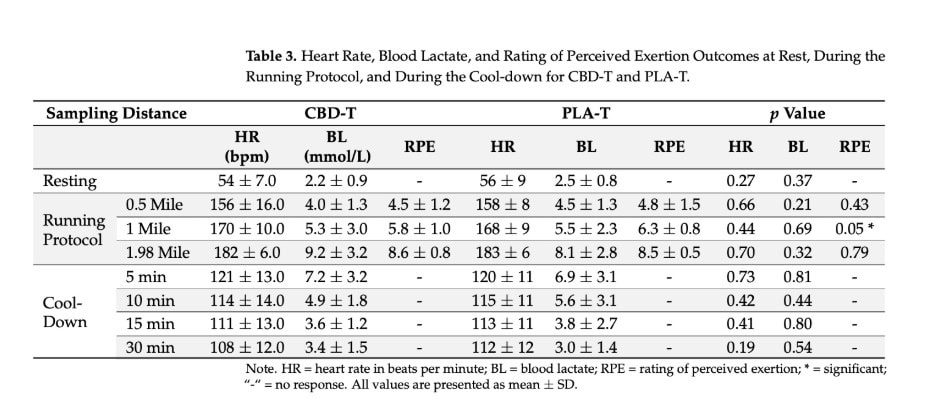
Runners completed an anxiety inventory assessing their subjective feelings and had their resting physiology measured, including blood pressure, heart rate, heart rate variability (HRV), and blood lactate. During the run, they captured heart rate (HR), lactate, and perceived exertion (RPE) at 0.5 miles, 1 mile, and just before finishing. Afterward, they walked for 30 minutes and tracked recovery lactate and HR, plus GI symptoms.
On average, runners were 3.1% faster in the CBD trial than in the placebo. That’s not trivial in the real world—if you’re running ~7:55/mile, that’s roughly ~30 seconds over two miles. But the study couldn’t confidently say CBD reliably improves time trial performance (the findings were “not statistically significant). Still, the direction of the effect is interesting, and 10 of the 12 runners ran faster with CBD.
At the one-mile mark, RPE was approximately 8% lower with CBD (5.8 vs 6.3 on their modified scale). At 0.5 miles and at the finish, RPE looked essentially the same between conditions.
Total mood and anxiety scores didn’t meaningfully differ, but two specific feelings did: runners reported feeling calmer and more relaxed after CBD, on the order of roughly ~20% shifts on those items compared to placebo. Qualitatively, runners also wrote more “positive” comments after the CBD trial (things like “felt calm,” “felt speedy,” “felt really good compared to last time”).
However, the body didn’t seem to care much either way. Resting blood pressure, heart rate, HRV, and blood lactate were similar between CBD and placebo. During the time trial, HR and lactate tracked closely across both conditions, and recovery values were also similar. CBD didn’t obviously change the physiological cost of the run.
One detail I can’t ignore is that every participant correctly guessed whether they received CBD or a placebo. That matters because if you know (or strongly suspect) you took the active supplement, it’s hard to fully separate pharmacology from expectation.
What this means for runners
If you’re considering CBD for performance, this study suggests the most realistic upside is psychological and perceptual: you might feel calmer before a hard effort and perceive the middle of a short race or time trial as slightly less taxing, without obvious changes in heart rate, lactate, or GI distress. If you experiment, do it in training first (same dose, same timing, same pre-run food), because 300 mg is a big dose and the placebo effect is clearly in play here.
References
RunClub — Free
Join 300,000+ runners in RunClub
Free training plans for every distance, a daily running game, exclusive coaching content, and a real community of runners. Create your free account in 20 seconds — no card.
Already a member? Log in →




Start the conversation