What if you could get many of the aerobic benefits of heat exposure—like an increase in VO₂max—without actually training in the heat?
A new study tested that exact idea using passive hot-water immersion (HWI) in trained runners. It was a tightly controlled, within-subject crossover trial involving 10 well-trained distance runners (9 men, 1 woman, VO₂max: 64.5 ± 8.1 mL/kg/min). Participants completed two 5-week blocks: one with five hot-water immersion sessions per week (45 minutes at ≥104℉/40°C), and one control period with no heat exposure. Both periods included their usual training, which was tracked and confirmed to be consistent across conditions. A 5-week washout period separated the two phases.
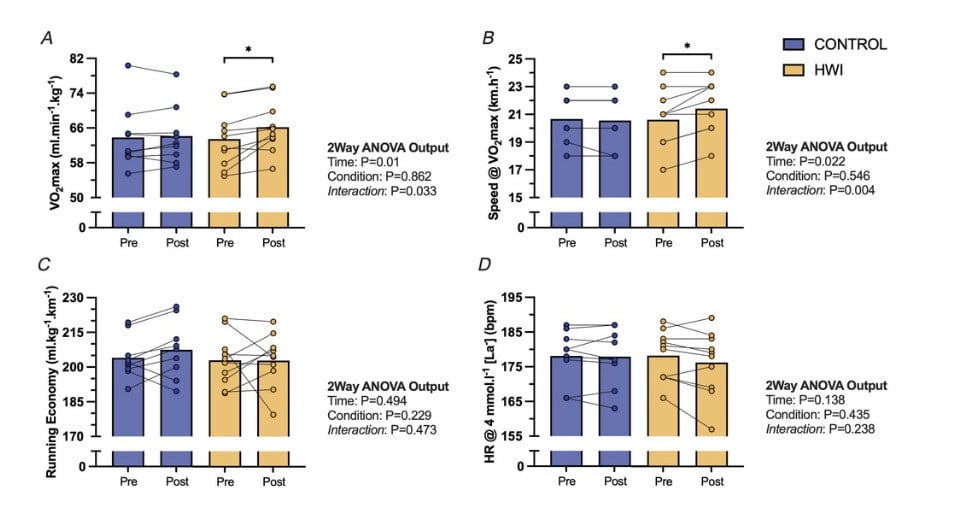
After five weeks of HWI, VO₂max increased by 2.7 mL/kg/min (a 4% bump from baseline), and treadmill speed at VO₂max improved by 0.5 mph/0.8 km/h. The HWI intervention also raised hemoglobin mass by an average of 33 grams, increased plasma volume by 250 mL, and expanded left-ventricular end-diastolic volume (LVEDV; a measure of heart function) by 10 mL. These changes weren’t seen in the control period.
In terms of tolerability, participants adapted well to the heat. The bath temperature was progressively increased across the five weeks, and although core temperature and sweat rate rose during immersion, there were no reports of adverse symptoms or declines in well-being. Subjective recovery, training volume, and heart rate zone distribution were identical across conditions, meaning the observed improvements can be confidently attributed to the passive heat exposure.
What this means for runners
This study builds on previous work showing that heat exposure can increase hemoglobin mass, much like altitude training. But until now, most of those studies involved exercising in hot environments, which typically requires reducing training quality. This research shows that passive heat alone is enough to drive meaningful improvements in aerobic capacity, while still allowing runners to train normally.
If you’re looking to boost VO₂max without compromising your training quality, regular post-run hot-water immersion could be a powerful tool. While it may not be practical year-round, heat exposure via bath or sauna could be especially useful during lower-volume phases, pre-altitude prep, or as an alternative to traditional heat training. The gains aren’t massive, but they’re real and sustainable.