


Conner Mantz ran his first half-marathon as a 12-year-old, finishing in 1:22:43. That didn’t satisfy him, so he returned two years later to clock a 1:11:24.
The kid is a gamer: Give him a target, and he’ll likely blow right past it. Give him a little more time, and he’ll run even faster.
Now 28, Mantz set an American marathon record with his 2:04:43 finish in Sunday’s Chicago Marathon. His time eclipsed Khalid Khannouchi’s 23-year-old mark, 2:05:38, set in 2002.
It also made Mantz the fastest-ever American, ahead of Ryan Hall’s 2:04:58 in the 2011 downhill and point-to-point Boston Marathon.
To call Mantz the top current American marathoner would be a vast understatement. In each of his last six marathons, all super-competitive, he has been the first American to finish. Count them: 2023 Chicago Marathon, 2024 Olympic Marathon Trials, 2024 Olympic Marathon, 2024 NYC Marathon, 2025 Boston Marathon, and now the 2025 Chicago Marathon.
Is he happy now? Yes, but … well, not totally. “I had these stretch goals that I didn’t want to express, because I might have sounded a little too confident,” he admitted in Chicago. “My stretch goals were to finish in the top three and run under 2:04.”
In other words, Mantz isn’t fully satisfied yet and aims to keep getting faster.
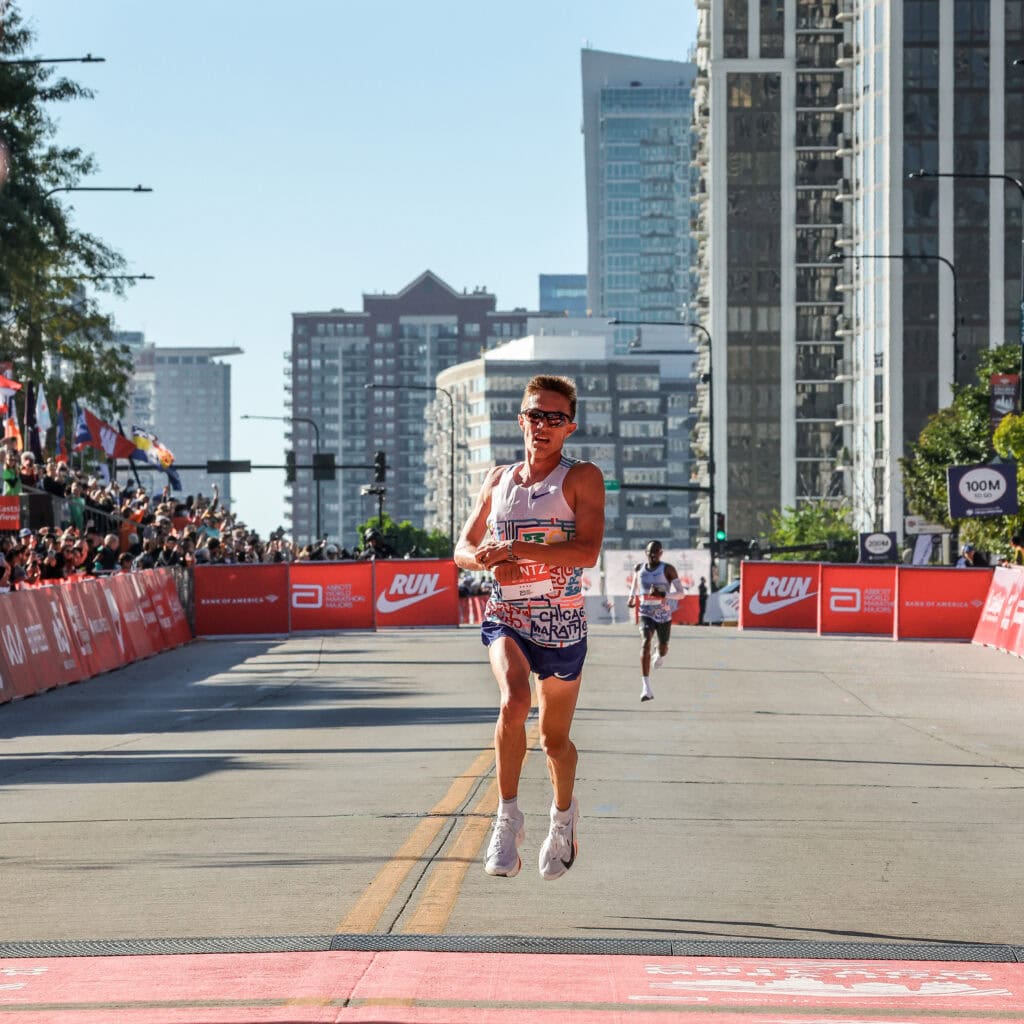
Conner Mantz Has Deep Utah Roots
Mantz was born in Logan, Utah, on December 8, 1996, and attended Sky View High School in Smithfield, Utah. There, he qualified three times for the Foot Locker Cross Country Championships, finishing seventh in 2013. During track season, his top times were 4:10.47 (1600 meters) and 8:57.99 (3200).
After high school, he committed to attending BYU. But first, as a member of the Church of Jesus Christ of Latter-day Saints, Mantz served a two-year mission in Ghana. In Africa, he had little time for formal training, but managed to squeeze in some running whenever possible.
He might have lost fitness in those two years, but he gained something more important. “When you come back from your mission, you’ve learned to work hard and are more focused on life,” he says. “You are usually more mature physically, mentally, and emotionally.”
Once he enrolled at BYU, Mantz’s running began an upward trajectory that has continued to the present. In 2020, he became the first U.S.-born runner to win the NCAA Division 1 Cross-Country Championships since Galen Rupp in 2008. The following year, he successfully defended his title.
On both occasions, he displayed his characteristic race tactic: Go to the front, grind it out, and keep grinding until your rivals can no longer stand the heat. This reminded American running fans of their all-time favorite athlete, the combative Steve Prefontaine.
“Conner likes to push,” notes Ed Eyestone, his BYU coach at the time and ever since. “That’s what we love about him. Sometimes he might look a little neurotic in terms of pushing his workouts, but he feels he has to do that to get the sort of rewards that he wants.”
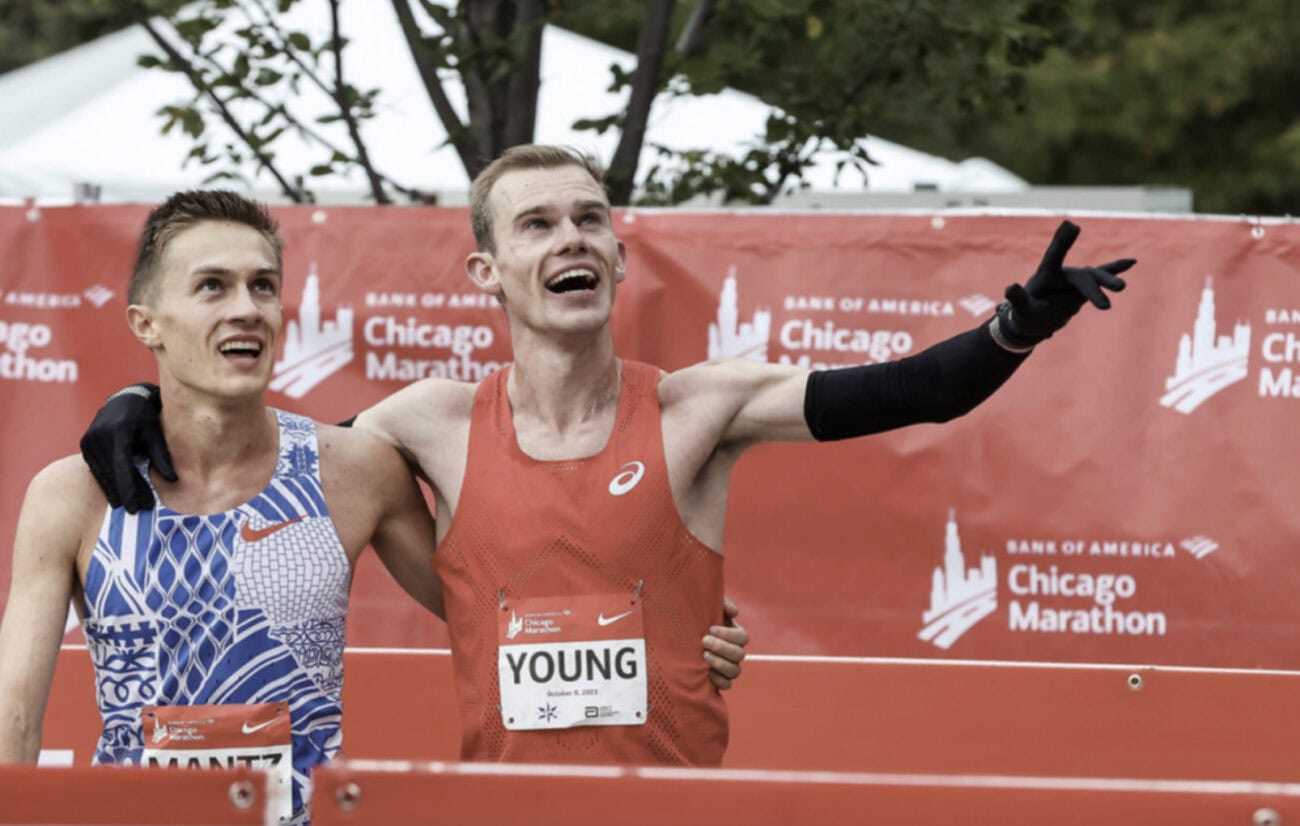
Mantz Finds The Perfect Running Community
At BYU, Mantz found himself in a near-perfect support community. Eyestone ranks first and foremost as a two-time U.S. Olympian in the marathon with a top finish of 13th in the 1992 Barcelona Olympics. Mantz feels confident he is being guided by an expert who has been there, done that. After all, who else gets an Olympic marathoner as their marathon coach?
And then there is sometimes training partner, Jared Ward, who placed sixth in the 2016 Rio Olympic Marathon without the benefit of super-shoes worn by the top three. Ward is a math whiz and marathon student who can be counted upon for the latest research on training, nutrition, and the like.
The team also includes frequent training and racing partner Clayton Young, who has followed close behind Mantz in several big marathons. One more, among many: Running biomechanics expert Iain Hunter, also a top masters marathoner, who ran 2:23:45 just two years ago.
Of course, it takes more than wizened veterans and scientific techies. In recent years, marathoners and their coaches have begun placing more emphasis on mental and emotional states. Mantz frequently points out how much he leans on his wife, Kylie, whom he met at BYU.
They married in the fall of 2022, after which he rewarded her with a honeymoon trip to the Manchester (CT) Road Race on Thanksgiving Day. Mantz won and set a course record, so at least he had enough pocket change to take Kylie on a splurge in New York City.
The Olympic Quest Begins
Mantz made his first attempt at an Olympic team at the 2021 Trials in Eugene, Oregon. He placed eighth in the 5,000 meters and fifth in the 10,000. He has since lowered his best times at these distances to 13:10.24 and 27:25.23. Though not known for his prowess at the mile, he improved his 1,500-meter time to 3:37.92 in 2023, equivalent to 3:54.7 in the mile.
Mantz broke into the national limelight when he won the highly anticipated 2024 U.S. Olympic Marathon Trials in Orlando, Florida. He and teammate Clayton Young moved to the front at 23 miles, and ran the last 3 miles together, as they have in thousands of training miles. Young looked smoother at the end, but Mantz surged just yards from the tape to claim the victory.
Even on a good day, Mantz looks more ragged than his rivals. He runs like someone who’s trying to punch his way out of a paper bag, leading with a stiff left jab. We don’t know what biomechanical quirks produce this distinctive movement, but they haven’t led to any chronic injury issues.
Before the Marathon Trials, Eyestone had advised his runners to follow a three C’s strategy: Chill for as long as possible, cover any moves after 10K, and close hard when you sniff the finish line. The plan worked to perfection, and Eyestone has become a master of alliterative marathon strategies.
Mantz and Young also ran strong in the Paris Olympics, finishing 8th and 9th. They recorded the two fastest times ever run by Americans in an Olympic Marathon, 2:08:12 and 2:08:44, despite a hilly course and the always unfriendly Summer Olympics weather.
Eight months later, Mantz showed that he had reached a new level when he finished fourth in the 2025 Boston Marathon in 2:05:08. That would have beaten Khannouchi’s American marathon record except that the downhill, point-to-point Boston course is not record-eligible.
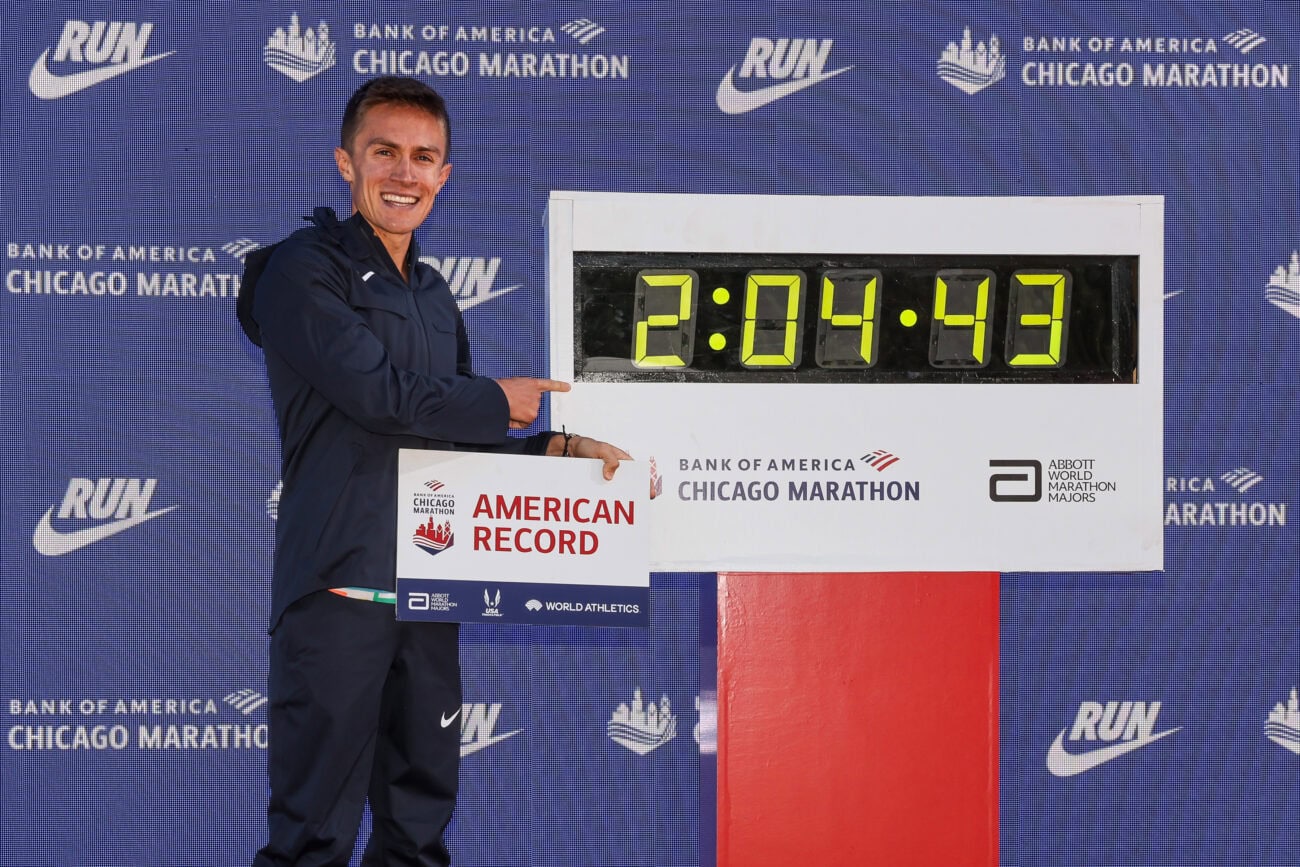
The Time Has Come For A New American Record
Clearly, the scene was set for a record attempt at Chicago, a race sponsored by Mantz’s shoe sponsor, Nike. Not typically one to raise expectations, Mantz even admitted as much. “After Boston, where I finished with guys who have run 2:02 and 2:03, it doesn’t feel like a stretch to say I can run 2:05:30 on a looped, flat course. I want to get the American record.”
In addition to his fast fourth in Boston, Mantz amassed a full plate of 2025 race successes to build upon. He began the year in January by breaking Ryan Hall’s long-standing American record in the half-marathon. Mantz clocked a 59:17 at the Houston Aramco Half Marathon to beat Hall’s 59:43 from 2007 on the same course. Two months later, Mantz ran 59:15 in the New York City Half Marathon.
Over the summer, he set a course record in the international Beach to Beacon race (“Joanie’s race”) in Freeport, Maine, with a 27:26. On Labor Day Monday, he established another American record at the Faxon Law New Haven Road Race 20K, where he ran 56:16 to break a course record that had stood for 27 years.
In Chicago, Mantz achieved his American record in front of a global, streaming audience. The Chicago NBC-5 broadcast included insightful commentary by Eyestone, who mixed objective analysis with enthusiasm for his protege. This recalled an era 50 years ago when Yale professor Erich Segal provided TV “color” to Frank Shorter’s victory in the 1972 Munich Olympic Marathon.
This time Eyestone had devised a four P’s strategy: patience, pace, (be) present, and push. Mantz almost careened off plan in the first mile. He was supposed to run at an average pace of about 4:46 per mile, but hit the mile mark in 4:30. “Oh, crap, I just blew my chance,” he later told LetsRun.com. But he settled down quickly and found the steady pace his coach had advised.
He ran at a near-2:04 pace with a deep pack that at times included more than a dozen world-class marathon racers. The weather was good (mostly mid-50s), the wind was light, and the supporting cast was excellent.
Mantz and 11 others reached halfway in 62:19. The five race leaders, including eventual winner Jacob Kiplimo, were two minutes ahead in 60:16. In other words, Mantz was in a mix of 17 top competitors.
From there, he battled his way to a fourth-place finish. Mantz recorded splits of 62:19 and 62:24 to improve the old American record by nearly a minute, 55 seconds to be exact.
How To Set An American Marathon Record
How did he do it? After finishing, Mantz noted three key factors in his sensational Chicago effort. First came “an accumulation of a lot of training for a lot of years.” This isn’t a sine qua non of marathon success. Some runners like Kelvin Kiptum and Sebastian Sawe start their marathon careers in the rarefied air of 2:01 and 2:02, and then eke out a few seconds here and there in subsequent performances.
But many more get faster only through years of hard, consistent training. One of the most famous runner physiology papers showed that Paula Radcliffe’s running economy improved by 15% over an 11-year period prior to her marathon world record in 2003.
This is why so many runners and coaches compare endurance training to building a home’s foundation: You’ve got to keep stacking the bricks.
Second, Mantz did much of his pre-Chicago training in Park City, Utah, about 45 miles north of his home in Provo, and about 2,500 feet higher (7,000 vs 4,500). He might have been influenced by the recent successes of track ace Grant Fisher, who moved from Oregon to Park City two years ago.
Third, and perhaps most interesting, he acknowledged recent discussions with a sports psychologist. In these sessions, he learned that his extreme focus on times, Mantz compulsively checks his watch while training and racing, perhaps limits his potential.
It was suggested that he should concentrate more on “the process of the race” and “just try to compete.” At Chicago, Mantz said he did this in the last six miles, where he and Alex Masai worked together to pass a half dozen runners.
This was the fourth P in Coach Eyestone’s strategy alliteration: process. It’s a new one, and it will be interesting to see where the athlete and coach take it from here.
What Comes Next For Conner Mantz
Mantz now faces the challenge all great runners encounter when they are at or near peak performance. How do you continue climbing upward? How do you avoid the injuries and setbacks that seem almost inevitable when you’re roiling along at 99 percent effort? How do you sidestep the social and economic entrapments?
There’s no predicting the future, but Mantz seems well-positioned for these tribulations. He runs just six days a week, following his faith. He’s got a coach and friends who understand the big picture, both the enticements and the pitfalls.
Most of all, he seems to have an innate “let’s do this” personality. He often uses the word “naive” to describe himself in the sense that he doesn’t know what he doesn’t know, and that’s A-OK.
Mantz says this is why he has been chasing marathon greatness since age 12. Why not? This is how he manages to keep improving. Why shouldn’t he?
He even looks the part, with his youthful face, shiny eyes, and boyish enthusiasm. Mantz has already set his next big goal. He wants to win a major marathon, and if you don’t think he can do that, don’t bother telling him. He doesn’t want to hear it.
Mantz thinks he keeps getting faster because he doesn’t obsess on the reasons why he can’t. Indeed, he hopes to stay “young and naive.” He believes his mindset has been a key asset in his constant improvement.
And why not? If it ain’t broke, don’t fix it.
RunClub — Free
Join 300,000+ runners in RunClub
Free training plans for every distance, a daily running game, exclusive coaching content, and a real community of runners. Create your free account in 20 seconds — no card.
Already a member? Log in →





Join the conversation
Can a marathon bar participation for a runner (ie Jacob Kiplimo) because they are affiliated with an agent involved in numerous doping cases (ie Federico Rosa)? Connor Mantz, quite probably, already earned his spot on the podium during the 2025 Chicago Marathon. I would like to see a strong message sent from world marathon majors to all professional runners: you can work with Rosa but, if so, then we won’t work with you.