


Endurance training stats usually get compressed into two numbers: how much did you run, and how hard was it?
That is why we spend so much time debating mileage, the 80/20 rule, and whether an athlete’s training is polarized, pyramidal, or something in between. These summaries are useful. But they also flatten a workout into a single dimension.

A new study of elite Ethiopian distance runners shows what can disappear in that flattening.
On a standard easy/moderate/hard chart, this group’s training looked relatively familiar to most of us—lots of easy running, very little moderate running, and a modest amount of hard work (characteristic of the polarized training model). But when the researchers added where the athletes ran, what was underfoot, how the terrain changed, how long the session lasted, and who was running together, a much richer structure emerged.
So let’s take a look…
Inside The Study: Reconstructing 97 Days Of Elite Training
The new paper followed 14 elite Ethiopian distance runners—six men and eight women—for 97 consecutive days between September and December 2025. Most specialized in the marathon or half marathon, with one 10K road runner.
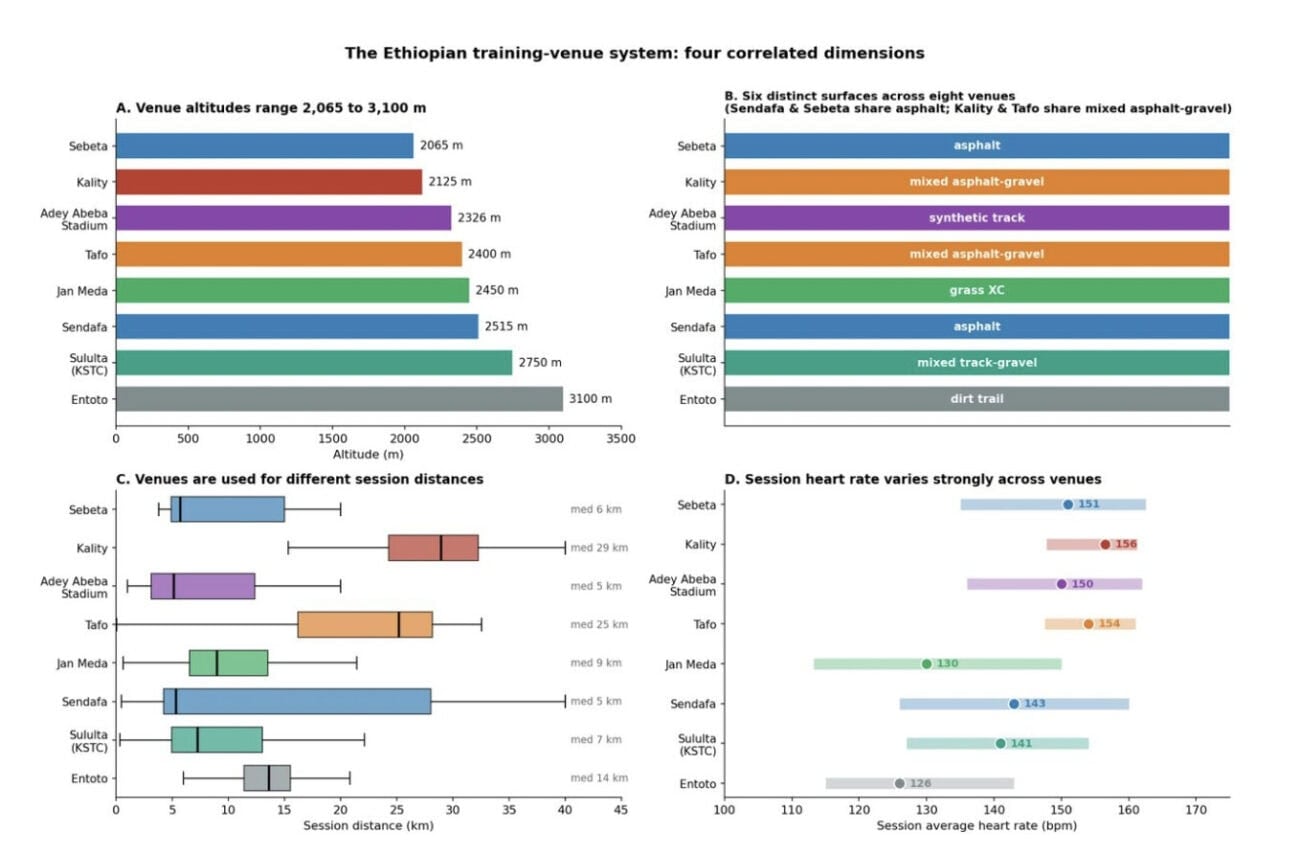
Their watches produced 22,605 GPS segments containing pace, heart rate, altitude, location, and elapsed time. Field information identified eight training venues between 2,065 and 3,100 meters of altitude and across six different surfaces. That’s a LOT of data…
The analysis itself used an unusual human-AI workflow. AI systems searched the large dataset, helped develop the numerical analyses, and then independently tested the methods and claims. The investigators chose the questions, corrected the analyses, and supplied the final interpretation. This framework came from domain experts who recognized what the data meant in the context of elite training and used AI to dissect it.
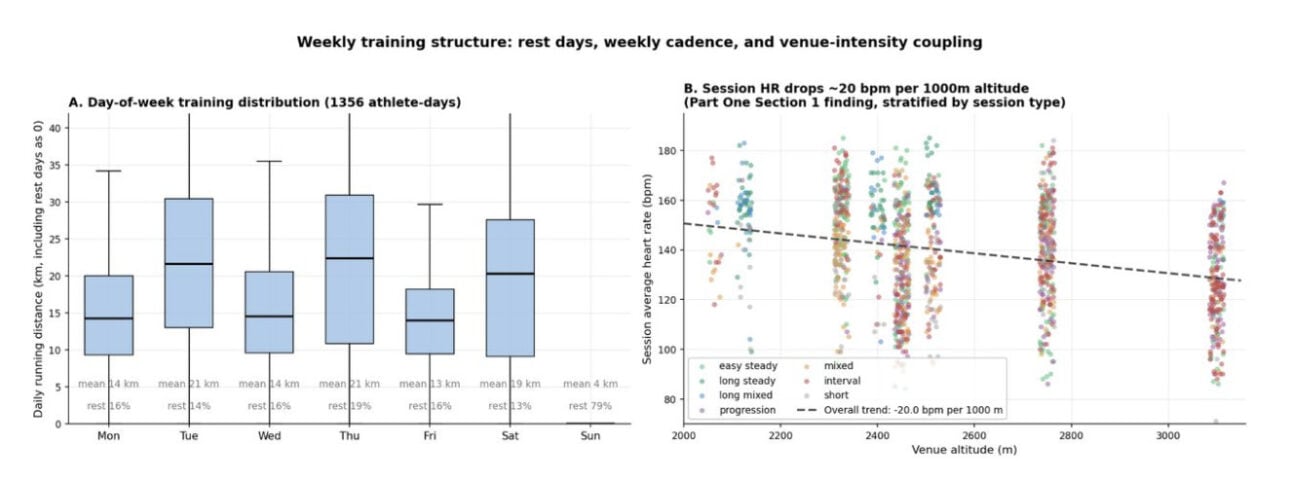
The average athlete ran about 75 miles (119 kilometers) per week across roughly eight and a half training sessions, but runners ranged from 40 to 100 miles (64 to 161 kilometers) per week.
The week followed a recognizable hard-easy rhythm.
- Tuesday, Thursday, and Saturday carried the most running—typically 13–14 miles (21–22 kilometers)
- Monday, Wednesday, and Friday were lighter.
- Sunday was a rest day in about 80% of athlete-weeks.
- About 40% of training days included a second run, usually a short, low-heart-rate recovery session in the afternoon after the main morning run.
On Paper, Their Intensity Distribution Looks Ordinary
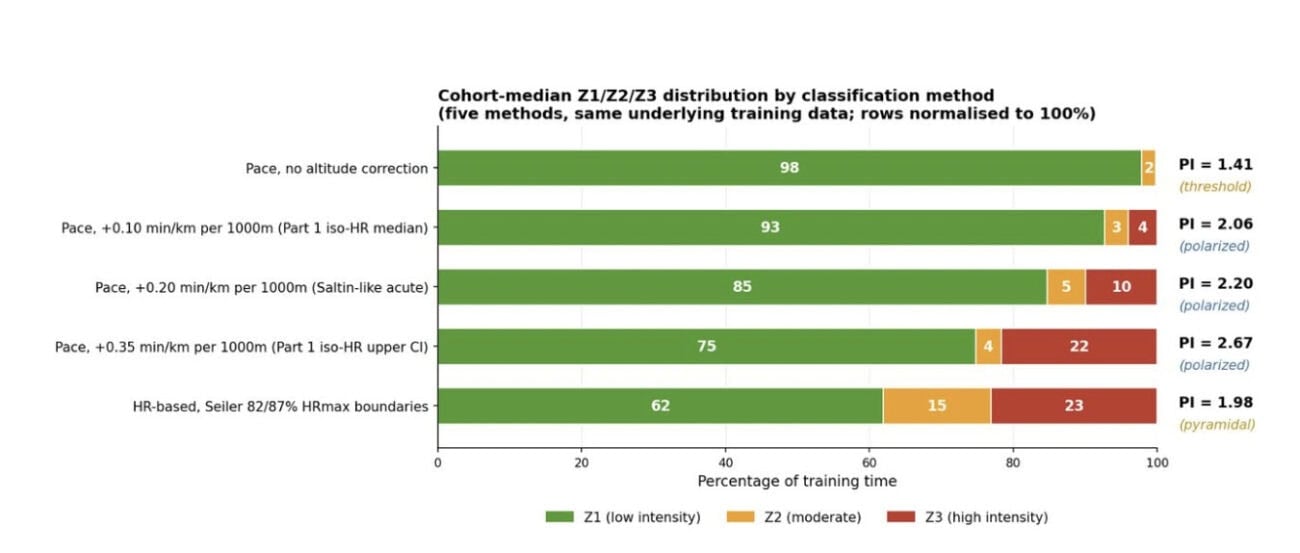
The researchers classified training intensity several ways because neither pace nor heart rate offers a perfect answer in this setting.
Across the altitude-corrected pace methods, roughly 75% to 93% of training time was easy, 3% to 5% was moderate, and 4% to 23% was hard.
The researchers also found a revealing pattern when they removed the zones entirely and plotted training time by altitude-adjusted pace. The data formed two preferred pace regions: a clearly easy mode and a faster mode closer to marathon pace, with relatively little running in between. Eleven of the 14 athletes showed this same dip individually.
Where They Ran Was Part Of The Workout
The researchers identified eight venues where training took place. Each one offered a particular combination of altitude, surface, and terrain, and the athletes used them for different purposes.
- Long aerobic runs concentrated on gently rolling, mid-altitude gravel roads. Those roads accounted for about two-thirds of all long-run time.
- High-altitude trails hosted slower, more variable running over routes that often changed from one session to the next.
- The synthetic track hosted short, structured repetitions.
- Easy recovery running was spread across several other venues, influenced partly by where individual athletes lived (we all can relate… my “preferred” route is right out my front door).
In other words, a track session offered precision and repeatability. A road offered a stable setting for sustained work. A trail offered variation—different climbs, descents, turns, and footing—even when the athlete’s effort remained controlled.
More than one third of all training time occurred as easy running on high-altitude soft trails, at roughly 71% of maximum heart rate and a pace near 9:00 per mile or 5:40 per kilometer. Taken out of context, that pace might look almost comically slow for a world-class distance runner. Put it back at high altitude, on soft and rolling terrain, and it makes sense.
The Group Did The Individualizing
The social structure of the training mattered too.
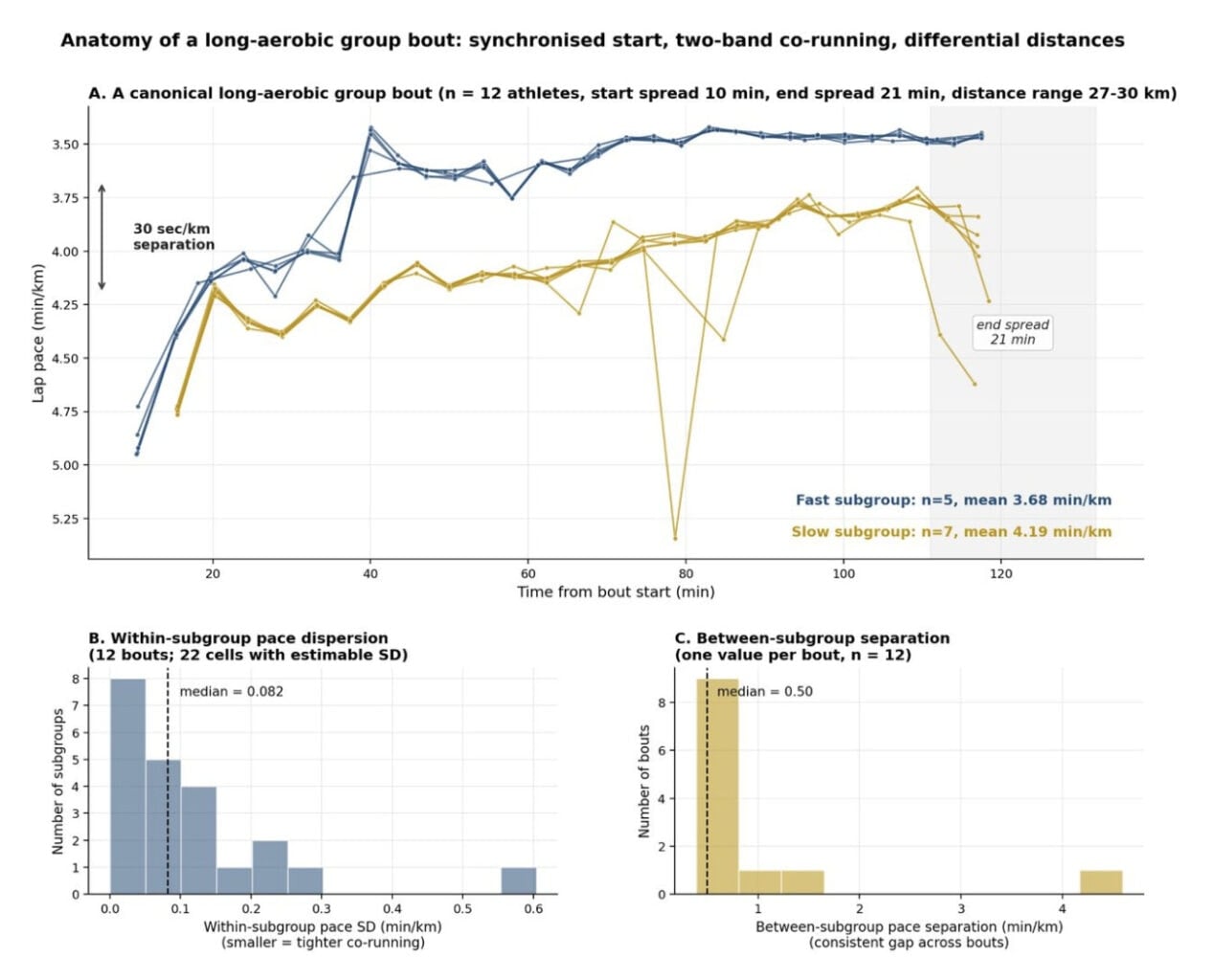
About three-quarters of all sessions were completed in groups, usually with around nine athletes. Long runs and harder sessions were especially likely to be shared: 93% of long steady runs, 97% of long mixed sessions, and 80% of interval sessions were group runs.
But “group training” did not mean every runner received the same dose. In runs of 5 athletes or more, the group separated into two pace bands about 30 seconds per kilometer apart. Athletes with performances closer to the world record were (obviously) more likely to occupy the faster band.
The researchers describe this as a form of group-based individualization. Instead of every athlete receiving a different written pace target, the group appeared to sort itself by fitness while still completing the session together.
What This Means For Runners
None of us should try to copy this map literally. Most runners don’t have access to eight venues above 2,000 meters, a group of world-class training partners, or coaches steeped in this specific tradition (but wouldn’t that be nice?).
The useful part is the way the study asks us to think.
First, stop treating pace as a complete description of effort. Your tempo pace can feel easy on a flat road but a strain on a soft trail above 3,000 meters. Heart rate and perceived effort are imperfect too, but pace needs environmental context.
Second, consider the venue as part of your workout. A track, road, hill, and trail do more than change the scenery. They change the session’s precision, mechanical demands, variability, and rhythm. Choosing where to run may be part of choosing what you want the run to accomplish.
Third, remember that a training-intensity distribution is not a full training plan. It can tell you whether too much work is accumulating in the middle or whether easy days are truly easy. It cannot tell you how long the sessions were, how the pace changed within them, what the terrain demanded, or whether a group pulled the athlete toward the right effort.
Finally, individualization does not always require isolation. A group matched to your fitness level can create multiple appropriate training doses inside one shared session. That does not mean every group run self-regulates perfectly (I’ve seen plenty of group runs become races), but the Ethiopian data show that group structure can be more sophisticated than “everyone runs the same pace.”
The simplest summary of a training week is volume plus intensity.
The more complete version adds duration, terrain, surface, altitude, session structure, and social context. These aren’t as easy to measure, but they’re something to think about as you design your next week of training.
RunClub — Free
Join 300,000+ runners in RunClub
Free training plans for every distance, a daily running game, exclusive coaching content, and a real community of runners. Create your free account in 20 seconds — no card.
Already a member? Log in →











Join the conversation
Nothing new here then!