


Runners love a good high-intensity interval training (HIIT) session for the physiological bang it delivers in a short window. But the real question is: how many of these sessions do you actually need each week to boost aerobic fitness?
A new study from Germany looked to answer that by testing the impact of weekly frequency—one, two, or three times per week—on cardiorespiratory fitness over 6 weeks.
Twenty-six recreational runners (average VO₂max 50.8 mL/kg/min, average age 30) were randomly assigned to perform one of three protocols: 1×, 2×, or 3× weekly HIIT sessions, while maintaining their normal endurance training. The sessions followed a classic Norwegian format: 4 x 4-minute intervals at 90–95% of max heart rate with 3 minutes of active recovery. Before and after the intervention, the researchers measured VO₂max, time to exhaustion (TTE), ventilatory threshold, submaximal VO₂, and heart rate.
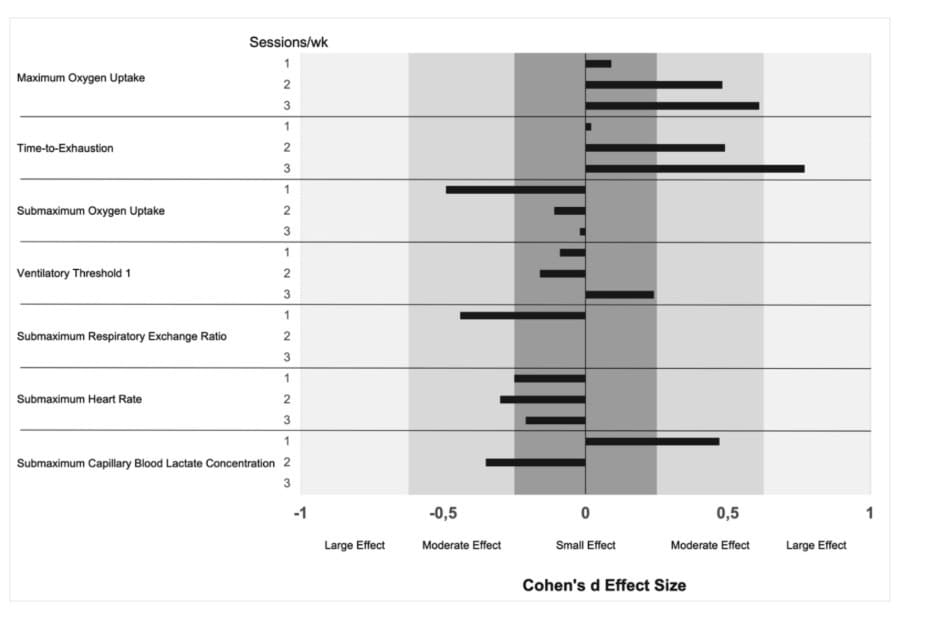
All three groups showed improvements in VO₂max and TTE, but the magnitude of change was most significant with more weekly sessions. VO₂max increased by just 0.6% in the 1×/week group, compared to 7.7% in the 2×/week group and 5.6% in the 3×/week group. The 2×/week group also had the most consistent improvement in time to exhaustion (+11%), while the 3×/week group improved by about 9%. In contrast, the 1×/week group showed negligible changes in endurance performance.
Despite the greater frequency, the 3×/week group did not outperform the 2× group—and showed slightly less improvement in VO₂max and TTE. Submaximal markers, such as running economy and ventilatory threshold, didn’t change significantly in any group. Notably, all participants completed nearly all sessions (91–100% adherence), and there were no adverse effects, suggesting good tolerance across the board and supporting that (for at least 5 weeks), multiple HIIT sessions per week are feasible.
What this means for runners
For trained runners or recreational athletes aiming to improve VO₂max and endurance with HIIT, two well-executed sessions per week offer the best tradeoff between stimulus and recovery. One session per week likely won’t move the needle much if you’re already fit, and three per week may be overkill without providing extra benefit. Stick to two high-quality interval days—ideally separated by at least 48 hours—to maximize adaptation and minimize fatigue.
RunClub — Free
Join 300,000+ runners in RunClub
Free training plans for every distance, a daily running game, exclusive coaching content, and a real community of runners. Create your free account in 20 seconds — no card.
Already a member? Log in →












Start the conversation