


Should I go out hard or hold back early? It’s a question that most runners have asked themselves at least once while standing on the start line.
A massive systematic review and meta-analysis set out to give some definitive answers on the “best” way to pace by comparing the performance effects of different pacing strategies: fast start, even pace, slow start, and self-selected pacing.
Researchers reviewed 24 studies involving 302 athletes (mostly male, with VO₂max values ranging from 47 to 72 mL/kg/min), covering middle- and long-duration time trials across cycling, running, swimming, and more. Each study compared at least one imposed pacing strategy (fast, even, or slow) to self-selected pacing, across time trials lasting from 1.5 minutes to 4 hours.
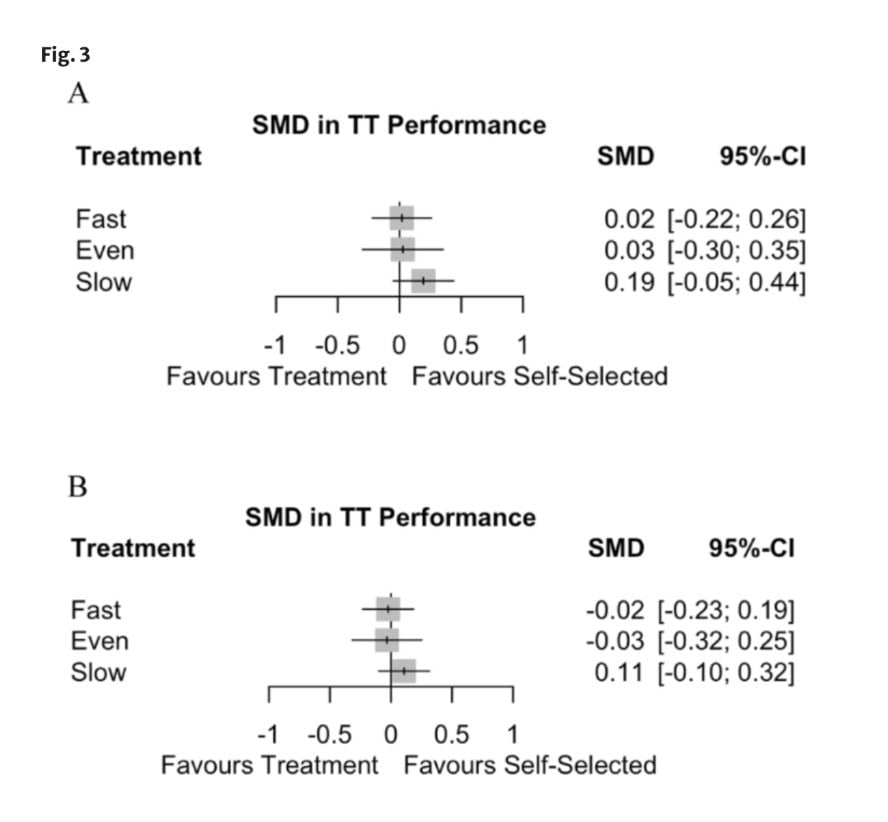
Surprisingly, there were no statistically significant performance differences between fast-start, even pacing, or slow-start strategies compared to self-pacing. This was consistent across all primary comparisons and even secondary measures, such as VO₂max, average VO₂, and blood lactate at the end of the test.
But when researchers dug deeper, they found a key exception: slow starts that dragged on too long impaired performance. The longer the initial slow phase lasted (as a percentage of the race), the worse the outcome. This makes sense physiologically—if you spend too long conserving energy early on, you delay the ramp-up of oxygen uptake and sacrifice time you can’t get back. As an example, one study found that starting a 2-kilometer cycling time trial at just 55% of ideal pace significantly slowed overall performance, compared to even or moderately fast starts.
So, while self-pacing didn’t always beat other strategies statistically, it never hurt performance. And in some cases, especially compared to excessively slow starts, it clearly helped. The authors suggest that self-pacing works because it allows athletes to continuously integrate internal and external cues—like perceived exertion, terrain, and competitors—and adjust effort on the fly.
However, the authors also point out limitations: most of these studies were conducted indoors, which may not reflect real-world competition dynamics, especially in cycling, where wind, terrain, and peloton behavior matter.
What this means for runners
If you’re debating your race strategy, especially for time trials or solo efforts, trust your instincts. Self-pacing allows you to listen to your body and adjust based on feel. While going out too hard might be risky, going out too easy for too long is a more consistent performance killer. Learn to calibrate your pacing through practice, and remember: the best pacing strategy is the one that adapts to the demands of the moment.
RunClub — Free
Join 300,000+ runners in RunClub
Free training plans for every distance, a daily running game, exclusive coaching content, and a real community of runners. Create your free account in 20 seconds — no card.
Already a member? Log in →








Start the conversation