


When Tigst Assefa passed 40K at the Berlin Marathon in September, she was 10 seconds inside Ruth Chepngetich’s world record of 2:09:56 and running like someone about to win back the record she used to own. She had felt something in her right Achilles at around 31K, her manager Gianni Demadonna said later, and kept going at record pace for another 9K anyway. Over the last 2.2K her stride came apart. She needed just over eight minutes to cover a distance she would normally run in under seven, still won in a course record of 2:11:04, and was in surgery the next day to repair a complete rupture of the tendon.

Assefa’s Berlin run is the most vivid example of something that has been happening all year. Sabastian Sawe and Yomif Kejelcha became the first men to break two hours in a record-eligible race in London in April, with Jacob Kiplimo third, only 47 seconds behind Kejelcha. Since then, Sawe has had a stress fracture, Kiplimo has hurt his hamstring, and Kejelcha and John Korir have both pulled out of the Valencia Marathon injured. That’s five of the athletes who have gone closest to the outer edge of marathon running, all hurt within about seven months, and it makes you wonder whether the times they are chasing are simply more than a human body can give right now.
How Close They Are to the Limit
In 1991, a Mayo Clinic physiologist named Michael Joyner published a paper estimating the fastest marathon a human could run. He took the best values ever measured for oxygen uptake, lactate threshold and running economy, put them in one imaginary athlete, and got 1:57:58. The world record at the time was 2:06:50, and plenty of people thought he was out of his mind.
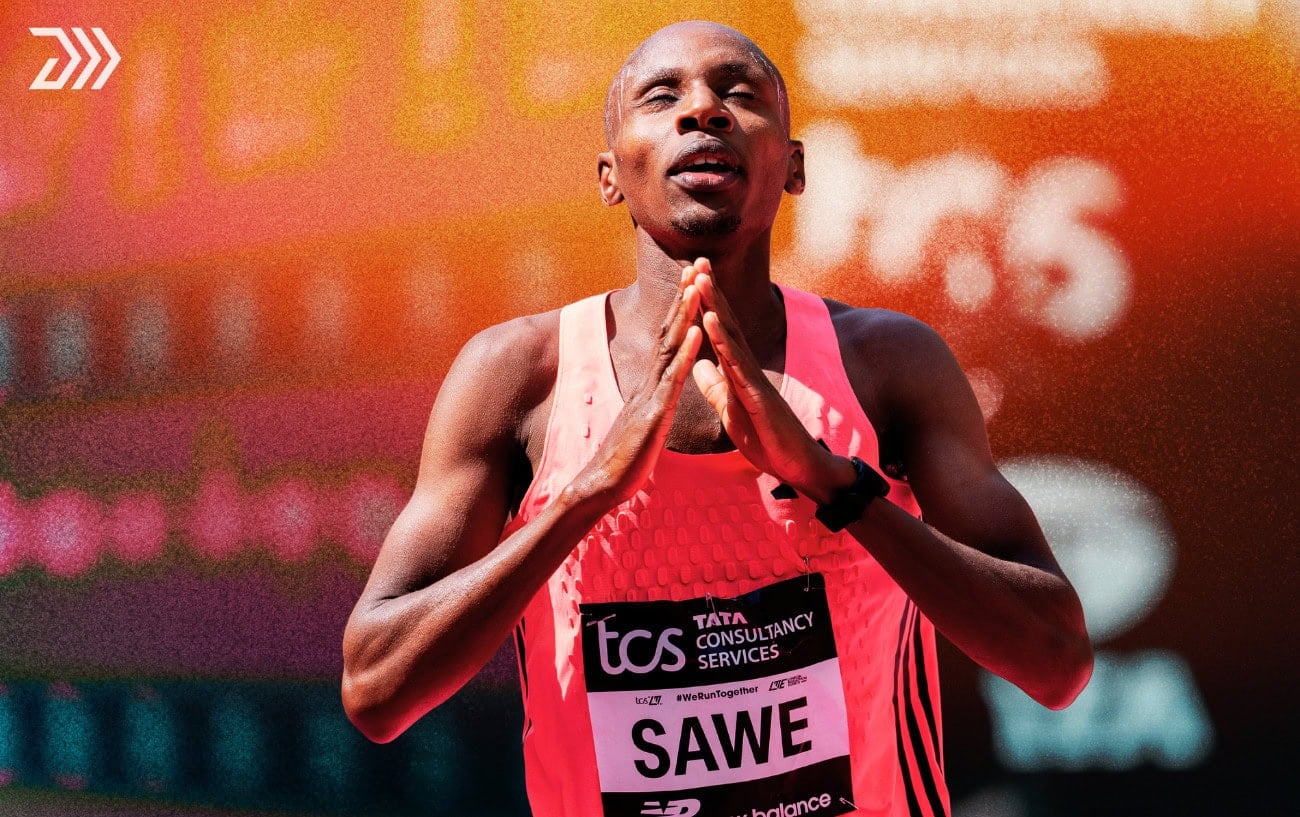
Thirty-five years later, Sawe’s 1:59:30 sits just 92 seconds outside Joyner’s number. Shoes closed a lot of that gap. In 2017, researchers at the University of Colorado found that Nike’s prototype Vaporfly cut the energy cost of running by 4% on average and calculated that the saving alone could take the world record down to about 1:58:54. Eliud Kipchoge broke two hours two years later in Vienna, behind 41 rotating pacemakers and a laser projected onto the road, and told the world afterward that “no human is limited.”
He was right that it could be done. What he couldn’t know then was what it would take to do it in a real race, against real rivals, more than once. Kipchoge’s run in Vienna was a one-off, staged for him. Sawe and Kejelcha did it in a race they then had to recover from, before turning around and training for the next one.

What It Is Costing Them
The training behind these performances is staggering even by marathon standards. Sawe’s coach, Claudio Berardelli, told The Guardian that Sawe averaged more than 200K a week before London and peaked at 241K. Korir said in September that he was running 45 to 48K a day, or 250 to 270K a week, in a buildup that he hoped would end in his own sub-two in Valencia.
The racing around those blocks hasn’t let up either. Kiplimo won the world cross-country title in January, ran a 57:20 half-marathon world record in March, raced London in April and then went to Chicago in October, where he covered 20K to 30K in 28:18, a split worth 1:59:24 over a full marathon, before his hamstring gave out shortly after 30K. Kejelcha followed London with a 56:51 half-marathon world record in August and went straight into a marathon buildup that ended in injury three weeks before Valencia.

Look at where the injuries happened, too. Assefa and Kiplimo got hurt in the middle of races run at record pace, while Sawe, Kejelcha and Korir got hurt preparing for their next attempts. Not one of them came out of nowhere.
The shoes complicate the picture in a way that I think deserves more attention. A super shoe lowers the energy cost of every stride, so the heart and lungs can hold a pace that used to be out of reach. The tendons, bones and hamstrings carrying that runner are the same ones they always were, though, and they are now being asked to handle faster running for longer, often on higher training loads. A study in PM&R this year found that elite runners in carbon-plated racers changed their stride in ways researchers associate with bone stress injuries. That is not proof the shoes hurt anyone, and the experts are still split on it. But it is at least possible that the engine has been upgraded faster than the chassis.

Doing It Once Versus Doing It Again
None of this means these times are beyond human beings. Sawe and Kejelcha have already run them, and Assefa was on her way when her tendon went. Fotyen Tesfay ran 2:10:51 on her debut in Barcelona in March and is on the start list for Valencia. Amos Kipruto ran a personal best of 2:01:09 to beat Kiplimo in Chicago at 34. Five injuries in seven months is a small sample, and marathoners have always got hurt.
The more honest version of the question is whether these times can be repeated without someone paying for it. It’s one thing to break a barrier once, and something else for the same small group of athletes to chase it every spring and fall, with €1 million ($1.1 million) bonuses on offer and shoe deals built around the next attempt. Very few people in that system are paid to tell an athlete to slow down, and the athlete is the one who goes home with the injury.

That’s why Valencia on Dec. 6 is worth watching for more than the clock. Tesfay and Agnes Ngetich, on her marathon debut, will go after the same 2:09:56 that Assefa was chasing in Berlin, with the bonus waiting if one of them gets under it. If either does, it will be one of the great runs in the sport’s history, and I hope she’s still walking normally the next day.Kipchoge said in 2019 that no human is limited, and seven years later the times have proved him right. This year’s injuries are a reminder that the body still has a say in how fast we go, for the athletes at the front and for every runner training in the same shoes behind them.
RunClub
Get more running stories — join RunClub
Daily running news, a community of 300,000+ runners, free training plans for every distance, and a daily running game. Free to join — no card.
Already a member? Log in →









Start the conversation