


I love wearables, but I’m also deeply suspicious of them, especially when they start spitting out numbers that feel medical (recovery scores, “training readiness,” and now… sweat loss). Sweat loss is one of those deceptively simple variables that’s hard to estimate without doing something unsexy like stepping on a scale before and after a run. A new study asked1Carrier, B., Melvin, A. C., Outwin, J. R., Wasserman, M. G., Audet, A. P., Soldes, K. C., Kozloff, K. M., & Lepley, A. S. (2025). Evaluation of Exertional Sweat Loss Estimates in Wearable Technology. Sports Health: A Multidisciplinary Approach. https://doi.org/10.1177/19417381251388642 whether smartwatch sweat-loss estimates are accurate enough to guide hydration the way we’re starting to use them.
Researchers recruited 111 physically active adults (average age ~40; average VO₂max ~46.8 ml/kg/min) and had them complete up to four running visits. Everyone did an outdoor 5K and an indoor 5K, then a third run that varied in distance (2.5K, 10K, 20K, or an interval workout). In total, they collected 293 running trials, with 291 producing sweat-loss estimates from both watches.
Participants wore two popular devices simultaneously: the Samsung Galaxy Watch5 and the Garmin Forerunner 945. The “gold standard” comparison was straightforward and practical: change in nude body mass pre- vs post-run, converted to fluid loss, with strict rules about limiting fluid intake and bathroom use outside the exercise window.
At a high level, both devices tracked the general direction of sweat loss but missed the actual amount by a wide margin.
Across all conditions, average sweat loss was ~659 mL, with a huge range (80 mL to 3,300 mL). Body mass loss ranged from 0.25% to 2.73% (which matters because many runners start to see performance decline as they drift past roughly 1.5–2% loss).
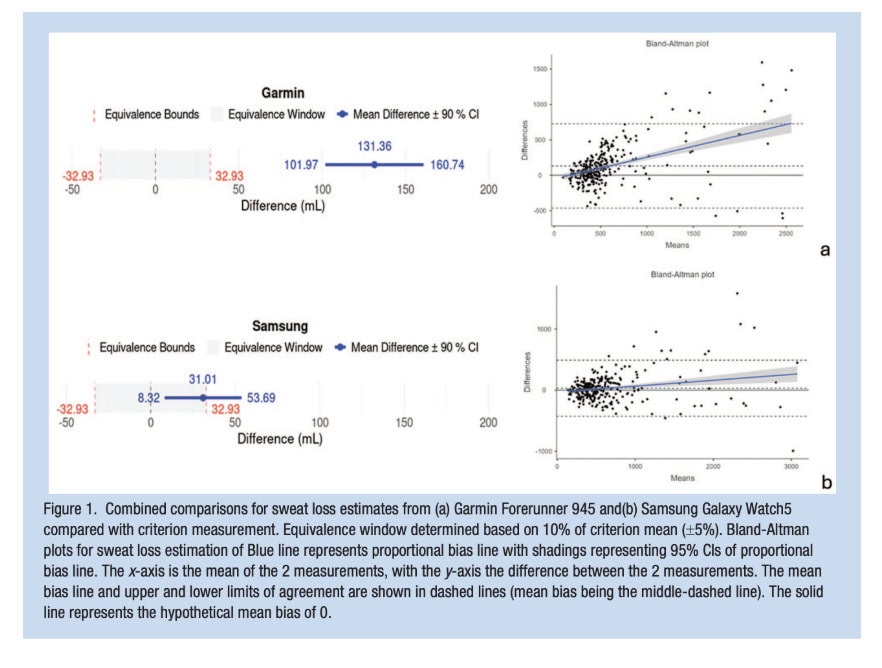
The correlation looked decent, especially for Samsung (0.90) and still “okay” for Garmin (0.77), meaning the watch’s estimations were generally in line with the direction and magnitude of actual sweat loss. But the error for the devices was high—Samsung’s average absolute percentage error was ~25%, and Garmin’s was ~33%. In plain terms: if you truly lost 1000 mL, your watch might reasonably tell you ~670 mL… or ~1330 mL, and that’s before we even talk about the worst-case misses.
The absolute errors reinforce that point: average miss was ~151 mL for Samsung, and ~218 mL for Garmin, but the more important detail is the spread. Samsung’s differences ranged roughly from ~428 mL under to ~491 mL over; Garmin ranged from ~464 mL under to ~727 mL over.
They also split the data by distance (short ≤5K, long ≥10K, and intervals) and environment (indoor vs outdoor). The headline didn’t change here, and the error stayed stubbornly high across conditions.
What this means for runners
The authors’ bottom line is the one I agree with: these watches may be useful for trend tracking (am I generally sweating more this summer than in winter?), but they’re not precise enough to replace weigh-ins when accuracy matters.
If you’re using sweat-loss numbers to guide a real hydration plan—especially for long runs, marathons, or hot conditions—treat your watch’s “mL lost” as a rough guess, not a dosing chart. The average error here is big enough to push you toward underdrinking or overdrinking, depending on the day. The better approach is to do a few simple pre- and post-run weigh-ins (same clothes, towel off sweat, track what you drank) to learn your personal sweat rate, then use the watch as a consistency tool to notice patterns (heat, humidity, pace, duration) rather than as the authority. Your scale is still the gold standard.
References
RunClub — Free
Join 300,000+ runners in RunClub
Free training plans for every distance, a daily running game, exclusive coaching content, and a real community of runners. Create your free account in 20 seconds — no card.
Already a member? Log in →




Start the conversation