


If 90 grams of carbohydrates per hour helps you maintain your pace late in a race, and 120 grams provides even more fuel, the next question should seem obvious. Would 150 grams be better still?
The logic is appealing. Because our carbohydrate stores are limited, and long-distance running depletes them, taking in more carbohydrate should help you keep going.
But several things have to happen between swallowing a sports drink and turning its contents into forward motion. The carbohydrate has to leave your stomach, cross your intestine, become available to your tissues, and ultimately be burned for energy. And even when more of that carbohydrate gets burned, the effect on performance still needs to be demonstrated. After all, it’s performance we care about… not how many carbs we can burn.

A new study published in Medicine & Science in Sports & Exercise puts several increasingly popular fueling targets through the same laboratory protocol to answer three important questions: How much carbohydrate did the athletes consume (and how much could they tolerate)? How much did they burn? And how long could they sustain the exercise at each carb intake?1Martyn, H. J., Gonzalez, J. T., Stellingwerff, T., Burke, L. M., Owens, D. J., Pugh, J. N., & Morton, J. P. (2026). Effects of 10, 90, 120 and 150 G.H -1 CHO on substrate metabolism, exogenous oxidation and exercise capacity: Implications for CHO Personalization. Medicine & Science in Sports & Exercise. https://doi.org/10.1249/mss.0000000000004176
The answers didn’t move in the simple direction you might expect.
Putting Four Intakes To The Test
The participants were eight endurance-trained male cyclists, averaging 33 years old, with an average VO₂ max of approximately 73 mL/kg/min. This was a small but very fit group.
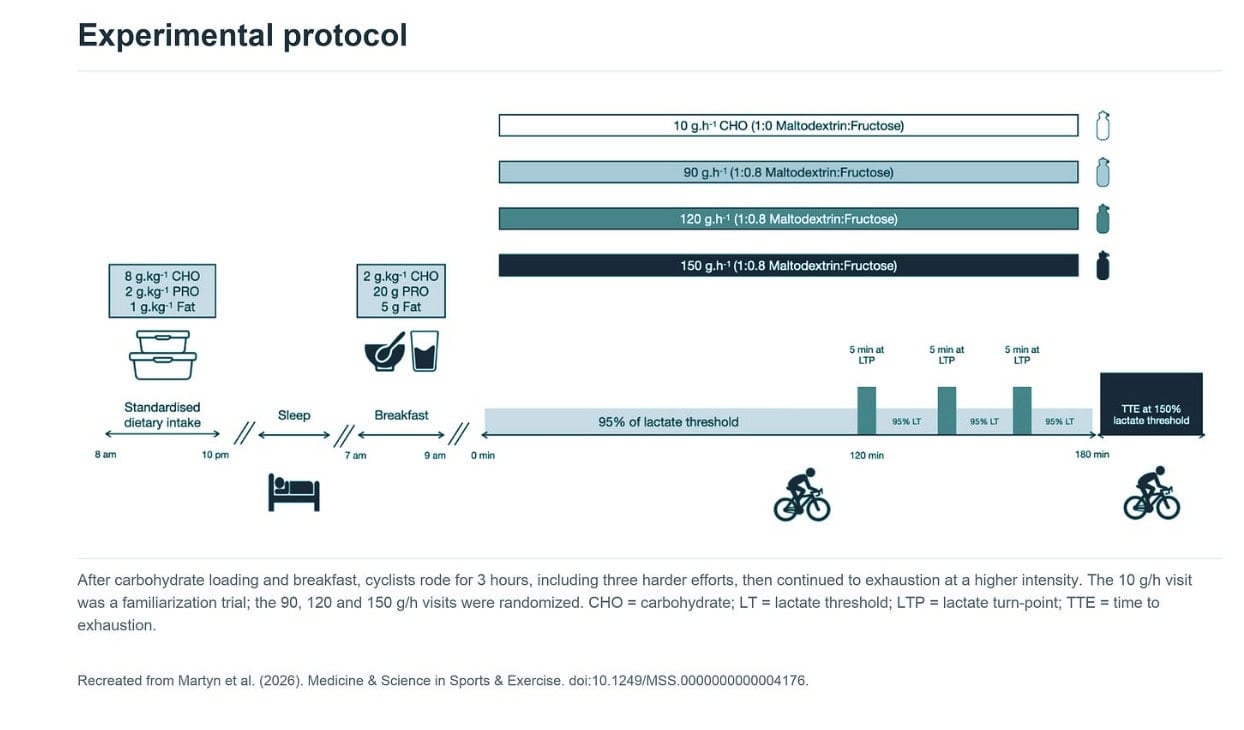
Each cyclist completed four visits involving a planned three-hour ride followed immediately by a hard effort to exhaustion. Most of the ride was performed just below the first lactate threshold, with three five-minute harder efforts added during the final hour. The finishing test required them to hold a fixed, demanding power output for as long as possible (a time-to-exhaustion test).
They consumed carbohydrates at one of four rates: 10, 90, 120, or 150 grams per hour. The 10-gram trial always came first and served as a familiarization session. Participants knew they were receiving that dose. The subsequent 90-, 120-, and 150-gram trials were randomized, and participants didn’t know which of the three doses they were getting. The three higher doses used the same 1:0.8 maltodextrin-to-fructose ratio, and because fluid intake was also held constant at 800 milliliters per hour, higher carbohydrate doses meant more concentrated drinks.
One last important detail. The cyclists arrived well fueled. Before every trial, they consumed a standardized diet providing 8 grams of carbohydrate per kilogram of body weight over the preceding day, followed by a breakfast containing another 2 grams per kilogram two hours before exercise. This is a strength of the study. It tested carbohydrate intake during exercise against a background of substantial carbohydrate availability beforehand.
To track the carbohydrate in the drinks, the researchers used glucose and fructose labeled with a stable carbon isotope. When the body burned that carbohydrate, the label appeared in the cyclists’ exhaled carbon dioxide. Combined with measurements of oxygen consumption and carbon dioxide production, this allowed the team to estimate how much energy came from ingested carbohydrate (exogenous carbohydrates), the body’s own carbohydrates (endogenous carbohydrates), and fat.
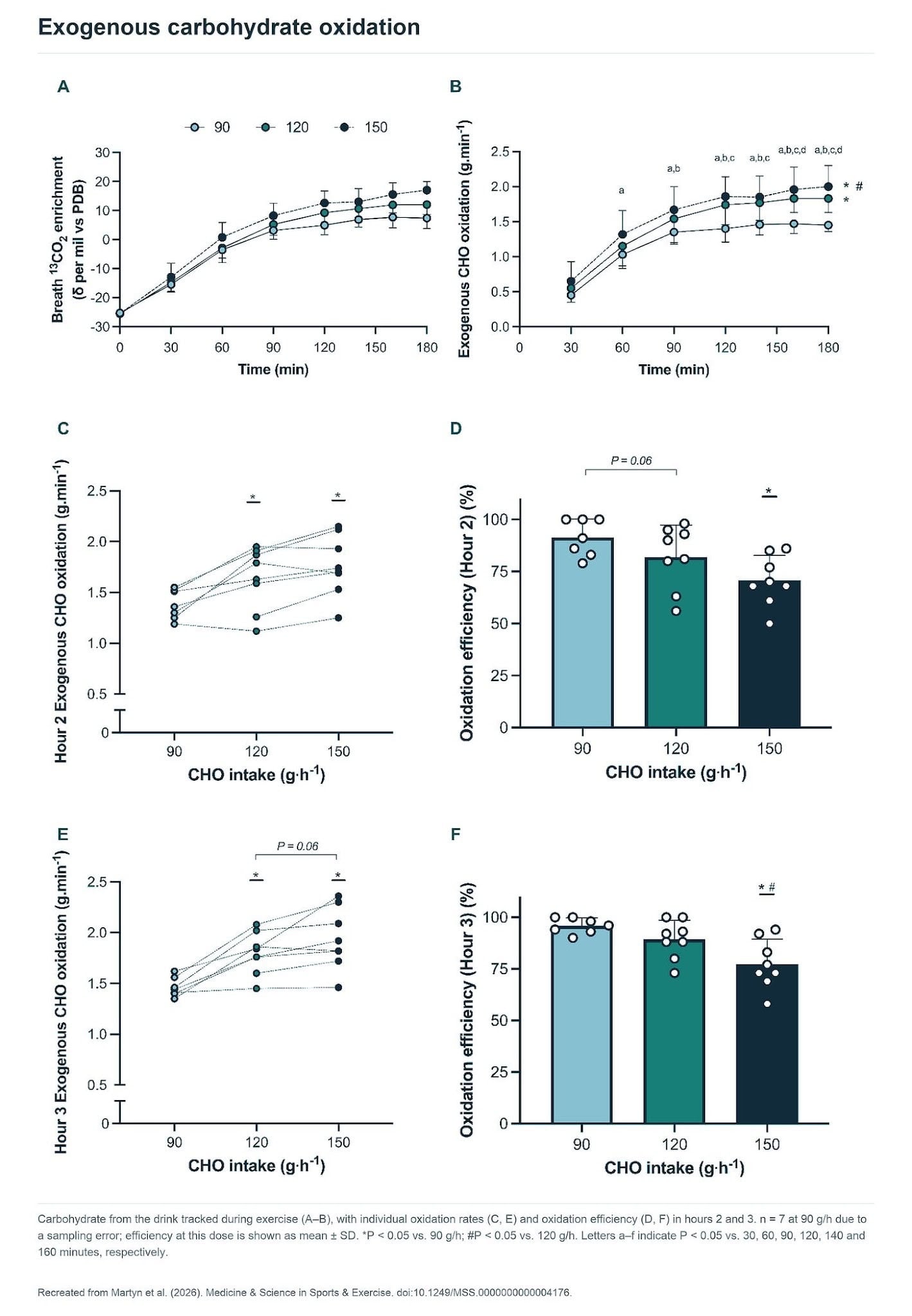
Increasing intake increased the average rate at which the cyclists burned carbohydrate from their drinks.
Across the three-hour protocol, the pattern looked like this:
- Moving from 90 to 120 grams per hour increased both exogenous and whole-body carbohydrate oxidation.
- Moving from 120 to 150 grams per hour produced a much smaller increase in exogenous oxidation—about 8 grams per hour, despite consuming an additional 30 grams per hour.
- Whole-body carbohydrate oxidation was essentially identical at those two doses.
The extra intake was producing a smaller metabolic return.
The fuel mix also changed over time. During the third hour, fat supplied approximately 54% of energy at 90 grams per hour, compared with 42% at both 120 and 150 grams per hour. Higher carbohydrate availability helped cyclists rely more on carbohydrate late in exercise.
The study couldn’t answer another question: What happened to the additional carbohydrate that wasn’t being oxidized? Did it vanish into thin air?
The oxidation efficiency results showed that the body did not increase carbohydrate use in direct proportion to carbohydrate intake. Oxidation efficiency is the proportion of ingested carbohydrate that is oxidized, or burned for energy, over a given period. As intake rose, each additional amount of carbohydrate produced a progressively smaller increase in the measured rate of carbohydrate burning—the capacity to oxidize carbohydrate was becoming increasingly limited at higher intakes.
However, the researchers did not directly measure intestinal absorption or track every possible destination for that carbohydrate. Some might have remained in the digestive tract or been handled through other metabolic pathways, so lower oxidation efficiency does not mean all remaining carbohydrates were unabsorbed or “wasted”; it only means that increasing intake produced a progressively smaller increase in the measured rate of burning that fuel.
Where The Performance Benefit Stopped
The 10-gram trial provides useful context.
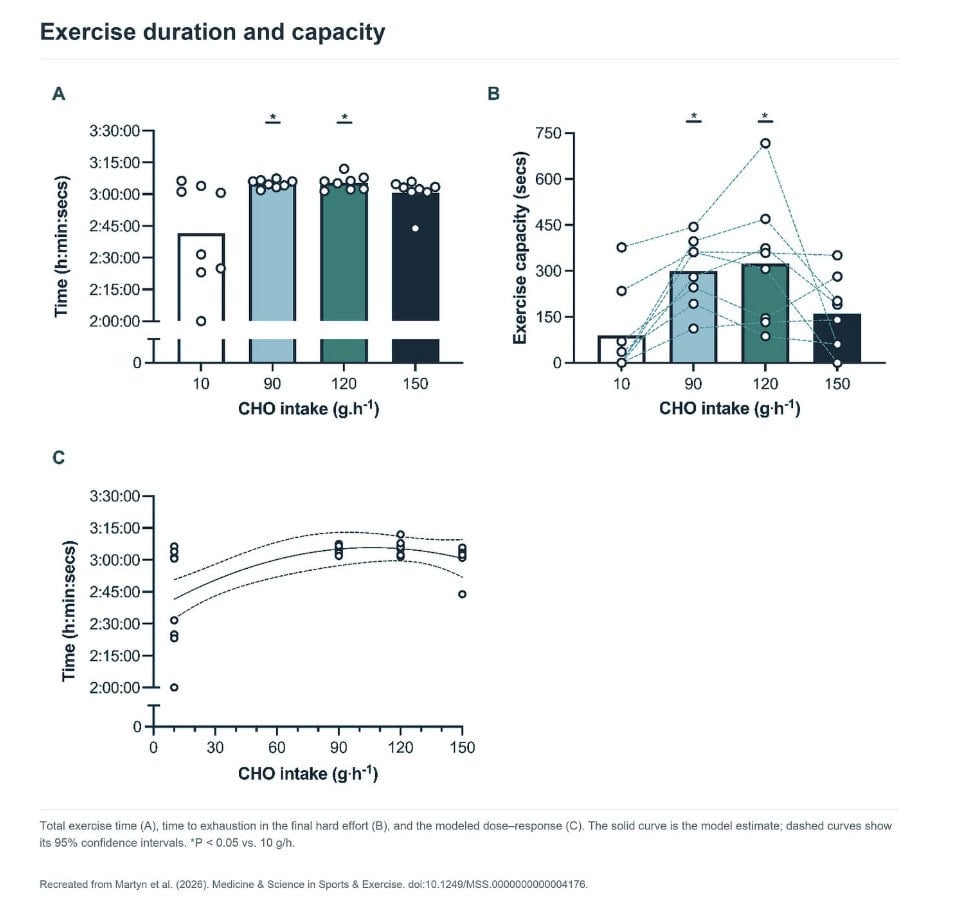
Despite the substantial carbohydrate intake before exercise, six of the eight cyclists demonstrated extremely low blood glucose during the test, and four stopped before completing the three-hour ride.
At 90 and 120 grams per hour, all eight completed the ride. Total exercise duration was significantly longer than at 10 grams per hour.
These results challenge the idea that a very small carbohydrate intake will reliably sustain blood glucose and prolonged exercise capacity under demanding conditions.
Among the higher doses, the final hard effort produced these average times to exhaustion:
- 90 grams per hour: 299 seconds.
- 120 grams per hour: 324 seconds.
- 150 grams per hour: 161 seconds.
One cyclist also stopped before completing the three-hour ride at 150 grams per hour.
The average result at the highest dose does not suggest a straightforward advantage (if anything, it suggests the opposite), and overall, the three tested doses showed no statistical difference in exercise capacity.
What we can say is that 150 grams per hour increased average exogenous carbohydrate oxidation without demonstrating an additional exercise-capacity benefit.
Then there is the number likely to attract the most attention: 107 grams per hour.
The researchers looked at the relationship between carbohydrate intake and total exercise duration. The resulting average estimated optimum was 107 grams per hour. Nobody actually consumed 107 grams per hour… that’s just what their model said.
Individual Responses Are Worth Paying Attention To
The group averages conceal some striking differences (as they often do in exercise physiology research).
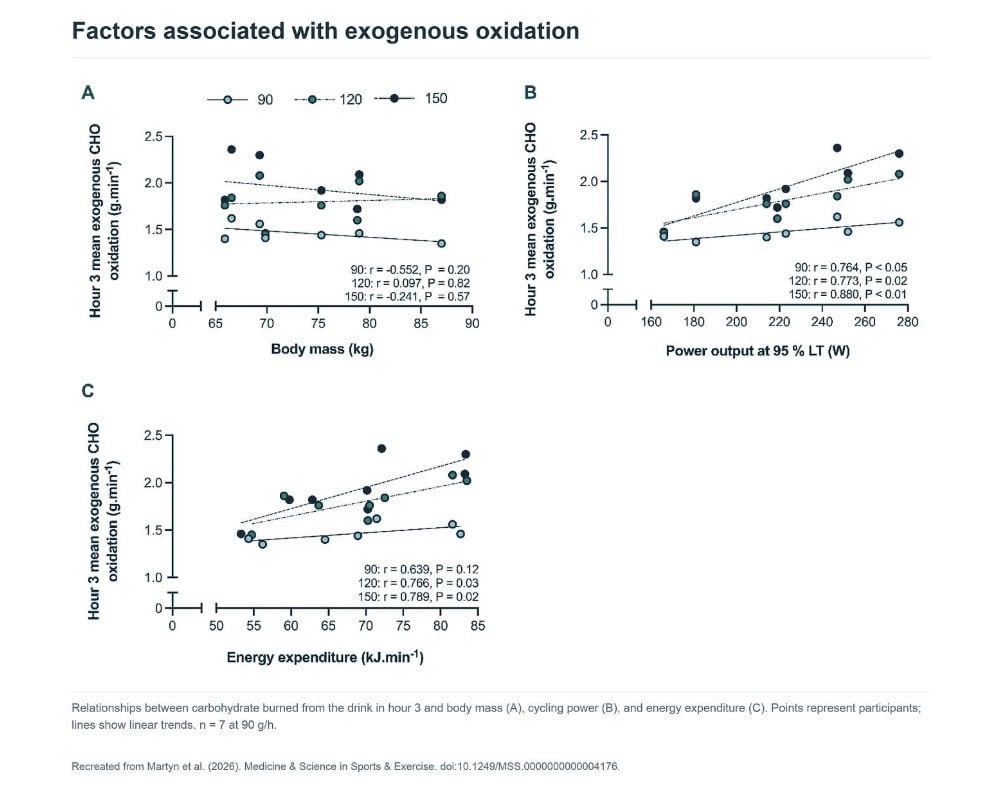
During the third hour at an intake of 150 grams per hour, individual exogenous carbohydrate oxidation rates ranged from 1.46 to 2.36 grams per minute—approximately 88 to 142 grams per hour.
That is a substantial spread among athletes consuming the same amount.
- One cyclist’s oxidation rate barely changed across the three higher doses: 1.41, 1.45, and 1.46 grams per minute at intakes of 90, 120, and 150 grams per hour.
- Another showed much larger increases: 1.56, 2.08, and 2.30 grams per minute.
For the first athlete, adding carbohydrate produced almost no additional oxidation during that period. For the second, more of the extra carbohydrate became available for oxidation.
This is why the authors emphasize carbohydrate personalization.
Gastrointestinal symptoms were generally mild, and total symptom scores did not differ significantly across conditions. However, some individual declines in exercise capacity coincided with greater symptoms. That makes gastrointestinal tolerance a plausible contributor worth studying, and it’s likely one of the reasons for the lower exercise capacity observed in the trial using 150 grams per hour.
What this means for runners
This study gives us a useful way to evaluate fueling decisions.
First, match the question to the run. A three-hour session with harder efforts and an exhaustive finish tells us little about what you need for an easy 45-minute run. It also can’t determine the requirements for a six-hour race. Duration and intensity are part of the fueling question. The type of training session also matters. Does the intensity call for a higher carb intake?
Second, evaluate higher intakes against something you already know works. If you are considering increasing carbohydrate intake, compare it to how you repeatedly perform and feel during similar sessions, including your ability to maintain the intended effort, your stomach comfort, and whether the feeding plan stays manageable as you get tired.
Third, give the extra carbohydrate a job. Consuming 150 grams per hour shows you can tolerate that intake under those conditions. Whether it improves your ability to sustain pace is a separate question. Both deserve attention. I wouldn’t simply shoot for a higher intake if the training session or race doesn’t call for it.
Fourth, avoid replacing one universal number with another. Neither 107 nor 120 grams per hour emerges from this experiment as the correct target for every runner. The study included eight men, used cycling, tested each dose once, and measured exercise to exhaustion. It does not provide direct evidence for women, recreational runners, different race durations, or different environmental conditions.
What I like about this paper is that it makes the fueling conversation more specific.
Carbohydrate intake, carbohydrate oxidation, and exercise capacity are related, but improving one does not guarantee equal improvements in the others. A productive fueling strategy has to connect all three.
The extra carbohydrate should “earn its place.”
References
RunClub — Free
Join 300,000+ runners in RunClub
Free training plans for every distance, a daily running game, exclusive coaching content, and a real community of runners. Create your free account in 20 seconds — no card.
Already a member? Log in →












Start the conversation