


We know that expectations can change pain, effort, and even performance. So what happens when trained runners swallow a placebo capsule but believe it contains caffeine? That’s what a new study set out to test.1Valero, F., González-Mohíno, F., Alda-Blanco, A., Rodríguez-Barbero, S., Muñoz de la Cruz, V., Juárez Santos-García, D., & Salinero, J. J. (2026). Caffeine Expectancy Does Not Affect Interval Running Performance, Physiological Responses, or Running Kinematics in Trained Runners: A Randomized Controlled Crossover Trial. Nutrients, 18(15), 2492. https://doi.org/10.3390/nu18152492

Fourteen trained male runners completed two 5 × 1,000-meter sessions on an outdoor track in randomized order. Before one session, they swallowed a placebo capsule but were told it contained 3 milligrams of caffeine per kilogram of body mass (a moderate dose—about ~200 mg for the average runner). Before the other, they took nothing. Each repetition was run at the fastest pace the runner believed he could sustain across all five intervals, with two minutes of recovery.
Belief alone did not produce a clear performance benefit.
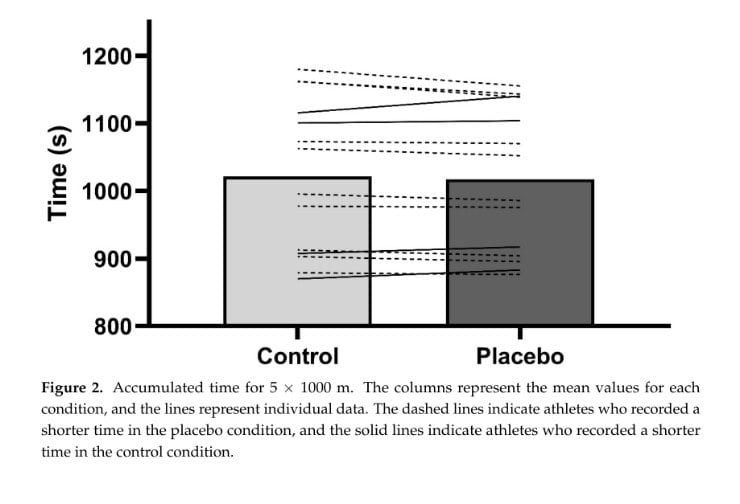
- Total time was 1,021.5 seconds in the control condition and 1,017.2 seconds after the fake-caffeine capsule—a 4.3-second difference that was not statistically significant.
- Nine of the 14 runners were faster with the placebo, but the responses were too variable to support a consistent effect.
- Pacing, heart rate, perceived exertion, cadence, ground-contact time, and vertical oscillation were also similar.
The mind did change something: runners reported feeling more active after the capsule, with a large standardized effect, and they reported more side effects they associate with caffeine—including urination and sleep disturbance—even though they consumed none.
What this means for runners
Expectations can change how a workout feels without reliably changing the stopwatch.
If you use caffeine, test the actual strategy in training—including dose, timing, sleep consequences, and gastrointestinal response—instead of relying on the belief that it “always works.” Also watch for nocebo effects: expecting jitters, urgency, or poor sleep may make those sensations feel more salient.
References
RunClub — Free
Join 300,000+ runners in RunClub
Free training plans for every distance, a daily running game, exclusive coaching content, and a real community of runners. Create your free account in 20 seconds — no card.
Already a member? Log in →












Start the conversation